


OTC Hearing Aids
The news matters beyond one brand. HearAdvisor, an independent lab, had ranked one Sony model first among the 60 OTC devices it had tested. Sony is also not the first higher-end OTC aid to leave. If you own a Sony aid, you may wonder who will fix it. If you are shopping, you may wonder how to pick an OTC aid that will still have support in two years. This page answers both questions, and it says where an OTC aid is not the right first step.
California Hearing Center is a hearing practice, not an OTC seller. We do not sell the Sony aids, and we do not recommend one brand over another before we have tested your hearing. What we can offer is a test that shows what you need, whichever path you choose. We wrote this page for people in San Mateo, San Carlos and around the Bay Area who read the headline and want a clear answer.
At a glance
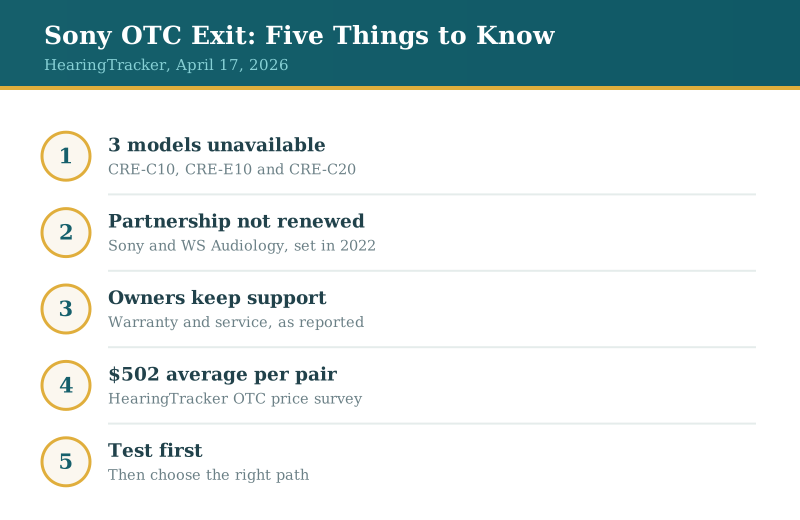
- Sony's U.S. site lists its three OTC hearing aids, the CRE-C10, CRE-E10 and CRE-C20, as no longer available. HearingTracker reported this on April 17, 2026.
- Sony and WS Audiology agreed not to renew their 2022 partnership. WS Audiology says it plans to stay in the OTC market, but not under the Sony name.
- HearingTracker reports that current Sony owners keep warranty and service support. Keep your receipt and keep the Hearing Control app on your phone.
- OTC aids are for adults with perceived mild to moderate hearing loss. The FDA lists signs, such as a sudden change or worse hearing in one ear, that mean you should see a doctor first.
What happened to the Sony hearing aids
Sony sold three over-the-counter hearing aids in the United States: the CRE-C10, the CRE-E10 and the CRE-C20. HearingTracker reported on April 17, 2026 that all three were listed as no longer available on Sony's U.S. website, and that they had been for several months. WS Audiology, known as WSA, built the aids for Sony. WSA confirmed that the two companies mutually agreed not to renew the partnership they announced in September 2022, shortly before the FDA's OTC hearing aid rule took effect on October 17, 2022. WSA said it expects little financial impact. HearingTracker also reported that the Sony models would stay available for a few more months through some WSA channels. We have not checked current stock, so do not read this page as a sign that any store still has them.
The three Sony models, as listed
Sony's website listed the CRE-C10 at $700. It uses disposable batteries and sits completely in the ear canal. The CRE-E10 was $900. It is an earbud-style aid with audio streaming for iPhones. The CRE-C20 was $1,000. It is rechargeable and also sits in the canal. All three came preset and ready to wear, with four to six programs, and a person adjusted them through Sony's Hearing Control app. HearAdvisor ranked the CRE-E10 first among the 60 OTC devices it had evaluated, and it gave the CRE-C10 an A SoundGrade, according to HearingTracker. Those are the prices Sony listed, not prices today.
Sony is not the only higher-end OTC aid to leave
HearingTracker names three other higher-quality OTC products that have been discontinued: the Sennheiser Conversation Clear Plus, the Jabra Enhance Plus and the Nuheara IQbuds2. It also points to price. A HearingTracker survey by Abram Bailey, AuD, found that the average OTC hearing aid costs $502 per pair. The report says that price is hard to reach if a maker also wants advanced technology and strong online support, which is what Sony and WSA, Jabra Enhance, and Lexie and Eargo offered. Apple adds pressure from another side. HearingTracker notes that AirPods Pro 2 and AirPods Pro 3, which cost $249, include a self-fitting hearing aid feature that the FDA has authorized. WSA's latest quarterly report, for the first quarter of its 2025-26 fiscal year, flagged softness in the U.S. market and put its emphasis on new Widex and Signia products. WSA still describes OTC as part of its strategy. Our reading is that a sophisticated OTC aid with real support is hard to sell at an OTC price. That is our interpretation. The reports do not say it outright.
If you own a Sony OTC hearing aid
HearingTracker reports that existing customers keep warranty and service support. That is the place to start. Keep your receipt and the model name. Keep the Hearing Control app installed on your phone. If the aid stops working, call or message Sony's support line or the seller first. Ask how long the app and its updates will continue, because the report does not say. If you want someone to check the aid and your hearing, we can do that. We service and reprogram hearing aids that patients bought elsewhere, for a fee. Some aids are locked to the maker's software, so a clinic cannot adjust every model. Our page on locked and used hearing aids explains the limits. Ask us before you book if you want to know whether yours can be adjusted.
If you are shopping for an OTC aid now
The FDA describes OTC hearing aids as devices for adults 18 and older who perceive mild to moderate hearing loss. You can buy one in a store or online without an exam or a prescription. The box must print the maker's return policy or say there is none, and the FDA does not require a warranty. The table below sets the FDA's description of OTC aids beside prescription aids. The Sony news is a good reason to ask harder questions before you pay.
| OTC hearing aid | Prescription hearing aid | |
|---|---|---|
| Who it is for | Adults 18 and older with perceived mild to moderate hearing loss | Any age and any level of loss, as the device allows |
| Exam or prescription to buy | None. Sold in stores and online | Fitted by a licensed hearing health care professional |
| Who sets it up | You, using the device's app or software | A professional programs it to your measured hearing loss |
| Return policy | Printed on the box, or the box says there is none. The FDA does not require a warranty | Set by the clinic. At California Hearing Center: a 45-day trial with no restocking fee |
| Where to turn for help | The maker's app, website or support line | The clinic that fitted it |
When an OTC aid is not the right place to start
The FDA lists signs that mean you should see a doctor, preferably an ear, nose and throat doctor, before you choose any hearing aid. They include blood, pus or fluid from the ear in the past six months, ear pain, a lot of earwax or an object in the ear, severe dizziness or vertigo, a sudden change in hearing in the past six months, hearing that goes up and down, hearing that is worse in one ear, and ringing in only one ear. People under 18 need a prescription aid and a doctor's visit. The FDA also says that if you cannot hear speech in a quiet room, you may need a professional. A sudden loss of hearing is an emergency, and it should not wait for a device. Our page on sudden hearing loss explains what to do. If only one ear is affected, read our page on tinnitus in one ear and our guide to seeing an audiologist or an ENT first.
Five questions to ask before you buy any OTC hearing aid
These questions do not rank brands. They help you compare any OTC aid, including one that is still on the shelf.
- How long is the return window, and is it long enough to test the aid at home, at work and in a noisy room?
- Who answers when it stops working: a phone line, a chat window or a local office?
- How long will the maker support the app and its updates?
- What battery does it use, and what will batteries or charging cost over time?
- Do you have any sign on the FDA's list that means you should see a doctor first?
How a hearing test helps, whichever path you choose
A hearing test at our San Mateo or San Carlos office takes about an hour, and it includes a talk about what the results mean. It shows how much loss you have, at which pitches, and in which ear. That tells you whether an OTC aid is a reasonable start or whether something else is going on. The FDA says you can get a hearing test from an audiologist, ask for your records and buy a device elsewhere. We do not push one brand before the test. After testing, the audiologist works out which device suits your hearing, your daily life and your needs. If we fit a prescription aid, you have a 45-day trial with no restocking fee. If you already hold a quote from another clinic, a second opinion visit is another option. Start with a hearing test.
More on OTC aids and news this week
For a cost comparison, see our guide to hearing aid costs in 2026, OTC versus prescription and our page on OTC devices for Bay Area patients. We have also written about the ELEHEAR Beyond 2 Pro, an OTC aid, Samsung's Galaxy Buds hearing aid feature, Meta's AI glasses hearing feature and Nuance Audio hearing glasses. For a prescription AI aid, see what we know about Fortell. For a plain list of questions to ask on any purchase, read how not to get ripped off buying hearing aids. Other news we covered this week: TICI UNICO and Envoy Acclaim, two fully implantable cochlear implants, the SPI-1005 Ménière's data and the study on hearing aids and mortality.
Last updated and sources
Last updated October 19, 2026. What changed: this is the first version. We will update this page if WS Audiology names a new OTC brand, or if Sony or WSA confirms stock and support terms. Sources: HearingTracker, Sales of Sony Hearing Aids Discontinued; WSA Eyes Next Steps for OTC Market, April 17, 2026 and FDA, OTC Hearing Aids: What You Should Know. Prices and rankings are as reported by HearingTracker. The 45-day trial and visit length are California Hearing Center's own policies.
Medical information notice
This page offers general information. It is not medical advice, and it does not diagnose or recommend treatment. If your hearing changed suddenly, see a doctor today. Call 650-342-9449 to book at our San Mateo office, 88 N. San Mateo Drive, or our San Carlos office, 1008 Laurel Street.
Frequently asked questions
Your questions, answered
Did Sony stop making hearing aids?
Sony's U.S. site lists its three OTC hearing aids as no longer available, and Sony and WS Audiology agreed not to renew their partnership. HearingTracker reported this on April 17, 2026. WS Audiology said it plans to stay in the OTC market under another brand.
Will my Sony hearing aid still be repaired?
HearingTracker reports that existing customers keep warranty and service support. Contact the seller or Sony's support line first. We can look at an aid you bought elsewhere, for a fee, but some aids are locked to the maker's software.
Are OTC hearing aids going away?
No. The FDA's OTC category took effect on October 17, 2022, and it still exists. Some higher-end OTC models have been discontinued, and WS Audiology says it plans to stay in OTC. Apple, for one, includes an FDA-authorized hearing aid feature in AirPods Pro 2 and 3.
Who should not buy an OTC hearing aid on their own?
The FDA says to see a doctor first if you have ear pain, drainage, a lot of earwax, severe dizziness, a sudden change in hearing, hearing that goes up and down, worse hearing in one ear, or ringing in only one ear. People under 18 need a prescription aid. A sudden loss of hearing is an emergency.
How much do OTC hearing aids cost?
A HearingTracker survey found an average of $502 per pair. Sony listed its three models at $700, $900 and $1,000. Prices change, so check the seller and the return policy before you buy.
Can I get a hearing test before I buy an OTC aid?
Yes. A hearing test takes about an hour at our San Mateo or San Carlos office. The FDA says you can ask for your results and use them to buy a device elsewhere. We do not push one brand before the test.