


Hearing Technology
In the same week, Meta said a version of its own glasses will get an FDA-cleared hearing feature. We wrote about that in our piece on Meta's Hearing Enhancement. Put the two announcements together and you have two ways to get hearing help from a pair of glasses. They are built differently, priced differently and suit different people.
We are an audiology practice with offices in San Mateo and San Carlos, so this is the view from the exam room. Below we set the two products side by side, explain what an open-ear design can and cannot do, and say who should get a hearing test before buying either one.
At a glance
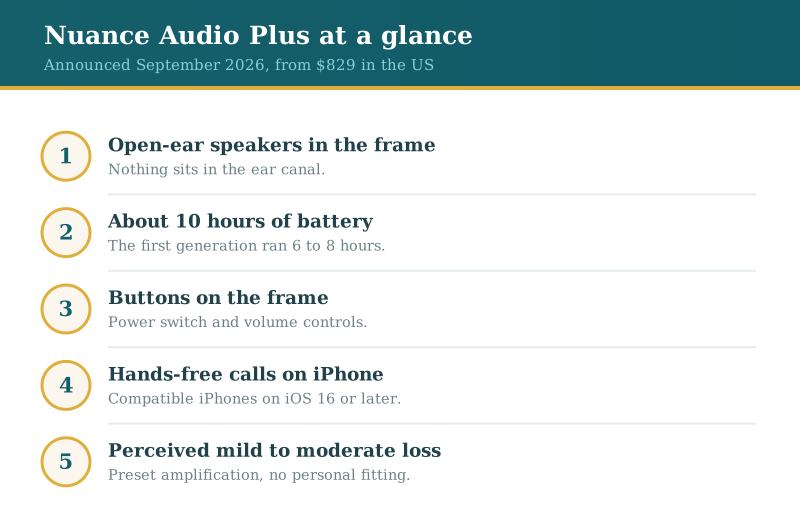
- Nuance Audio Plus is a hearing device built into eyewear. It starts at $829 in the US, is rated for about 10 hours of battery, has power and volume buttons on the frame, and handles hands-free calls with a compatible iPhone.
- Meta's Hearing Enhancement is software on Meta's glasses. Meta has said it costs $149.99 after a 30-day free trial, or comes with a Meta One subscription, and that it arrives in the US later this year. The glasses are a separate purchase.
- Both are self-fit, open-ear products meant for mild to moderate loss. Neither one measures your hearing first, so a hearing test is still the way to find out whether either is a sensible choice for you.
What Nuance Audio Plus is
Nuance Audio comes from EssilorLuxottica, the eyewear group behind Ray-Ban and Oakley. Plus keeps the original design: directional microphones in the frame, small open speakers in the temples, and nothing placed in the ear canal. An app controls two listening modes (Frontal and All-Around), four amplification presets and three levels of noise reduction. The company rates the battery at about 10 hours. It comes in three frame shapes, Square, Panthos and Upturn, and five colors, and it accepts prescription lenses, including Transitions. A charging pad and USB-C cable come in the box, and HearingTracker reports an optional portable case that holds three charges.
What changed from the first generation
The first Nuance Audio glasses were reviewed by HearingTracker using HearAdvisor's lab testing. They scored above average for speech in noise and well above average in quiet, but well below average on feedback handling, meaning the whistling you get when a hand or hat moves near the frame. Battery life ran six to eight hours, and there was no phone-call or music streaming. Plus targets those gaps: about 10 hours of battery, hands-free calls on iPhones running iOS 16 or later, and physical controls on the frame in place of a single button. Those are the company's published specs. Whether the whistling is fixed we cannot say yet, because we have not seen independent lab results for Plus. Claims of better amplification and clearer speech in noise are the company's own until someone else measures them.
How it compares with Meta's hearing feature
Plus is a device designed around hearing, and the frames are part of the product. Meta's Hearing Enhancement is one feature on general-purpose glasses that also carry cameras and an AI assistant. Meta says it amplifies sound from a profile you set up yourself, treats each ear separately, and switches on with a voice command. Meta has said it will launch in the US later this year, first on its newer Meta Glasses models rather than the Ray-Ban Meta line. So the price comparison is $829 and up for a complete pair of Nuance glasses, against the cost of Meta's glasses plus $149.99 for the feature after the trial. Plus is on sale now and Meta's feature is not, which means there is nothing yet to compare on battery life with hearing turned on, whistling, or how each one handles a busy restaurant. Plus is also sold through optical and hearing care professionals, so there is a person to ask. Meta's feature is set up on your own.
What an open-ear design does to your hearing
With nothing in the ear canal, your own voice sounds natural and the room sounds like the room. That is why some people find open designs more comfortable than a sealed hearing aid. The cost is that the speaker can only add so much sound before it leaks out and whistles, and background noise reaches your ear untouched. The HearingTracker review also noted that some wearers hear a slight echo in their own voice, and that a larger head puts the speaker farther from the ear, which lowers the usable amplification. Glasses add their own fit questions: nose pad position, frame weight with your lenses, and the fact that you hear less the moment you take them off. If your hearing aids have ever whistled, our note on why hearing aids whistle explains the causes.
Who these glasses are a reasonable fit for
The people most likely to be happy with them are adults who already wear glasses all day, miss words in restaurants or meetings, follow a quiet one-on-one conversation without much trouble, and do not want a visible device. Comfort with a phone app helps. The FDA's over-the-counter category is written for adults 18 and older with perceived mild to moderate loss, and the word perceived matters: nobody checks your assessment. Our guide to what the OTC rule changed and our comparison of prescription and OTC hearing aids cover the category in more detail. See an audiologist first if your hearing dropped suddenly, if one ear is clearly worse than the other, if you have ear pain, drainage, dizziness or one-sided ringing, or if you hear people talking but cannot make out the words.
Why a hearing test comes before the purchase
A hearing test answers the questions a product questionnaire cannot. It shows the degree and shape of your loss, whether both ears match, how well you understand speech, and whether wax or a middle ear problem is involved. Open-ear devices tend to do their best work on mild loss in the high pitches, so the shape matters as much as the number. One page of results tells you whether you sit inside the range these glasses are built for. It also gives you a baseline to compare against later. The four presets in Plus are fixed starting points. A professionally fitted hearing aid is programmed to your results and checked with real-ear measurement, and our cost comparison of OTC and prescription hearing aids shows what that difference costs. If you have an audiogram already, these five things are worth checking on it.
Questions to ask before you buy either one
Ask how long the return window is and who handles it. Ask what happens to the hearing hardware when your eyeglass prescription changes, and who repairs the frames if one speaker fails. Ask how long the battery lasts on calls, not just on amplification, and whether the glasses still work as ordinary glasses once the battery is empty. If you use an Android phone, check whether calling and app control work for you, because the company's release describes hands-free calling only for iPhones. Our team at either the San Mateo or San Carlos office can read your test results with you and tell you honestly which route looks reasonable.
Frequently asked questions
Your questions, answered
Is Nuance Audio Plus FDA-cleared?
EssilorLuxottica's announcement says so, for adults with perceived mild to moderate hearing loss. The software in the first-generation glasses has a public record, 510(k) K243150. We have not looked at the FDA filing for Plus itself, only the company's statement, so check the labeling of the exact model you are buying.
How much do Nuance Audio Plus glasses cost?
In the US the company lists a starting price of $829, and the final price depends on the lens setup. The first-generation Nuance Audio glasses remain on sale, and HearingTracker lists them at $699.
Should I buy Nuance Audio Plus or wait for Meta's hearing feature?
There is no way to compare them fairly yet, because Meta's feature has not launched. Waiting for a product that may not suit your hearing is a poor reason to delay a test, though. A hearing evaluation takes under an hour, and the results help you judge either product.
Can hearing aid glasses replace prescription hearing aids?
For some adults with mild loss, yes, for part of the day. They are preset devices without a personal fitting, they rely on an open ear, and they are not meant for more than moderate loss. Anyone who struggles to follow conversation in a quiet room should be tested rather than trying a self-fit product first.
Do these glasses work with Android phones?
The company's release describes hands-free calling for compatible iPhones running iOS 16 or later and does not describe the same for Android. Ask the seller before you buy if you use an Android phone.