


Hearing Aid Technology
The engineering story is a new processor called HYPERSONIC. Phonak's argument is not that it hears better than the platform before it, which is worth noticing, because Phonak is usually happy to argue exactly that. The argument this time is efficiency: the same real-time neural-network speech processing in a shell that is a quarter smaller and a fifth lighter, drawing a third less power. And, importantly for anyone who is not buying at the top of the price list, it runs at three technology levels instead of two.
This page is written more carefully than most of what you will read about EON this month, because a launch is the point at which the least is actually known. Every performance figure in circulation comes from a document Phonak wrote. No independent laboratory has measured EON. No price has been published. We have separated what is confirmed from what is claimed from what nobody knows, and we have read the footnotes, which is where the interesting part turned out to be.
We fit and verify the full Phonak range at our San Mateo and San Carlos offices. Whether EON is the right device for you depends on your audiogram, the rooms you struggle in and the shape of ear you have. Not on how recently it launched. There are several situations described below where Phonak Infinio is still the correct answer, and we will say so.
At a glance
- Phonak EON launched August 24, 2026 in three receiver-in-canal models, the Audéo EON Sphere, the Audéo EON R and CROS EON, built around a new chip called HYPERSONIC.
- The most quoted claim, that wearers are twice as likely to understand every word from any direction, is footnoted to a 2024 study of the previous platform's neural network, compared against the same feature switched off.
- The real change is reach and size: the neural network now runs at three technology levels instead of two, in a shell 25% smaller and 20% lighter, with up to 38 hours of battery.
- Auracast, LE Audio, Bluetooth Classic and RogerDirect all work from day one. But there is no telecoil on any EON model, and no custom, power or pediatric style yet.
- No independent laboratory has measured EON. The platform it replaces scored 4.9 out of 5 at HearAdvisor, and its speech-in-noise result went from 3.1 to 5.0 once tuned. That is an argument for verification, not for a platform.
What the technology actually is
EON is built around a new chip Phonak calls HYPERSONIC, which replaces the two-chip DEEPSONIC arrangement used on Infinio Sphere. The headline feature running on it is Spheric Speech Clarity 3.0, a deep neural network that separates speech from background noise in real time before the rest of the processing gets to it. Alongside it runs AutoSense OS AI 8.0, Phonak's automatic program system, which classifies your surroundings, Phonak says as often as seven hundred times a second, and blends the appropriate feature set rather than making you choose a program. A third addition, WindBlock 2.0, targets the specific problem of wind striking the microphones. The genuinely new part is not any one of these. It is that the neural network now reaches further down the range. On the Infinio generation, Spheric Speech Clarity was confined to the top two technology levels; on EON it appears at the Premium 90, Advanced 70 and Standard 50 levels, and WindBlock 2.0 is available across all of them. For a practice that regularly fits people who cannot justify a top-tier device, that is a more consequential change than any of the numbers in the press release.
What Phonak claims, and who measured it
EON launched with four striking figures. We think you should see each one with its source attached. Phonak states that wearers are twice as likely to understand every word from any direction; the footnote behind that sentence cites Wright and colleagues, 2024, a Phonak Field Study News about Spheric Speech Clarity, and the same footnote defines the comparison as hearing aids using Spheric Speech Clarity against the same hearing aids with the feature switched off. Phonak states that the Audéo EON Sphere outperforms four other hearing aids for clear speech in loud noise; that footnote cites Ulloa Sanchez and colleagues, 2026, published as a Phonak Insight, Phonak's own in-house series. The four competitors are not named, and no protocol, sample size or outcome measure is given. Phonak states that WindBlock 2.0 reduces wind noise by up to 50 dB and can improve the signal-to-noise ratio by up to 30 dB; the footnote defines the comparison as WindBlock 2.0 switched off, and the supporting preference study, by Vaisberg and colleagues, ran with nineteen experienced wearers. And Phonak states that EON uses 37% less power, is 25% smaller and 20% lighter; those footnotes read, in full, that the comparison is with Phonak Infinio Ultra running the previous version of the same feature, and with the previous Sphere generation. Those are baselines, not studies. One footnote on Phonak's own product page says simply that a claim is based on Sonova internal data and invites you to email the company if you want to know more. None of this means Phonak is wrong. Internal validation and bench measurement are how hearing aids get built, and Phonak's research group is a serious one with a long publication record. It does mean nobody outside Sonova has checked any of it yet.
The evidence behind the headline is two years old
This is the part worth slowing down for, and as far as we can tell nobody else has printed it. The single most quoted line in EON's launch coverage is that wearers are twice as likely to understand every word from any direction. Follow the footnote and it leads to a 2024 study of Spheric Speech Clarity, the version that shipped on the previous platform, in which the comparison was the feature turned on against the feature turned off. It is not a measurement of EON. It is not a comparison with Infinio Ultra, and it is certainly not a comparison with whatever you are wearing now. What it says, accurately, is that Phonak's neural network beats the same hearing aid with its neural network disabled, which was established two years ago and was never really in doubt. Read alongside that, something else becomes visible: Phonak is not claiming a step change in speech understanding over Infinio Ultra. In the one area where the company has spent two years building a competitive lead, the launch material is careful. The improvements EON does claim are real and they are about the device rather than the sound. Smaller, lighter, more efficient, and available further down the price list. That is a perfectly good reason to buy a hearing aid. It is just not the reason the headline implies.
| Phonak EON | |
|---|---|
| Released | 24 Aug 2026 (US same day; UK, Germany, France, Australia Sept 2026) |
| Styles | RIC only — Audéo EON Sphere, Audéo EON R, CROS EON |
| Independent measurement | Not tested by any independent laboratory |
| Telecoil | None, on any model |
| AuracastHardware that supports Auracast and Auracast that works are not the same thing. | Yes, working from launch day |
| Tinnitus programme | Not mentioned in the launch materials |
| Rechargeable / batteryQuoted hours are manufacturer maxima measured under different feature sets, so two headline numbers rarely compare directly. | Rechargeable only, up to 38 h |
| IP rating | Not stated in the launch materials |
| Published price | Not published at any tier |
What is genuinely confirmed
The hardware picture is clear and it is good. EON launches in three models, all receiver-in-canal and all rechargeable: the Audéo EON Sphere and Audéo EON R, both fitted from mild through profound hearing loss, and the CROS EON for single-sided hearing. Phonak quotes up to 38 hours of battery life on a charge, with the usual and honest footnote that runtime depends on your hearing loss, how noisy your days are and how much you stream; early hands-on reports put a heavy day with around eight hours of streaming at roughly 22 hours, which is still a full day with room to spare. There are two chargers, including a portable one with a battery of its own. Eight colours are offered: Sienna Red, Sand Beige, Sandalwood, Chestnut, Champagne, Silver Grey, Graphite Gray and Velvet Black. Receivers come in the standard S, M, P and UP powers plus a MAV option, so the fitting range is wide. Connectivity is where EON is strongest. It combines Bluetooth Classic, Bluetooth LE Audio, Phonak's RogerDirect and Auracast in one device, and unlike some devices launched this month, Auracast works from day one. You join a broadcast by scanning a QR code in the myPhonak app or through your phone's own Auracast controls. The fitting side has moved too: Phonak Target 12.0 introduces Adaptive Phonak Digital 4.0 and adds support for the NAL-NL3 prescription formula, and an updated feedback test gives us up to 6 dB more headroom before whistling becomes the limit on how much gain we can give you. The United States got EON on announcement day; Germany, France, the UK and Australia follow in September 2026.
What it cannot do yet
EON exists in one form factor. Every model is a receiver-in-canal device. There is no custom in-the-ear EON, no powerful behind-the-ear model, and no pediatric model. Those remain on the Infinio, Lumity and Paradise platforms, which Phonak still sells. If you need a custom device because handling a small receiver is difficult, a power behind-the-ear fitting for a severe-to-profound loss, or a titanium in-the-canal shell, Infinio is not a downgrade. It is the only Phonak that can do the job. There is also no telecoil, on any EON model. That is not new. Phonak's Audéo line has never offered one. But it is worth stating plainly, because a telecoil is still how you get sound in a great many theatres, houses of worship and public buildings on the Peninsula, and Auracast has not replaced those installations yet. Beyond that, Phonak has not published a price at any technology level, has not stated an IP rating for dust and moisture in its launch materials, and has not mentioned tinnitus anywhere. Phonak's Tinnitus Balance noise generator has been standard equipment across the Audéo line for years, so we expect it carries forward, but we are not going to promise a tinnitus feature we have not opened in the fitting software ourselves. We will confirm it and update this page.
Nobody has measured EON. Infinio Ultra has been measured very well
No independent laboratory has tested Phonak EON. HearAdvisor, whose standardised measurements are the nearest thing this industry has to a neutral referee, has published nothing on it, and neither has anyone else. Testing is reportedly under way; based on previous launches, expect published results in a matter of months rather than weeks. We raise it rather than glossing over it because the platform EON replaces has been measured, and the numbers are unusually strong. HearAdvisor gave the Phonak Sphere Infinio Ultra an A grade with a SoundScore of 4.9 out of 5, placing it second in its category among the 36 prescription hearing aids the lab has tested. The detail that matters most to us is buried in the same report: measured at the manufacturer's own initial-fit settings, its speech-in-noise score was 3.1 out of 5; measured again after being tuned, it was 5.0. The category average for speech in noise across all 36 devices is 1.96. In other words, the difference between an out-of-the-box Phonak and a properly adjusted one was larger than the entire gap between an average hearing aid and a good one. That is the most useful fact on this page, and it has nothing to do with which platform you buy.
How EON compares to the other flagships this season
August 2026 has been an unusually crowded month. Signia MaX launched on the same day as EON, and the two make an almost clean trade on connectivity: MaX has a telecoil built into the standard device but its Auracast will not be switched on until a firmware update due by March 2027, while EON's Auracast works today and has no telecoil at all. We set the two side by side on our Phonak EON vs Signia MaX page. Oticon Reveal arrived two weeks earlier with LE Audio, Auracast and a telecoil all working on day one, plus tinnitus sound therapy confirmed at every technology level. Starkey Omega AI has been independently graded A and offers the custom in-the-ear styles EON does not. And the original Widex Allure has no neural network in its sound path whatsoever and still outperforms several AI flagships on the bench. That is the clearest available evidence that counting neural networks does not predict how a hearing aid actually performs. We fit all of these, which is why we can afford to be blunt about where each one loses.
Eight finishes, and the only line on the spec sheet you choose
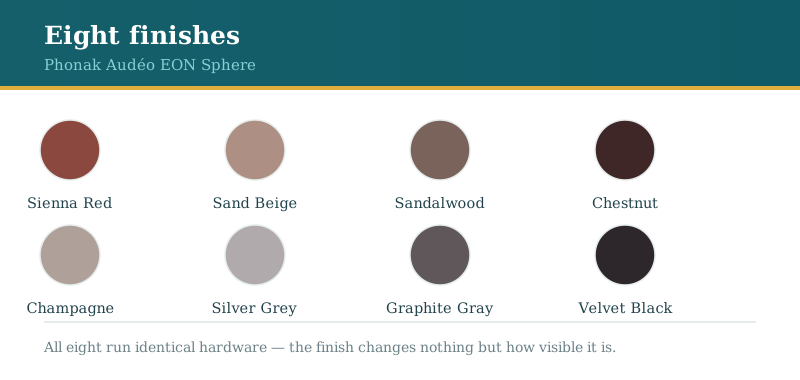
Almost everything on this page was decided in Switzerland. The colour was not. EON is made in Sienna Red, Sand Beige, Sandalwood, Chestnut, Champagne, Silver Grey, Graphite Gray and Velvet Black, and the electronics inside are the same in every one. Nothing about the sound changes. That makes it the one specification you control outright, and it deserves more attention than a colour swatch usually gets, for a reason that is easy to miss. Hearing aids only work while they are on the ear, and how many hours a day someone wears them predicts their outcome better than almost anything else we can measure. A device its owner quietly dislikes the look of comes out at the restaurant door. So the question is not which colour is nicest but which one you will stop noticing. Broadly, people who want the device to disappear go to Sand Beige, Sandalwood or Champagne and match it to hair rather than skin, since that is where most of the device actually sits. Others take the opposite view and pick Velvet Black or Graphite Gray, on the same instinct that made earbuds unremarkable: better to look like a gadget than like a medical appliance. And Sienna Red, new to this platform, is chosen far more often than you would guess. We keep the real finishes in the office and hold them up at your appointment, because they look nothing like they do on a screen.
Verified to your prescription, not to the brochure
No platform performs on specification alone, and the Infinio Ultra measurements above are the proof rather than an opinion. We program EON to your prescription and confirm it with real-ear measurement. A thin probe microphone sits in your ear canal, measuring what the hearing aid actually delivers at your eardrum against your targets across pitches. Then we fine-tune it over follow-up visits as your brain adapts. Manufacturer first-fit settings routinely land well below prescriptive targets, which is why a carefully verified mid-tier device will beat an unverified premium one more often than the price list suggests. A neural network cannot compensate for the wrong amount of gain at 3000 Hz. If your current hearing aids were never verified this way, that may account for more of the disappointment you are hoping a new platform will fix than the new platform will. Our fitting process page sets out exactly what we do and why.
Hear it for yourself
Specification arguments settle nothing. A demonstration takes about thirty minutes, costs nothing, and tells you more than any comparison table. You will hear the difference or you will not. Bring your most recent audiogram if you have one, or we can test first. We are glad to set EON up next to Phonak Infinio, or next to whatever you are wearing now, in the same visit and in a noisy room rather than a quiet booth. Call 650-342-9449 or request an appointment and tell us whether San Mateo or San Carlos is easier for you. If you are weighing a quote from somewhere else, our second opinion visit on a hearing aid quote covers that too, with no obligation to buy anything here.
Frequently asked questions
Questions patients ask us
When can I get Phonak EON?
Phonak announced EON on August 24, 2026 and released it in the United States the same day, with Germany, France, the UK and Australia following in September 2026. Availability at any particular practice depends on stock and fitting software updates. Call us at 650-342-9449 and we will tell you exactly where we are.
What is the difference between Audéo EON Sphere and Audéo EON R?
Both are rechargeable receiver-in-canal hearing aids fitted from mild through profound hearing loss. The Sphere model is the one that runs Spheric Speech Clarity 3.0, the deep neural network that separates speech from noise in real time, and it is the more expensive of the two. The EON R covers the same fitting range without that particular processing. Which one is worth it depends almost entirely on how much time you spend in genuinely noisy rooms, and that is a conversation rather than a specification.
Does Phonak EON have a telecoil?
No. No EON model has a telecoil, and Phonak's Audéo line has not offered one for several years. EON does support Auracast, which is the technology intended to replace loop systems, and it works today rather than being promised in a future update. But most looped venues on the Peninsula are still loops, so if hearing well at a particular theatre, lecture hall or place of worship is a priority, tell us which one and we will find out what it actually broadcasts before you choose a device.
Has anyone independently tested Phonak EON?
Not as of late August 2026. HearAdvisor, the laboratory most often cited for standardised hearing aid measurements, has published nothing on EON, and no other independent party has either. Every figure currently in circulation originates from Phonak's own Field Study News and Insight documents. The platform EON replaces has been measured, and scored very well. See the section above on what has been measured.
Does Phonak EON support Auracast?
Yes, and it works now. You join a broadcast by scanning a QR code in the myPhonak app, or through the Auracast controls on a compatible phone. That is a real advantage over Signia MaX, which launched on the same day with Auracast hardware that Signia says will not be fully enabled until a firmware update due by March 2027.
What styles does Phonak EON come in?
Three, and all of them are receiver-in-canal: Audéo EON Sphere, Audéo EON R and CROS EON. There is no custom in-the-ear, powerful behind-the-ear or pediatric model on the EON platform. Phonak still sells those on the Infinio, Lumity and Paradise platforms, and for the patients who need them they remain the right choice rather than a compromise.
Does Phonak EON help with tinnitus?
Phonak has not mentioned tinnitus in any EON launch material, which is a little unusual. The Tinnitus Balance noise generator has been standard across the Audéo range for years. We expect it carries forward and we will confirm it in the fitting software before we tell you it does. If tinnitus is your main reason for seeking help, our tinnitus service explains how we approach it; sound therapy through hearing aids is one part of that rather than the whole of it.
Should I buy EON now or wait?
If you are struggling to hear today, being fitted and verified properly now almost certainly outweighs waiting. If you are wearing Infinio Ultra and it is working, there is no urgency at all. Phonak is not claiming EON hears better than what you already own, and we would rather check your fitting than sell you a replacement. We are happy to talk it through without pressure at either office.