


Cochlear Implants
On October 19, 2026, MD+DI made TICI UNICO its lead story. A week earlier, Envoy announced a new step toward FDA approval. We read the company releases and the trade reports for both devices. This page sets out what each device is, what the evidence is so far, and where each one stands with the FDA. It also keeps what the companies say apart from what has been shown over years of use.
At California Hearing Center we do cochlear implant candidacy workups and, after surgery, the mapping that programs the implant. We refer the surgery to an ENT surgeon at an implant center. We do not offer TICI UNICO or Acclaim, and nobody in the United States can yet. If you live in San Mateo, San Carlos or elsewhere on the Peninsula, the useful step today is to find out whether any cochlear implant belongs on your list. For the first of the two devices, see our earlier page on TICI UNICO.
At a glance
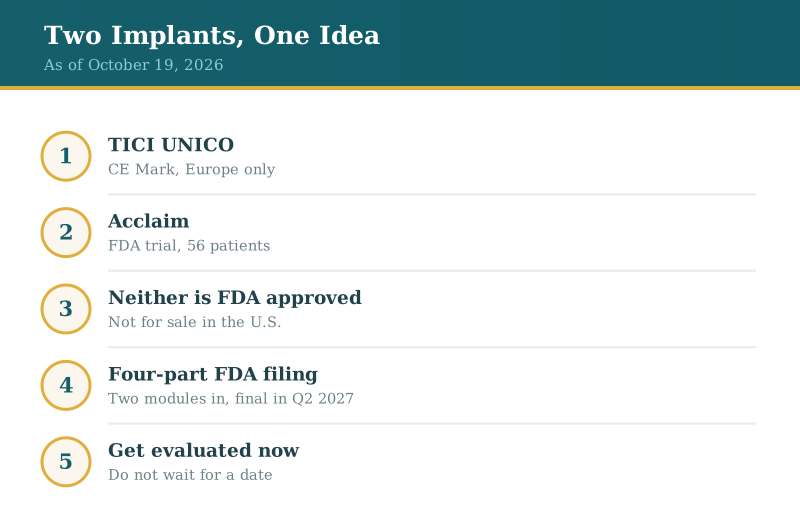
- TICI UNICO from MED-EL has a CE Mark and is being introduced in European markets. It is not FDA approved and not for sale in the United States.
- Acclaim from Envoy Medical is investigational. It has FDA Breakthrough Device Designation, granted in 2019, which is not an approval. The pivotal trial enrolled 56 people, and the last was implanted on March 11, 2026.
- Envoy is filing its FDA application in four parts. Parts one and two are in. It targets the final part, with clinical data, for the second quarter of 2027, and it gives no date for an FDA decision.
- The devices capture sound differently. TICI UNICO uses a microphone under the skin. Acclaim uses a sensor that draws on the ear's natural anatomy. So far the results are company reports from small groups.
Two devices, one idea
A conventional cochlear implant has two halves. A surgeon places the internal part under the skin, with an electrode array in the cochlea. The wearer puts on an outside sound processor that holds the microphone and battery and sends sound to the implant across the skin. A fully implantable system removes the outside half. That could mean nothing to take off at night, in the shower or in the pool, and no processor to lose. It also raises new questions about batteries, charging, sound quality and what happens when a part wears out. MED-EL and Envoy answer those questions in different ways.
TICI UNICO: what MED-EL and the trade reports say
MED-EL announced TICI UNICO on September 29, 2026 in Innsbruck, Austria. It has a CE Mark, and the company says it is being introduced in various European markets. The implanted microphone picks up sound through the skin, and the device sends electrical signals to the cochlea. MD+DI reports that the battery is expected to last 15 years or more and that recipients keep hearing while it charges. MD+DI also reports that patients wear an external charger each day, and that if the battery weakens, a patient can use an external sound processor that works with the implant. A trade report from Hearing Health Matters says the device is MR Conditional at 1.5 and 3 Tesla, under conditions it did not list. MED-EL says the device is for severe-to-profound sensorineural hearing loss, and the same report says there is no upper age limit. On evidence, MED-EL says clinical investigation data and experience so far point to hearing performance comparable to established cochlear implants. The release we read gave no numbers. MD+DI reports that MED-EL believes conventional implants and TICI UNICO can both have a place.
Envoy Acclaim: what Envoy has reported
Envoy Medical's Acclaim is an investigational device. The FDA gave it Breakthrough Device Designation in 2019. That status is meant to speed review, and it is not an approval. The company says Acclaim uses a sensor that draws on the ear's natural anatomy instead of a microphone. It is meant for adults with severe to profound sensorineural hearing loss that hearing aids do not adequately address. The U.S. pivotal trial enrolled 56 people. The last was implanted on March 11, 2026, and all 56 have been activated. Envoy reported early data from the first 10 patients. Average CNC word recognition rose from 15.2 percent before implantation to 39.2 percent at six months and 53.2 percent at 12 months, and the median daily wear time was 24 hours. At six months it reported no study-defined serious adverse events. CNC is a test of single-syllable words heard in quiet. These are company figures from 10 people. The trial's main endpoint will use 12-month data from the whole group. Envoy's one FDA-approved product is the Esteem, a fully implanted middle ear implant. That is a different device from Acclaim.
Where each device stands with the FDA
No fully implantable cochlear implant has FDA approval. Envoy is filing its application in four parts, called modules, on a rolling basis. It submitted the first module on June 30, 2026. It submitted the second on October 12, 2026, and says that one holds mostly engineering information. The final module, with the full clinical data, is targeted for the second quarter of 2027. Envoy has given no date for an FDA decision, and we have no basis to guess one. MED-EL did not state a U.S. plan in the releases we read. TICI UNICO is not approved or sold in the United States. A CE Mark is Europe's conformity approval. It is not an FDA approval, and the two reviews are separate.
| TICI UNICO (MED-EL) | Acclaim (Envoy Medical) | |
|---|---|---|
| Sound capture | A microphone under the skin | A sensor that uses the ear's natural anatomy, per Envoy |
| Battery and charging | Rechargeable. Hearing continues during charging. Battery expected to last 15 years or more, per MD+DI | The releases we read do not describe the battery |
| Who it is designed for | Severe-to-profound sensorineural hearing loss | Adults with severe to profound sensorineural loss that hearing aids do not adequately address |
| Evidence so far | MED-EL says performance is comparable to established implants. No numbers in the release | First 10 patients: CNC word score 15.2% before, 53.2% at 12 months, per Envoy |
| Regulatory status | CE Mark. Not FDA approved | Investigational. Breakthrough Device Designation in 2019. Four-part FDA filing under way |
| Available in the United States | No | No |
What we do not know yet
Neither company has given a price in the material we read, and we know of no insurance coverage decision for either device. We have not seen independent long-term results for either one. We do not know how a microphone under the skin handles a noisy room compared with a processor worn on the ear. We do not know what happens at the end of a battery's life, or what the MRI conditions are for Acclaim. No study compares the two devices head to head. People often call this a race. We would not pick a winner. The devices capture sound in different ways, and they are at different stages.
Questions to ask an implant team
If you reach the stage of choosing an implant, the questions below apply to any device, whether it has an outside processor or not. Your surgeon and implant team know what is approved where you live and what suits your ear.
Five questions to ask an implant team before you choose any implant
These apply to a device with an outside processor and to a fully implantable one.
- Is this device approved where I live, or is it part of a clinical trial?
- What happens when the battery reaches the end of its life, and does that need another operation?
- Can I have an MRI, and under what conditions?
- How does the device handle noisy rooms compared with a processor worn on the ear?
- What will my insurance cover, and what will I owe?
Cochlear implants you can get in the United States today
Three companies sell implant systems in the United States today: Advanced Bionics, Cochlear and MED-EL. All of them use an outside sound processor and coil. For a good candidate, these systems bring large gains in understanding speech, most of all in quiet rooms and on the phone. Waiting has a cost, because an ear that goes a long time without useful hearing tends to do less well after implantation. For an example of how the outside processors keep improving, see our page on the Advanced Bionics Integro processor.
What we do here, and what we refer out
Our part is audiology. We test each ear, with and without hearing aids, and run recorded sentence testing. We first check that your hearing aids are set correctly with real-ear measurement, because a poor fit can look like a candidacy problem. A common referral screen is a pure-tone average of 60 dB HL or worse with speech understanding of 60 percent or less, which our page on the 60/60 rule explains. If the results point to an implant, we refer you to an ENT surgeon at an implant center. After activation we do the mapping. We do not offer any device that lacks FDA approval. Read more on our cochlear implants page, or see our guide to hearing aids for profound hearing loss. A hearing evaluation shows where you stand. More news this week: Sony's exit from OTC hearing aids, the SPI-1005 Ménière's data and the study on hearing aids and mortality.
Last updated and sources
Last updated October 19, 2026. What changed: this is the first version. We will update this page if the FDA acts on Acclaim, if Envoy submits a later module, or if MED-EL announces a U.S. filing. Sources: MD+DI, MED-EL unveils TICI UNICO, October 19, 2026, MED-EL's launch release on Business Wire, September 29, 2026, Hearing Health Matters on TICI UNICO, Envoy Medical, second PMA module, October 12, 2026, Envoy Medical, second quarter 2026 results and Envoy Medical, first quarter 2026 results. All performance figures are company reports.
Medical information notice
This page is for general information only. It is not medical advice, and it does not diagnose or recommend treatment. Whether a cochlear implant is right for you depends on testing and on a conversation with your clinical team. Call 650-342-9449 to book at our San Mateo office, 88 N. San Mateo Drive, or our San Carlos office, 1008 Laurel Street.
Neither device is approved in the U.S. Get one email the week anything changes.
We will email you if the FDA acts on Acclaim, or if MED-EL announces a U.S. filing.
Frequently asked questions
A few questions worth asking
Is there an FDA-approved fully implantable cochlear implant?
No. TICI UNICO has a European CE Mark but is not FDA approved. Acclaim is investigational and is in a U.S. trial, with the FDA application still being filed in parts.
Does California Hearing Center offer TICI UNICO or Acclaim?
No. Neither device is approved in the United States, so no clinic here can offer it. We do candidacy workups for cochlear implants and mapping after activation. An ENT surgeon at an implant center does the surgery.
How do TICI UNICO and Acclaim differ?
TICI UNICO uses a microphone under the skin. Acclaim uses a sensor that draws on the ear's natural anatomy, according to Envoy. They are at different stages: one has a CE Mark in Europe, and the other is in a U.S. pivotal trial.
When could Acclaim be approved?
Envoy has not given a date. It is filing in four parts and targets the final part, with clinical data, for the second quarter of 2027. The FDA decides after that.
Should I wait for a fully implantable implant?
No. A candidacy evaluation does not commit you to surgery, and it shows where you stand. An ear that goes a long time without useful hearing tends to do less well after implantation, so waiting for a device with no U.S. date has a cost.
Will insurance cover a fully implantable implant?
We know of no coverage decision for either device. Many insurers cover current cochlear implants when criteria are met, and what you pay depends on your plan. Ask for a benefits check before you commit.