


Hearing Aid Technology
Most hearing aids that advertise artificial intelligence run a single neural network trained to pull speech out of noise. MaX runs four, each trained on a different job: detecting speech, recognising your own voice, reading the acoustic scene you are standing in, and deciding how to handle the noise. Signia calls the combination Acoustic Intelligence, and the argument is that a system which understands all four dimensions at once behaves more sensibly than one that only knows how to make voices louder.
This page is deliberately more careful than most of what you will read about MaX this month. The platform is only weeks old. Signia's own performance numbers trace back to documents Signia wrote. One independent lab has now scored the top tier, and a third-party listing shows prices, but we have not seen Signia publish one. We have separated what is confirmed from what is claimed from what nobody knows. That is what you actually need in order to decide. Updated October 8, 2026: we added HearAdvisor's score, the tier details and listed prices, and the UK and US launch timeline.
We fit and verify Signia at both our San Mateo and San Carlos offices, and we have fit the Signia range for years. Whether MaX is right for you depends on your audiogram, the rooms you struggle in, and what you need the device to do. Not on how recently it launched. In several situations described below, Signia IX is still the correct choice, and we will tell you so.
At a glance
- Signia MaX (Multi-adaptive Xperience) launched August 24, 2026 with four deep neural networks running together as one system Signia calls Acoustic Intelligence: speech detection, own-voice detection, scene analysis and noise processing.
- Signia's own figures come from its white papers or from a chip comparison against Signia IX. HearAdvisor has scored the top MaX 7 tier at 4.3 out of 5, according to HearingTracker, and Signia has not published a price that we can find.
- OneConnect puts Bluetooth Classic, LE Audio, telecoil and Auracast in one device. Full Auracast is not enabled until a firmware update due by March 2027.
- It launches in one style only, the rechargeable Pure Charge&Go MaX. For custom, behind-the-ear, instant-fit or CROS fittings, Signia IX remains the platform that can do it, and IX has independent lab scores that MaX does not.
- We fit and verify Signia MaX with real-ear measurement in San Mateo and San Carlos. Verification usually matters more to your result than which platform you choose.
Four neural networks instead of one
The architectural change is real, and it is worth understanding before you weigh the marketing around it. Signia says MaX runs four deep neural networks simultaneously: one for speech detection, one for own-voice detection, one for scene analysis, and one for noise processing. They are coordinated as a single adaptive system rather than four separate features taking turns. In the wearer-facing language, these surface as RealTime Conversation Enhancement AI, Own Voice Processing AI, Ambient Scene Adaptation AI and Dynamic Noise Control AI. The practical claim behind the architecture is about judgement rather than raw noise reduction. A single-network system knows how to suppress noise; it does not necessarily know whether you are in a conversation, whether the voice it just found is your own, or whether the room changed. Splitting those decisions across purpose-trained networks is meant to stop the device from doing the wrong helpful thing. Muting a restaurant while you are trying to hear the person across the table, say, or ducking your own voice as you speak. Whether that produces a better result in your ears is a separate question, and one no published evidence can yet answer.
What Signia claims, and who measured it
MaX launched with a short list of striking numbers. We think you should see them with their sources attached rather than as bare facts. Signia reports that 97% of wearers perform better with MaX in noisy group conversations than with key competitors, and that MaX ranks first in signal-to-noise ratio performance in group conversation in noise. Both figures cite white papers authored by Jensen and colleagues in 2026. Those are Signia's own documents, not peer-reviewed publications, and not currently available to read anywhere we can find. The competitors are never named, and the sample size, test protocol and outcome measure are not disclosed. Signia reports that the new MaX chip delivers 54 times more processing power, 50% greater energy efficiency and twice the memory. The footnote attached to that sentence reads, in full, "Compared to Signia IX." That is a baseline statement rather than a citation. There is no study behind it. And Signia reports that RealTime Conversation Enhancement now processes 75% more data points per second than on Signia IX, a figure that carries no footnote at all. None of this makes the claims wrong. Bench measurement and internal validation are how hearing aids get engineered, and Signia's research group has a long record. It does mean nobody outside the company has checked any of it, and that the most impressive-sounding numbers are chip specifications compared against Signia's own previous product rather than evidence about how you will hear.
What is genuinely confirmed
The hardware picture is clear. MaX launches with one model, the Pure Charge&Go MaX, a rechargeable receiver-in-canal device offered in eight colours. It reached the United States, Germany and the Nordic markets on August 24, 2026, with most remaining markets following later in the year. The UK and Ireland followed on September 4, and Signia held a US launch event at COSM Dallas on September 18. The charging case is pocket-sized and holds up to four full charges; a full charge takes four hours, and thirty minutes on the charger returns about six hours of use. Connectivity is the standout. Signia calls it OneConnect Technology, and it puts Bluetooth Classic, Bluetooth LE Audio, a telecoil and Auracast into a single device. That combination matters more than it sounds: on Signia IX, choosing a telecoil meant choosing a specific variant, so a patient who needed loop access in a theatre or place of worship gave something up to get it. On MaX there is no such trade-off. Own Voice Processing is also confirmed to work without the in-clinic calibration step IX required, which removes a small but real piece of fitting-day friction.
| Signia MaX | |
|---|---|
| Released | 24 August 2026 |
| Styles | RIC only — Pure Charge&Go MaX; no CROS on the platform |
| Independent measurement | Not tested by any independent laboratory |
| Telecoil | Yes, in every standard device (OneConnect) |
| AuracastHardware that supports Auracast and Auracast that works are not the same thing. | Hardware only until a firmware update Signia has scheduled for March 2027 |
| Tinnitus programme | Not mentioned in the launch materials |
| Rechargeable / batteryQuoted hours are manufacturer maxima measured under different feature sets, so two headline numbers rarely compare directly. | Rechargeable only; total runtime per charge not published |
| IP rating | Not stated in the launch materials |
| Published price | Not published at any tier |
The Auracast caveat nobody is printing
Auracast is listed as a MaX feature, and the device is built for it. But it does not fully work yet. Signia's own launch footnote states that full Auracast functionality will be enabled through a firmware update by March 2027. Between now and then, MaX is Auracast-ready rather than Auracast-capable. This is worth knowing because Auracast is being marketed hard across the whole industry right now and very few people are distinguishing between hardware that supports it and hardware on which it currently functions. If broadcast audio in public venues is a reason you are buying, ask about it specifically. For MaX the honest answer today is "soon, and the telecoil works in the meantime," which is not a bad answer, but it is not the same as "yes."
What MaX cannot do yet
This is the part launch coverage leaves out. MaX exists in one style. There is no custom in-the-ear model, no behind-the-ear model, no Silk-style instant-fit device, no Styletto, no Motion, and no CROS or BiCROS option on the platform. Signia IX offers every one of those, which means that for a patient who needs a powerful behind-the-ear fitting, a custom device for dexterity reasons, an instant-fit tip, or a CROS solution for single-sided deafness, IX is not a compromise. It is the only Signia that can do the job. HearingTracker describes three tiers, MaX 7, MaX 5 and MaX 3, with 48, 36 and 32 processing channels, but we have not seen Signia publish the tier structure itself. Signia has also not published a fitting range or receiver power options, and has not stated an IP rating for dust and moisture. HearingTracker lists prices of MaX 7 from $3,298 a pair, MaX 5 from $2,798 and MaX 3 from $2,698, which we cannot confirm from Signia. Notably, no launch material mentions tinnitus therapy at all. Notch Therapy and the static and ocean-wave relief signals are standard across the Signia IX range, so carrying them forward would be the obvious move. But Signia has not said so, and for a practice that treats a great deal of tinnitus we are not going to assume it. We will confirm it in the fitting software and update this page.
One independent score so far. Signia IX has more
HearAdvisor, the lab whose standardised measurements are the closest thing this industry has to a neutral referee, has now scored the top MaX tier. HearingTracker's listing shows a SoundScore of 4.3 out of 5 and a SoundGrade of A for MaX 7, with an Expert Choice award. Speech in noise scored 2.1 out of 5 with the first fit and 2.8 out of 5 after professional tuning, which the listing says is above the prescription category average. MaX 5 and MaX 3 have not been rated separately. Signia IX has been measured repeatedly and well. HearAdvisor scored the Pure Charge&Go BCT IX at 4.4 out of 5, and the Active Pro IX landed in the top five percent of every product the lab has tested. So the choice in front of you is not "new and better" against "old and worse." It is a platform with a genuinely new architecture and one strong score for its top tier, against a platform with a longer measured record, more styles, and probably a better price once dispensers begin clearing stock. Both are reasonable. Which one is right depends on you, and we would rather have that conversation than sell you the newer box.
How MaX compares to the other 2026 flagships
MaX did not launch into an empty field. Oticon Reveal arrived two weeks earlier running two AI systems with deliberately opposing objectives, and unlike MaX its Auracast support is live on day one. We set the two side by side on our Signia MaX vs Oticon Reveal page. Phonak's Audéo Infinio Ultra Sphere carries an A grade and a SoundScore of 4.9 out of 5 from HearAdvisor, one of the strongest independent results on the market, but it has no telecoil and no enabled Auracast, which is exactly the gap MaX's OneConnect is aimed at. Phonak replaced that platform with EON on the very same day MaX launched, and EON's Auracast does work today while MaX's waits on firmware. We set the two side by side on our Phonak EON vs Signia MaX page. Starkey Omega AI ranks second of thirty-six devices tested and offers custom in-the-ear styles MaX does not. The original Widex Allure has no neural network in the sound path at all and still outscores several AI flagships on the bench, which is the clearest evidence available that counting neural networks does not predict how a hearing aid actually performs. We fit all of these, which is why we can afford to be blunt about where each one loses. Starkey added Omega AI+ on October 1, so five makers launched neural network flagships in about seven weeks. Our Signia MaX explainer has the table, and our sister practice's guide to the new AI hearing aids of fall 2026 compares all five.
Eight finishes, and why that is not a trivial detail
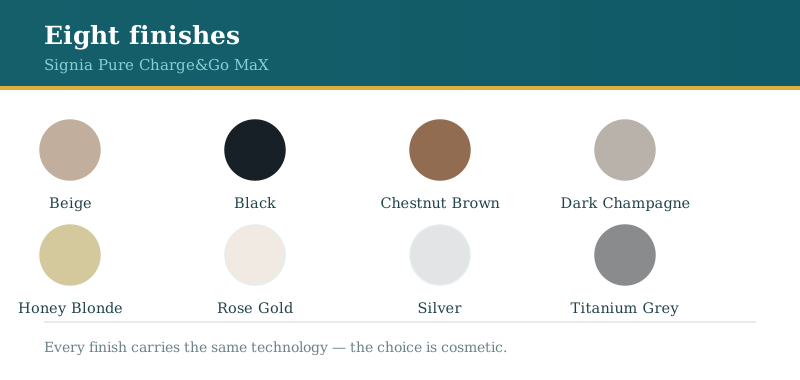
MaX comes in eight colours: Beige, Black, Chestnut Brown, Dark Champagne, Honey Blonde, Rose Gold, Silver and Titanium Grey. They are identical devices; the finish changes nothing about the sound. We raise it because it is one of the few decisions on this page that is entirely yours, and because it matters more to real patients than the specification sheets suggest. A hearing aid you are self-conscious about is a hearing aid that stays in a drawer, and the single strongest predictor of benefit is hours worn per day. Patients who want the device to disappear against hair or skin usually land on Beige, Honey Blonde or Chestnut Brown; those who would rather it read as a piece of technology than a medical appliance tend to choose Black, Titanium Grey or Silver. We will hold the actual colours against your hair and skin at the fitting rather than asking you to choose from a screen.
Verified to your prescription, not to the brochure
No platform performs on specification alone. We program MaX to your prescription and confirm it with real-ear measurement. A probe microphone sits in your ear canal and measures what the device actually delivers against your targets across pitches. Then we fine-tune over follow-up visits as your brain adapts. Manufacturer first-fit settings routinely land well below prescriptive targets, which is why an unverified premium device can easily underperform a carefully verified mid-tier one. Four neural networks cannot compensate for the wrong amount of gain at 3000 Hz. If your current hearing aids were never verified this way, that may account for more of the difference you are hoping a new platform will fix than the new platform will.
Hear it for yourself
Specification arguments settle nothing. A demonstration takes about thirty minutes, costs nothing, and tells you more than any comparison table. You will hear the difference or you will not. Bring your most recent audiogram if you have one, or we can test first. We are happy to set MaX up next to Signia IX, or next to whatever you are wearing now, in the same visit. Call 650-342-9449 or request an appointment and tell us which office is easier for you. If you are weighing a quote from somewhere else, our second opinion visit on a hearing aid quote covers that too.
Frequently asked questions
Questions patients ask us
What does MaX stand for?
Multi-adaptive Xperience. It is Signia's naming convention. The previous platform, IX, stood for Integrated Xperience, and before that AX was Augmented Xperience. MaX is the 2026 generation and sits above IX as the new flagship.
When can I get Signia MaX?
Signia announced MaX on August 24, 2026 and released it in the United States, Germany and the Nordic markets that day, with most other markets following later in 2026. Availability at any particular practice depends on stock and on fitting software updates. Call us at 650-342-9449 and we will tell you where we actually are.
How is Signia MaX different from Signia IX?
The headline difference is four purpose-trained neural networks instead of IX's multi-stream conversation processing, running on a new chip Signia says is substantially more powerful. The practical differences are that own-voice processing no longer needs an in-clinic calibration step, and that telecoil and Auracast are built into the standard device rather than requiring a specific variant. The trade-off is style range. IX comes in custom, behind-the-ear, instant-fit and CROS forms that MaX does not yet offer. We go through it properly on our MaX versus IX page.
Has anyone independently tested Signia MaX?
In part. HearingTracker's listing shows a HearAdvisor SoundScore of 4.3 out of 5 and a SoundGrade of A for the top MaX 7 tier only. MaX 5 and MaX 3 have not been rated separately, and Signia's own figures still come from its white papers. Signia IX has a longer independent record, which is worth weighing.
Does Signia MaX support Auracast?
The hardware does, and it is part of what Signia calls OneConnect Technology alongside Bluetooth Classic, LE Audio and a telecoil. But full Auracast functionality is not switched on yet. Signia states it will arrive in a firmware update by March 2027. The telecoil works today, which covers most looped venues in the meantime.
How much does Signia MaX cost?
We have not seen Signia publish pricing. HearingTracker lists MaX 7 from $3,298 a pair, MaX 5 from $2,798 and MaX 3 from $2,698, and says prices vary by provider and included services. We will not invent a number of our own. What we can do is explain what actually drives the figure and what is included in our fee. See what Signia MaX costs. We will quote you something real once we can stand behind it.
Does Signia MaX help with tinnitus?
Signia has not mentioned tinnitus therapy in any MaX launch material, which is unusual. Notch Therapy and the static and ocean-wave relief signals are standard across the Signia IX range. We expect they carry forward, but we are not going to state it as fact until we have confirmed it in the fitting software, and we will update this page when we do. If tinnitus is your main reason for seeking help, our tinnitus service explains how we approach it, and sound therapy through hearing aids is one part of that rather than the whole of it.
Should I buy MaX now or wait?
If you are struggling to hear today, the benefit of being fitted and verified properly now almost certainly outweighs waiting. If you are comfortable in your current hearing aids and simply curious about the new platform, there is no urgency. Independent measurements and a fuller style range will both arrive over the coming months. We are happy to talk it through without pressure at either office.