


Hearing Research
Ménière's disease is an inner ear condition that causes attacks of vertigo along with ringing in the ear, a feeling of fullness and hearing loss. There is no cure, so any trial that lifts hearing in Ménière's gets attention. This page explains in plain words what the Phase 3 trial and the new analysis report. It also covers the company's suggestion that the same drug could one day help sudden hearing loss. That suggestion is a plan for later testing. It is not a result.
We are an audiology practice. We test hearing, track changes in low-pitch hearing and fit hearing aids for people with Ménière's. We do not prescribe drugs, and nothing here is a treatment recommendation. If you live in San Mateo, San Carlos or elsewhere on the Peninsula and have symptoms like these, a hearing test is a useful first step. See also our pages on Ménière's disease and on tinnitus and Ménière's.
At a glance
- Sound Pharmaceuticals says its abstract on SPI-1005 in Ménière's disease won Best in Scientific Orals at the AAO-HNS meeting, held October 17 to 20, 2026 in Los Angeles.
- SPI-1005 is an investigational oral drug that contains ebselen. It is not FDA approved. The company reports FDA Fast Track and Breakthrough Therapy designations for Ménière's, and neither one is an approval.
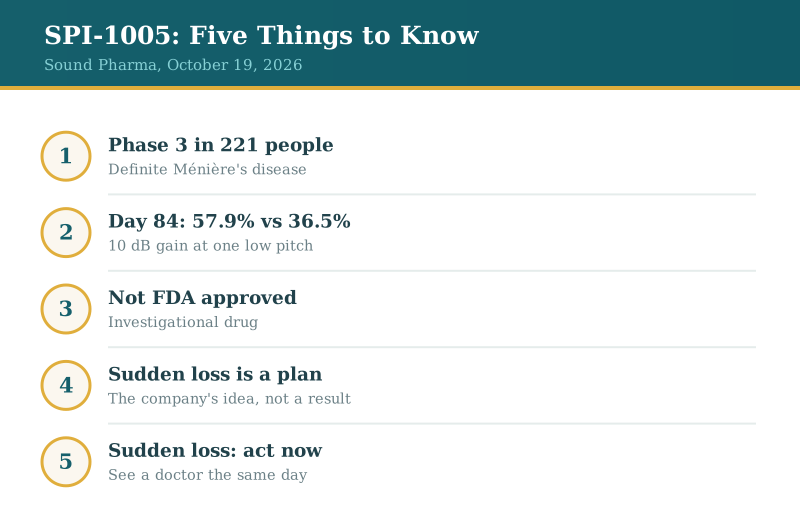
- In the company-reported Phase 3 trial of 221 people, more people on SPI-1005 gained at least 10 dB in low-pitch hearing by day 84 than people on placebo. The company releases we read do not cite a peer-reviewed paper.
- The company says the analysis supports future study in sudden sensorineural hearing loss. That is the company's interpretation. Sudden hearing loss is an emergency, and it needs a doctor's care now.
What was announced
The Business Wire release of October 19, 2026 says the Best in Scientific Orals award went to Sound Pharma's abstract on SPI-1005 in Ménière's patients. The AAO-HNS annual meeting ran October 17 to 20 in Los Angeles. The abstract analyzed the Phase 3 trial's group of people with definite Ménière's disease. It looked at three to four low-to-mid pitches in each ear, and it counted an ear as improved if its average hearing gained at least 10 decibels from baseline. People took the drug for 28 days and were followed for 84 days. The company says improvement rates were higher on SPI-1005 than on placebo at days 28, 56 and 84. It calls the differences highly significant, with p-values below 0.01 at several time points, for both pure-tone hearing and words-in-noise scores. The release gave no effect sizes for this analysis.
What SPI-1005 is
SPI-1005 is an oral capsule that contains ebselen, and it was taken twice a day in the trials. The company describes it as an anti-inflammatory drug that mimics and boosts the action of glutathione peroxidase, an enzyme that helps protect cells of the inner ear. The company argues that this enzyme's activity falls after noise, certain drugs and aging. That is the company's description of how the drug works. The company is also developing SPI-1005 for noise-induced hearing loss, tinnitus, and hearing loss from certain antibiotics and chemotherapy drugs. None of these uses is approved.
The Phase 3 trial, STOPMD-3
The company announced the main results on December 10, 2024. The trial was randomized, double-blind and placebo-controlled. It enrolled 221 adults with definite Ménière's disease at 11 sites. Participants took SPI-1005 400 mg or a matching placebo twice a day for 28 days, with monthly checks through day 84. The company says the trial met both of its co-primary goals: one for hearing at low pitches, and one for understanding speech in noise on the words-in-noise test. The table below shows the day-84 results the company reported, with the gap between the groups in percentage points.
How to read these numbers
Three points help. First, these are responder rates, which means the share of people who reached a set gain. They are not average hearing improvements. Second, the company also quotes relative differences, such as about three times as many responders on the two-pitch measure. Those figures sound large because the placebo group's rate was low. The gaps in percentage points are easier to compare. Third, the placebo group improved too, as the table shows. Ménière's symptoms rise and fall from week to week, and that is one reason trials need a placebo. The December 2024 release did not report adverse events, and the releases we read do not cite a peer-reviewed paper with the full results.
| Goal | SPI-1005 | Placebo | Gap (points) |
|---|---|---|---|
| At least 10 dB better at one low pitch | 57.9% | 36.5% | 21.4 |
| At least 10 dB better at two neighboring low pitches | 41.1% | 13.5% | 27.6 |
| Words in noise: at least 4 more words correct | 42.1% | 27.1% | 15.0 |
Where SPI-1005 stands with the FDA
In December 2025, the company announced that the FDA granted Breakthrough Therapy Designation to SPI-1005 for hearing loss in Ménière's disease. It had earlier received Fast Track designation. The company's release describes Breakthrough Therapy status as meant for drugs that treat a serious condition where early evidence suggests a meaningful gain over available therapies. It is not an approval. The company says it is working with the FDA toward a future New Drug Application, and that a second Phase 3 study, an open-label safety study, has been enrolling people with probable and definite Ménière's. The company also calls SPI-1005 the only investigational drug to hold both designations for Ménière's. That is its own claim, and we could not confirm it independently.
The claim about sudden hearing loss
The company says its new analysis is the first from a definite Ménière's Phase 3 group that supports treating sudden sensorineural hearing loss, or SSNHL, in the future. It points to similarities. Both conditions mostly affect one ear and low-to-mid pitches, and both are treated today with oral and injected steroids. The company also notes a difference: SSNHL comes on over about 72 hours with no vertigo. This is the company's interpretation. The analysis did not test SPI-1005 in people with sudden hearing loss. A future trial would have to do that. Until then, nothing about SPI-1005 changes what to do about a sudden loss.
If you lose hearing suddenly, do not wait
The National Institute on Deafness and Other Communication Disorders (NIDCD) says to treat sudden deafness as a medical emergency. Sudden sensorineural hearing loss is a rapid, unexplained loss that comes on all at once or over a few days, often in one ear. See a doctor right away. The NIDCD says treatment started more than two to four weeks after onset is less likely to restore hearing. The usual treatment is a corticosteroid, taken by mouth or injected through the eardrum, and it works best when started as soon as possible. About half of people recover some or all hearing on their own, usually within one to two weeks, but nobody can tell in advance who will. Only about 10 percent of cases have a cause that doctors can find. Call a doctor the same day, and do not wait to see whether it passes. Our page on sudden hearing loss as an emergency explains the steps, and our page on sudden-onset tinnitus covers the ringing that can come with it.
Questions to ask about any drug headline
Drug news often arrives as a press release, and a release is written to present the best case. These questions help with any headline, not only this one.
Five questions to ask about a drug-trial headline
Use these on any news about a new hearing or balance treatment.
- Is the drug approved for this use, or is it still investigational?
- Who ran and paid for the analysis, and is the full result in a peer-reviewed journal?
- How many people were in the study, and how did the placebo group do?
- Were safety results reported, and were they complete?
- Did the study cover my condition, or a related one?
Ménière's disease today, and what an audiologist adds
The NIDCD describes Ménière's as an inner ear disorder with vertigo attacks, ringing, a feeling of fullness and hearing loss that mostly affects low and middle pitches. It usually affects one ear, and both ears in 15 to 25 percent of people. It most often starts between ages 40 and 60. An ear, nose and throat doctor diagnoses it, and there is no single test for it. There is no cure yet. Options a doctor may use include limiting salt, a diuretic, medicines for dizziness, vestibular therapy, injections into the middle ear and, when other treatments fail, surgery. The NIDCD recommends hearing aids for the hearing loss. Our part is audiology. We test hearing and record changes in low-pitch hearing over time, we help with tinnitus, and we fit hearing aids. We refer you to an ENT doctor for diagnosis and medical care. Read more in our guides to vertigo and balance disorders, gentamicin and hearing loss, tinnitus therapy and what audiologists can diagnose. A hearing test is the place to start. More news this week: Sony's exit from OTC hearing aids, two fully implantable cochlear implants and the study on hearing aids and mortality.
Last updated and sources
Last updated October 19, 2026. What changed: this is the first version. We will update this page if the FDA acts on SPI-1005 or if the full results appear in a peer-reviewed journal. Sources: Sound Pharma release of October 19, 2026, republished on Fox47 MarketMinute, Sound Pharma Phase 3 results release, December 10, 2024, Sound Pharma Breakthrough Therapy release, December 1, 2025, NIDCD: Ménière's disease and NIDCD: Sudden deafness. All trial figures are the company's. The gap column in the table is our own subtraction.
Medical information notice
This page is for general information only. It is not medical advice, and it does not diagnose or recommend treatment. SPI-1005 is investigational and cannot be prescribed. If your hearing changed suddenly, see a doctor today. Call 650-342-9449 to book a hearing test at our San Mateo office, 88 N. San Mateo Drive, or our San Carlos office, 1008 Laurel Street.
SPI-1005 is not approved. Get one email the week anything changes.
We will email you if the FDA acts on SPI-1005 or if the full trial results are published.
Frequently asked questions
Your questions, answered
Is SPI-1005 FDA approved?
No. SPI-1005 is investigational. The company reports Fast Track and Breakthrough Therapy designations for Ménière's disease, and neither one is an approval. The company says it is working toward a future New Drug Application.
Can I get SPI-1005 now?
Not as a prescription. If you have Ménière's disease, ask your ENT doctor whether any clinical trial or access program applies to you. We do not prescribe drugs.
What is Ménière's disease?
It is an inner ear disorder that causes vertigo attacks, ringing, a feeling of fullness and hearing loss, mostly at low and middle pitches. It usually affects one ear and most often starts between ages 40 and 60. An ENT doctor diagnoses it.
Does SPI-1005 treat sudden hearing loss?
That has not been shown. The company says its analysis supports future study in sudden sensorineural hearing loss, but the analysis was in people with Ménière's disease. A separate trial would have to test it.
What should I do if I lose hearing suddenly?
See a doctor the same day. The NIDCD treats sudden deafness as a medical emergency, and treatment works best when it starts early. Do not wait to see whether the hearing returns.
Can hearing aids help with Ménière's disease?
The NIDCD recommends hearing aids for the hearing loss that comes with Ménière's. We test your hearing, record how low-pitch hearing changes over time, and fit hearing aids. Your ENT doctor manages the disease itself.