

Hearing Aid Technology
We should be direct about our position, because you should weigh what follows accordingly. Fortell does not sell through independent practices. It employs its own audiologists and fits only in its own clinics, so we are not a dealer for it and never will be. That makes us a competitor writing about a competitor. We have tried to write this the way we would want someone to write about us: what is confirmed, what is claimed and by whom, what nobody outside the company has checked, and where we think it is genuinely good.
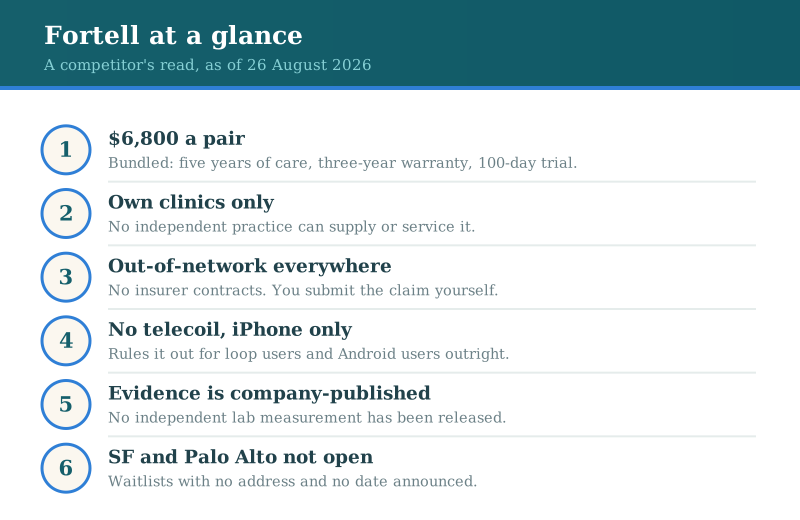
The immediate reason this page exists is that Fortell has announced San Francisco and Palo Alto, and neither one is open. Both are waitlist pages with no address and no date. Boston is the only announced location with a stated timeframe. So a lot of Bay Area readers are currently reading national coverage of a device they cannot yet be fitted with, and there is very little written for them that is neither a press release nor a competitor complaining.
One caveat on everything below: it is accurate as of September 25, 2026, and this is a company that moves quickly. Where we could not verify something we have said so rather than filling the gap. This page was corrected on September 8, 2026, and updated on September 25, 2026 with newly published independent test results and a battery-life clarification; see the note at the foot.
At a glance
- Fortell sells only through its own clinics, at $6,800 a pair, and is out-of-network with every insurer. Three clinics are open, in New York, Palm Beach and Greenwich. San Francisco and Palo Alto are waitlists with no published address or date.
- The technology is a real architectural bet: source separation running on a custom chip at around ten milliseconds of latency, rather than the environment-switching most hearing aids do.
- The evidence is company-funded and company-authored, and it is stronger than we first said. The preference study is published in the International Journal of Audiology, in twenty adults; the intelligibility study is a pre-registered double-blind trial in thirty hearing aid users, posted on Fortell's own site. HearAdvisor has now published independent laboratory measurements as well, with a record speech-in-noise score.
- There is no telecoil and no Android app. That rules the device out for loop users and for anyone not on an iPhone, regardless of how well it performs.
- The one independent clinician we found who verified a Fortell fitting with real-ear measurement said the result was accurate. That is a single case, and it is the most encouraging data point in this article.
The idea, in one paragraph
Most hearing aids that advertise artificial intelligence classify your surroundings and then adjust: this is a restaurant, so reduce noise and narrow the microphones. Fortell's position is that classification is the wrong level to work at, and that the device should instead pull the individual sound sources apart and rebuild the mixture with the voices you want brought forward. That is source separation, the same family of technique behind the noise suppression on a video call, and the reason it has not appeared in hearing aids before is latency. A hearing aid that lags behind the room makes your own voice sound wrong and makes lip movement stop matching sound. Fortell's answer was to build its own chip, and its founder has told reporters the system runs at roughly ten milliseconds, which is inside the window where most wearers stop noticing. Whether or not the marketing around it holds up, this is a genuine engineering position rather than a rebrand of existing processing, and it is different from what Signia, Oticon, Phonak and Starkey are each doing with neural networks in their 2026 flagships.
What is confirmed
Fortell Research Inc. is based in New York and was founded in 2021. The product launched in December 2025 and is a behind-the-ear processor with a receiver in the ear, offered in five colours. It is a prescription device, professionally fitted: it is not over-the-counter, it is not self-fitting, and it requires a hearing test or a recent audiogram. Candidacy is adults with mild to severe hearing loss. It costs $6,800 a pair, which includes five years of audiological care, a three-year warranty, three years of loss and damage cover, a charging case and consumables, with one replacement pair available at $400. There is a hundred-day trial, refundable minus a $300 fitting fee, and financing through Affirm. The company has an advisory board with real audiological standing, including Dr Matt Fitzgerald at Stanford and Dr Barbara Weinstein at NYU Langone. Three clinics are open: New York, Palm Beach and Greenwich. That is the confirmed picture, and most of it comes from Fortell's own published materials, which have been consistent.
The claims, and where they come from
Fortell's website leads with three numbers: that it is the world's most intelligent hearing aid, that it eliminates up to 98% of background noise, and that wearers understand ten times more words. Behind those sit two studies, both posted as PDFs on Fortell's evidence page. The first, from November 2025, is a pre-registered, double-blind randomised trial of speech intelligibility in thirty hearing aid users, measured with QuickSIN against a commercial hearing aid that uses neural-network noise reduction. The second, dated May 2026, is a blinded preference study in twenty adults, and it is published: Spatial AI consistently preferred to state-of-the-art hearing aids in multitalker noise, International Journal of Audiology. An earlier version of this page said we could not find that paper indexed outside Fortell's own site, and that neither study stated a sample size. Both statements were wrong, and the corrections are set out at the foot of this page. What we would still put to a reader is narrower than what we first wrote. Every author on the published paper is a Fortell founder, employee or compensated consultant, the study was funded by Fortell, and the paper declares as much in its statement of interest, which is more than a good deal of industry research does. Neither study names the make and model of what it was compared against: the preference study describes its five controls as the top-spec device from each of the major manufacturers, and the intelligibility study withholds its single control altogether. The January 2026 reporting on that trial named the control as Phonak's Audéo Infinio Sphere.
What the numbers actually mean
Two numbers need separating, because we ran them together. The 9.2 dB quoted in January and the 17 dB on the site today are different measurements from the same trial, and neither has moved: 9.2 dB is the SNR-50 improvement, the shift in the noise level at which listeners get half the words right, measured against the control aid, while 17 dB is a laboratory measurement of signal-to-noise improvement over the unaided ear, where the control aid managed 1.9 dB. Our description of the headline figure as having changed was wrong. The ten-times claim needs the same care. It is an odds ratio rather than a count of words. In the hardest condition tested, minus 6 dB, the model puts the odds of identifying a word correctly 18.9 times higher with the Fortell device than with the control, which the company converts to roughly ten times the probability for a typical listener. The raw group averages are 50% against 7% at minus 6 dB, and 80% against 31% at 0 dB. We set the 0 dB percentages against a claim the company makes about the hardest condition, called the ratio two and a half, and have withdrawn it. What is left is a point about presentation rather than fact: a shopper reads ten times more words as ten times the words, and the figure behind it is a modelled odds ratio at the single most difficult signal-to-noise ratio in the study. That is worth asking about. One thing has not changed. The NYU researcher quoted on Fortell's homepage saying he had never seen so categorical a result also told the same reporter that the configuration used was “a configuration that’s particularly good to show the advantages of this aid”, and that different configurations might show different results. That caveat still does not appear in the marketing.
What independent testing now shows
Update, September 25, 2026: this has changed since our last correction. HearAdvisor, whose standardised measurements are the closest thing this industry has to a neutral referee, published its results on Fortell on September 15, 2026 (see also Fortell's summary). Testing on an acoustic manikin gave it an overall SoundScore of 6.0, a speech-in-noise score of 6.4, which HearAdvisor describes as the highest it has recorded, a first-fit speech-in-quiet score of 5.4, and a perfect result on feedback management. That is a genuine independent laboratory measurement, and it answers the gap we flagged in an earlier version of this page. Two things still temper it. It reflects HearAdvisor's laboratory conditions at first-fit, without the individualised tuning we would do in the office, so treat it as what the hardware can do rather than what a given wearer will experience. And the trade-press gap has narrowed but not closed: we still could not find a review from Hearing Review, The Hearing Journal or HearingHealthMatters, from Doctor Cliff AuD, or from HearingTracker's Matthew Allsop; most of the wider professional discussion is still happening in one HearingTracker forum thread.
The limitations that decide it for some people
Three, and they are the kind that settle the question before performance enters into it. There is no telecoil. If you use loop systems in theatres, places of worship, ticket counters or transit, the device cannot receive them, and no amount of processing quality substitutes for that. The app is iPhone-only, with no Android version, which is a hard exclusion rather than an inconvenience. And the noise-elimination mode that the marketing is built around, Front Voices, has to be switched on manually rather than engaging when the room gets difficult. An earlier version of this page flagged an unresolved discrepancy on battery life: Fortell claims 24 hours or more in AI mode, while the most detailed independent write-up reported 18. That gap has since been explained rather than resolved by new testing: Fortell says the lower, independently reported figure predates an over-the-air software update that improved battery management, and current devices carry the 24-hours-or-more claim. Separately, and this is the one that surprises people: Fortell is out-of-network with every insurer. It will give you paperwork to submit yourself, and nothing more. If you have hearing aid benefits through your plan, a union, or a Medicare Advantage rider, that is real money the model does not let you use.
What is genuinely good about it
We would rather say this plainly than bury it. The engineering bet is serious and specific, and building custom silicon to get latency low enough for source separation is not something a company does for marketing reasons. The advisory board is not decorative. The pricing is honest in a way much of this industry is not: $6,800 with five years of care, a three-year warranty and a hundred-day trial is a clear, bundled number, and plenty of practices charge more for less while being vaguer about it. And the single most useful data point we found is not from Fortell at all. An independent audiologist on the HearingTracker forum described fitting a patient with Fortell devices, then running real-ear measurement and verifying directionality, and reported the result was spot on, with the patient delighted. That is one case and it proves nothing statistically. But it is exactly the check we would run, performed by someone with no stake in the answer, and it came out well.
The comparison that has not been written
There is, as far as we can find, no published head-to-head between Fortell and any current flagship. Not against Phonak's Infinio Ultra Sphere, which holds one of the strongest independent laboratory scores on the market. Not against Signia MaX, which launched in late August with four neural networks and a telecoil Fortell does not have. Not against Oticon Reveal or Starkey Omega AI. The only comparative claim in existence is Fortell's own preference study, run against the top-spec device from each of the major manufacturers, none of which it names. We are not going to invent that comparison either, because we have not had a Fortell device on a test box. What we can tell you is what the comparison would have to control for, and it is not neural network counts. It is verified output against prescriptive target, real-world hours worn, and whether the device does the specific thing that defeats you. On the evidence available today, nobody can honestly tell you Fortell measures better than the flagships. They also cannot tell you it measures worse.
If you are on the San Francisco or Palo Alto waitlist
A few practical things. Neither location has an address or an opening date, and the company's chief executive has said publicly that hiring qualified audiologists is what limits how fast it can open clinics, so treat announced cities as intentions rather than schedules. As of January 2026 the New York clinic was booking about three months out. Ask what happens to your five years of included care if a Bay Area clinic opens later than you expect, or if the nearest one stays in New York. Ask which comparator devices were used in the preference study, by make and model, because the studies publish sample sizes but not the devices. Ask whether your fitting will be verified with real-ear measurement and whether you can have the printout. Ask about the telecoil directly if loops matter to you, and check today whether the Android app has shipped. And if you are trading in working hearing aids, ask what happens to them, because the hundred-day trial refunds all but $300 and you may want the old pair until you are certain.
What we can do, and what we cannot
We cannot sell you a Fortell device and we cannot service one; the company does not supply independent practices, by design. What we can do is two things. If you are holding a quote from anywhere, Fortell included, we will give you a second opinion visit on it, which is a conversation about whether the device suits your audiogram and your rooms rather than a sales pitch for something else. And if you already own hearing aids fitted somewhere else, we will verify them with real-ear measurement: a probe microphone in your ear canal measuring what the device actually delivers against your prescription across pitches. Manufacturer first-fit settings routinely land well below target, and an unverified premium device can easily underperform a carefully verified mid-tier one. That verification is worth having whoever fitted you. We fit Phonak, Oticon, Signia, Starkey, ReSound and Widex at our San Mateo and San Carlos offices, which is the actual difference between us and a single-product clinic: we can be wrong-footed by any one manufacturer's marketing and it costs us nothing to say so. Call 650-342-9449 or request an appointment. We will update this page as independent measurements are published.
Corrections
We went back over this page against the primary sources and found four statements that were wrong. We have rewritten the relevant passages rather than quietly adjusting them. First, we said we could not find the company's May 2026 preference study indexed anywhere outside its own site. It is published in the International Journal of Audiology and you can read it at https://doi.org/10.1080/14992027.2026.2663345. Second, we said neither study states a sample size. Both do, in their abstracts: thirty in the intelligibility trial, twenty in the preference trial. Third, we said the headline improvement figure had moved between January and August, from 9.2 dB to 17 dB. It has not. Those are two different measurements reported in the same paper, the first an SNR-50 improvement against the control aid and the second a laboratory signal-to-noise improvement over the unaided ear. Fourth, we said the ten-times claim was contradicted by Fortell's own posted figures of 80% against 31%. Those figures are the 0 dB condition, while the claim concerns the minus 6 dB condition, where the modelled odds ratio is 18.9 and the raw averages are 50% against 7%; our comparison was not like for like and we have withdrawn it. We have described the original wording here rather than deleting it, because a page that holds a company to an evidentiary standard should show its own corrections in the open. What had not changed as of that correction: no independent laboratory had published measurements of this device, both studies are funded and authored by the company, and neither names the devices it was compared against. Corrected September 8, 2026. Update, September 25, 2026: two further items have changed since that correction, neither of them an error on our part, both reflecting new information. First, HearAdvisor has published independent laboratory measurements of Fortell, described above under 'What independent testing now shows,' which closes the gap we noted on September 8. Second, the battery-life discrepancy described above under 'The limitations that decide it for some people' has been explained: Fortell attributes the lower, independently reported figure to a since-applied over-the-air software update, after which current devices carry the 24-hours-or-more claim. Updated September 25, 2026.
Frequently asked questions
Your questions, answered
Can I buy Fortell hearing aids from California Hearing Center?
No. Fortell does not sell through independent audiology practices at all — it employs its own audiologists and fits only in its own clinics. We cannot supply or service the device. If you are considering one, we are happy to give you a second opinion visit on the quote, and we can verify any hearing aids you already own with real-ear measurement.
Is Fortell open in San Francisco or Palo Alto yet?
Not as of September 8, 2026. Both cities have waitlist pages on Fortell's site with no address and no opening date. The company's three open clinics are in New York, Palm Beach and Greenwich, and Boston is the only announced location with a stated timeframe. Fortell's chief executive has said hiring audiologists is the constraint on opening new clinics.
Does insurance cover Fortell hearing aids?
Fortell is not in-network with any insurer. The company provides paperwork for you to submit an out-of-network claim yourself, and nothing further. If you have hearing aid benefits through an employer plan, a union, or a Medicare Advantage rider, those are generally easier to use with an in-network provider, and it is worth checking what your plan is actually worth before deciding.
How good is the evidence that Fortell works better?
Stronger than this page first said, and still largely controlled by the company. Two studies exist. The preference study, in twenty adults, is published in the International Journal of Audiology. The intelligibility study, in thirty hearing aid users, is a pre-registered double-blind trial posted on Fortell's own site. Both state their sample sizes; an earlier version of this page said they did not, which was wrong and has been corrected. Every author on both studies is a Fortell founder, employee or paid consultant, and Fortell funded the work, which the published paper declares. Neither study names the make and model of what it was compared against. Independent measurement has now arrived from another source: HearAdvisor published standardised laboratory test results on September 15, 2026, giving Fortell an overall SoundScore of 6.0 and the highest speech-in-noise score HearAdvisor has recorded. That is a genuine independent measurement, though it reflects laboratory conditions at first-fit rather than an individually tuned fitting.
What should I ask before paying $6,800?
Which comparator devices were used in the studies, by make and model, because neither study names them. Whether your fitting will be verified with real-ear measurement, and whether you can have the printout. What happens to your five years of included care if the clinic nearest you opens later than planned. Whether the Android app has shipped, if you are not on an iPhone. And whether you use loop systems anywhere, because there is no telecoil.