


Hearing Technology
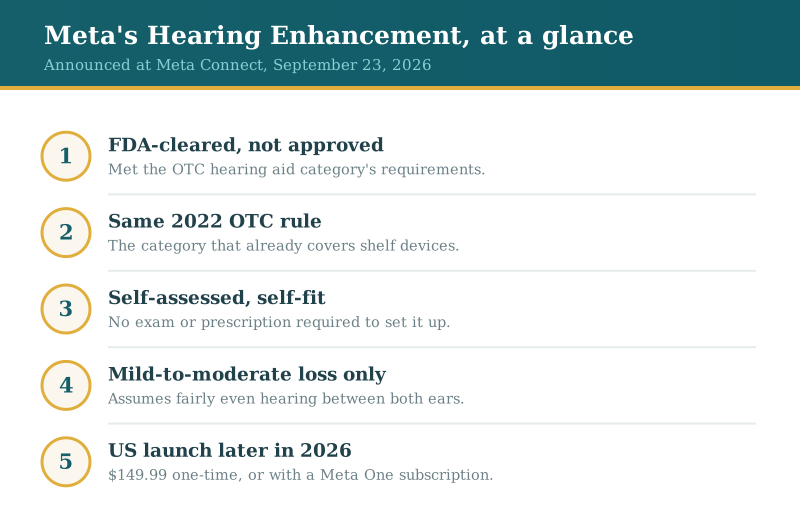
It is worth being precise about what was actually cleared. "FDA-cleared" is not the same claim as "FDA-approved," and it does not mean the glasses were evaluated as a general medical device. It means this specific software feature met the agency's requirements for the OTC hearing aid category the FDA created in 2022 — the same category that already covers shelf and app-based hearing aids from several manufacturers.
For our patients on the Peninsula, the practical question is simple: does this change anything about how you should think about your hearing? Below is a plain look at what Meta announced, how it fits into the category you may already know from OTC hearing aids, and where it does and doesn't overlap with what we do at our San Mateo and San Carlos offices.
At a glance
- Meta's Hearing Enhancement is an FDA-cleared OTC software feature, not a new class of medical device — it follows the same 2022 OTC hearing aid rule as shelf and app-based devices.
- It is built for adults 18+ with self-perceived mild-to-moderate hearing loss, set up at home with no exam or prescription, launching on select Meta Glasses in the US later this year for $149.99 or with a Meta One subscription.
- The same OTC boundaries apply: it assumes fairly even, mild-to-moderate loss, and it does not replace a hearing test for anyone with sudden, one-sided, or unusual symptoms.
What Meta actually announced
At Meta Connect on September 23, 2026, Meta said Hearing Enhancement will roll out later this year in the US, first on its newer Meta Glasses models rather than the Ray-Ban Meta line. The feature amplifies sound based on a hearing profile you set up yourself, adjusts for your left and right ear separately, and can be turned on or off with a voice command. Meta is offering a 30-day free trial, after which it costs a one-time $149.99, or comes included with a Meta One subscription. The company has said it will expand to other countries as it clears each region's own medical device rules, and it has not yet said which specific glasses models will qualify beyond a minimum hardware bar. If you are also weighing glasses built only for hearing, we set Nuance Audio Plus and Meta's feature side by side after EssilorLuxottica announced the Plus model.
Where it fits: the OTC hearing aid category
This is not a new regulatory category — it is the same one behind the OTC hearing aids we already get asked about regularly. Since 2022, the FDA has allowed adults to buy real, regulated hearing aids without a prescription, an exam, or a professional fitting, provided the loss is self-assessed as mild-to-moderate. Meta's feature works the same way: you judge your own hearing, the software sets itself up around that self-assessment, and there is no clinician involved unless you choose to see one. What has changed is the form factor, not the rulebook. A hearing aid that lives in a pair of everyday glasses is a genuinely new idea; the standard it had to meet to get there is not.
Who this is a reasonable fit for
The same profile that suits any OTC device suits this one: adults who notice they miss words in a noisy restaurant or keep reaching for the remote, but who still follow one-on-one conversation in a quiet room without much trouble. If that describes you, and you are comfortable managing a phone app and a self-assessed setup, an OTC option — glasses-based or otherwise — can be a reasonable, lower-cost way to start. It suits people who want to try something before committing to a full evaluation, which is a legitimate way to begin.
Where a self-assessment runs out of road
OTC devices, including this one, assume your hearing loss is mild-to-moderate and roughly even between your two ears. That assumption does not always hold, and nothing about wearing glasses changes that. See an audiologist before relying on any self-fit device if your hearing dropped suddenly, if one ear is clearly worse than the other, or if you have ear pain, drainage, ringing, or dizziness alongside the hearing change. Those symptoms can point to something a hearing aid, in any form, will not fix. A self-assessed setup also cannot tell you the shape of your loss the way an audiogram can, which matters more the longer you expect to rely on the device.
Getting a real answer either way
You do not need to guess which category you fall into. A straightforward hearing evaluation tells you the degree and shape of your hearing loss, which is the single most useful fact for deciding whether a self-fit OTC option — including one built into a pair of glasses — is likely to serve you well, or whether a professionally fitted hearing aid programmed to your specific results is the better starting point. Plenty of people test as good OTC candidates and go that route with confidence. Others learn their loss is further along or less even than they assumed. Either way, our audiology team is glad to walk through your results and your options at either our San Mateo or San Carlos office, with no pressure either direction.
Frequently asked questions
What patients often want to know
Is Meta's hearing feature a real hearing aid?
Yes, in the regulatory sense. It falls under the FDA's over-the-counter hearing aid category, the same one that covers other shelf and app-based devices sold since 2022. "FDA-cleared" means the feature met that category's requirements — it is a different, more limited claim than "FDA-approved," and it applies to adults with self-assessed mild-to-moderate hearing loss.
Do I need a hearing test before trying it?
Not strictly, since it is designed to be self-assessed and self-fit, the same as any OTC device. That said, a hearing test is the only way to know for certain whether your loss is actually mild-to-moderate and fairly even between ears, which is the assumption the whole OTC category rests on. If you have any of the warning signs above, get tested first rather than after.
How is this different from a hearing aid we'd fit for you?
The biggest difference is precision and follow-up. A professionally fitted hearing aid is programmed to your specific hearing test results and adjusted over return visits as your ears and your needs change. A self-fit device, glasses or otherwise, sets itself up within preset ranges based on how you describe your own hearing, with no one checking that assessment against real measurements.
Should I wait for this instead of getting tested now?
There is no real reason to wait. A hearing evaluation takes under an hour, is painless, and gives you a clear answer regardless of which product you eventually choose. Knowing your results now means you can judge any device, including this one when it launches, against your actual hearing rather than a guess.