

Hearing Technology
The new name is not the main story. The useful part is the wording around it. "FDA-registered," "FDA-cleared" and "FDA-approved" sound alike and mean different things, and patients bring that confusion to the office. This page explains the three labels and the difference between situational help and treating a hearing loss.
Product claims here are ClearCast's own. We found no independent testing, and we do not say the product fails to work. Our concern is the category, not this company. At California Hearing Center we test hearing and fit prescription hearing aids, and we do not sell ClearCast.
At a glance
- ClearCast describes its AIR (behind the ear, $499 MSRP) and AI (neckband, $299.99 MSRP) as FDA-registered listening aids for situations, not all-day wear.
- ClearCast claims its AI isolates a nearby voice and suppresses background noise, with 24 or more hours of battery. These are company claims.
- FDA registered, cleared and approved are three different statuses. Registration is an administrative listing. It is not a review of safety or effectiveness.
- A conversation booster can help in a specific moment. It cannot tell you why you are struggling or catch a medical cause.
- If conversation is getting harder in more and more places, that calls for a hearing evaluation.
What ClearCast launched
ClearCast Hearing, led by Chicago ENT physician Dr. Sreek Cherukuri, announced the products on October 20, 2026. The company says its AI was trained for three years on millions of sentences and thousands of hours of speech, so it can pick out a nearby voice and suppress competing sound in real time. It says no tests, tuning or apps are needed: you put the device on and press a button. The AIR is a behind-the-ear wearable. The AI is a neckband that the company describes as made for older adults with dexterity limits. Both are rechargeable with 24 or more hours of battery per charge, per ClearCast. ClearCast says the devices are for moments when conversation is hard to follow, not for all-day wear.
Registered, cleared, approved: three different words
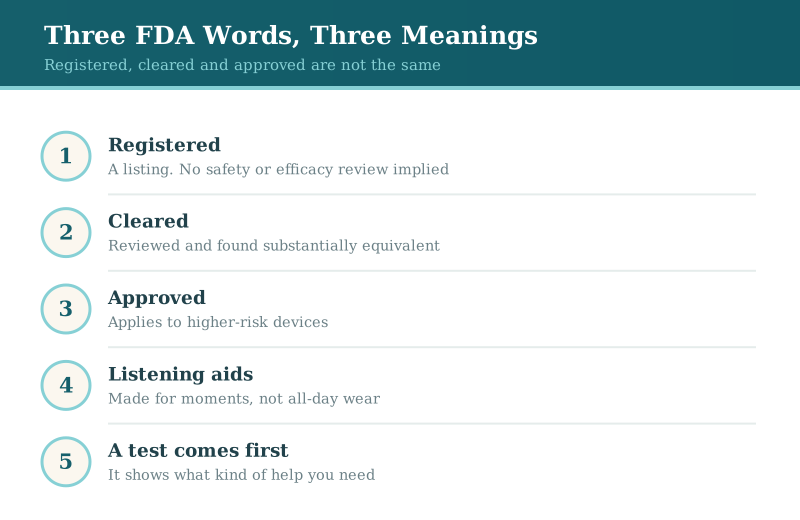
Registered means a company has listed a device with the FDA. It is an administrative step and says nothing about whether the FDA reviewed safety or effectiveness. Cleared means the FDA reviewed a submission, called a 510(k), and found the device substantially equivalent to one already on the market. Meta's hearing feature, for example, was cleared this way, and it appears in our page on Meta's glasses feature. Approved is the strongest status. It applies to the highest-risk devices, such as cochlear implants. Hearing aids themselves are regulated as medical devices, and over-the-counter hearing aids follow a separate FDA rule. ClearCast positions its listening aids outside that hearing aid category. We have not checked the FDA record for them, so read any label closely. A different category does not mean a device is useless. It means the rules and the labeling differ.
| Label | What it means | Example from this field |
|---|---|---|
| FDA-registered | The company listed the device with the FDA. No review of safety or effectiveness is implied | ClearCast describes its listening aids this way |
| FDA-cleared | The FDA reviewed a 510(k) and found the device substantially equivalent to one already on the market | Meta's Hearing assist software, decision July 13, 2026 |
| FDA-approved | The FDA approved a premarket application for a higher-risk device | Cochlear implants sold today |
Situational help is not treatment
A booster that helps you follow one voice at a noisy dinner is doing something useful. A hearing aid is fitted to a measured loss and worn to treat it across the day. The two can overlap, but they answer different questions. If you reach for a booster more and more often, that pattern is information. It may point to a loss that is growing. See our guide to OTC options for seniors and our page on TV and streaming help for other situational tools, including a remote microphone.
The hidden risk of the situational route
The main risk is delay. A device that makes dinner easier can let you skip the evaluation, and an untreated loss tends to grow harder to treat. Some hearing problems also have medical causes, such as wax, fluid or a nerve problem, and no gadget finds them. Sudden loss, loss in one ear, dizziness or ear pain need a doctor first.
A four-question self-check
Answer yes or no. Do I struggle in more than one or two settings? Do I miss words even in quiet rooms? Is one ear worse than the other? Have I noticed ringing, dizziness or a change over a few weeks? Two or more yes answers point to a hearing evaluation, not a gadget decision.
Two or more yes answers point to an evaluation
Think about the last month of conversations.
- I struggle to follow people in more than one or two settings.
- I miss words even in quiet rooms.
- One ear seems worse than the other.
- I have noticed ringing, dizziness or a change over a few weeks.
A note for patients
A listening aid can be a fine tool for a specific moment, like a noisy dinner or a grandchild's visit. What it cannot do is tell you why you are struggling, or catch the causes that need a doctor. If conversation is getting harder in more and more situations, that is a hearing evaluation, not a gadget decision.
What to do next
Book a comprehensive hearing evaluation at our San Mateo office or our San Carlos office, or call 650-342-9449. See how the new categories compare: open-ear OTC aids and direct-to-consumer RIC aids.
Last updated and sources
Last updated October 28, 2026. What changed: this is the first version. We will update the page if independent testing or a regulatory change appears. Sources: ClearCast launch release, PR Newswire, October 20, 2026, FDA: OTC hearing aids, FDA: premarket notification 510(k).
Medical information notice
This page offers general information. It is not medical advice, and it does not diagnose or recommend treatment. Sudden hearing loss, hearing loss in one ear, ear pain or dizziness need prompt medical care. Call 650-342-9449 to book at our San Mateo office, 88 N. San Mateo Drive, or our San Carlos office, 1008 Laurel Street.
Frequently asked questions
Questions patients ask us
Is a listening aid a hearing aid?
ClearCast says no. It calls its devices listening aids for specific moments, not hearing aids worn all day. Hearing aids are regulated as medical devices. ClearCast positions its listening aids outside that category.
Does FDA-registered mean it works?
No. Registration is an administrative listing with the FDA. It does not mean the FDA reviewed the device for safety or effectiveness, and it is not the same as cleared or approved.
When is a listening aid enough?
It can be enough for a specific moment, such as a loud dinner, if your hearing is otherwise fine. If you need it more and more often, or in quiet rooms, you may have a loss that needs a test.
Does ClearCast work?
We have seen no independent testing, and we do not say it fails. ClearCast's claims about AI voice isolation and battery life are the company's own. Our point is about the category, not this product.
Do you sell ClearCast at California Hearing Center?
No. We test hearing and fit prescription hearing aids. We can test your hearing and explain which kind of device fits your loss.