


OTC Hearing Aids
This page explains what open-ear means, what the design gains and what it gives up. The performance claims here are Cearvol's own, taken from its launch release, and we have seen no independent testing yet. Prices are launch pricing at the time of writing, and promotions end.
At California Hearing Center we test hearing and fit prescription hearing aids. We do not sell or fit Liberte. If the plugged-up feeling is the reason you have avoided hearing aids, this design is worth understanding, and so are its limits. For the wider price picture, see our guide to OTC and prescription hearing aid costs in 2026.
At a glance
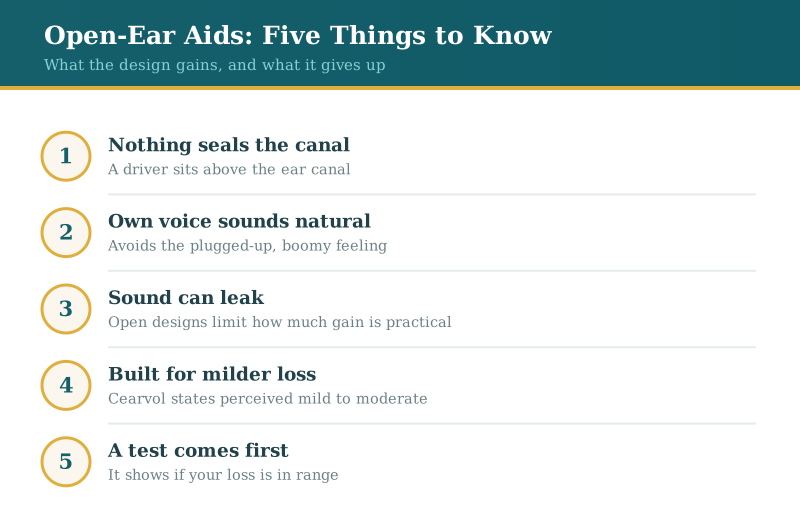
- Cearvol Liberte is an OTC hearing aid for perceived mild-to-moderate hearing loss. A wire behind the ear holds a speaker above the canal, so nothing seals the ear, per Cearvol.
- Cearvol lists a $399 MSRP and a $297 launch price on Amazon and in its own store. The direct store adds a 45-day trial, per Cearvol. This is launch pricing at the time of writing.
- Open-ear designs can feel more natural and keep your own voice from booming. They also let sound leak and limit how much gain is practical, so they suit milder loss.
- Battery life, speech isolation and awards are company claims or industry awards. They are not independent test results.
- A hearing test tells you whether your loss is in the range these devices are built for, before you spend money finding out.
What Cearvol announced
Cearvol says Liberte is on sale now in the U.S. through Amazon and the Cearvol store. The company lists a four-microphone array with what it calls real-time AI speech isolation, multipoint Bluetooth streaming, and an app with hearing profiles and scene presets. It states up to 14 hours of amplification per charge, plus 30 hours of reserve power in the charging case. The price is $399 MSRP, with a $297 launch price. Buying direct adds free two-day shipping and a 45-day trial, per Cearvol. The release also lists three awards: the 2026 Hearing Technology Innovator Awards (Non-Traditional Hearing Devices), USA TODAY and Reviewed's Best of CES, and a MUSE Design Award. Awards recognize design and innovation. They are not clinical tests of how well a device helps people hear.
How open-ear works
A conventional receiver-in-canal hearing aid sends sound through a thin wire to a speaker in the ear canal, held by a dome. A closed dome seals the canal. An open dome leaves air gaps. Liberte goes a step further: according to Cearvol, a flexible titanium memory wire rests behind the outer ear and suspends a small driver above the canal, with nothing placed inside it. Because the canal stays open, you hear much of the room naturally and the amplified sound is added on top. Cearvol says the design works with glasses and face masks. For background on the standard design, see our guide to receiver-in-canal hearing technology.
| Cearvol Liberte (open-ear OTC) | Prescription receiver-in-canal aid | |
|---|---|---|
| Ear canal | Open. A driver sits above the canal, per Cearvol | A speaker with a dome in the canal. Your audiologist picks an open or closed dome |
| Set-up | You choose a profile in the app | Programmed from your audiogram and checked with real-ear measurement |
| Intended loss | Perceived mild to moderate, per Cearvol | Mild to profound, depending on the model |
| Price | $399 MSRP, $297 launch price, per Cearvol | Varies by technology level. See our cost guide |
| Trial | 45 days when bought direct, per Cearvol | 45 days with no restocking fee at California Hearing Center |
| Follow-up | Support line and app, per Cearvol | In-person adjustments and cleanings |
What open-ear genuinely gains
The plugged-up feeling, called the occlusion effect, happens when a sealed ear traps the sound of your own voice and chewing. An open design avoids it. Many people who tried a hearing aid and gave it up cite that feeling. Open-ear designs also keep you aware of your surroundings, and they can be comfortable for people who dislike anything in the ear canal. Cearvol also says the design suits glasses wearers. These are real advantages for the right person.
Four questions before you spend $300 on any OTC aid
Answer these first. They matter more than the spec sheet.
- Do I know my hearing loss is mild to moderate, or am I guessing?
- Is the loss the same in both ears?
- Do I have ringing, dizziness, ear pain or drainage in one ear?
- Who adjusts the sound if the first setting is wrong?
What open-ear gives up
Physics sets the limits. With the canal open, low-pitched sound escapes and amplified sound leaks out and can loop back into the microphones as whistling. Designers manage this with processing, but the practical result is that open designs work best when hearing loss is mild to moderate and mostly in the high pitches. Louder, deeper or more uneven loss usually needs a sealed or custom-fit device with enough gain. That is why Cearvol, like other OTC makers, states a mild-to-moderate range. It is also why a self-chosen device can leave someone with a bigger loss disappointed.
Who may reasonably try it
Adults who notice mild difficulty, who hear low voices well but miss high-pitched speech sounds, and who dislike plugged ears may find an open-ear aid a fair first step. Seek a medical or audiology evaluation first if you have sudden hearing loss, hearing loss in one ear only, ear pain or drainage, dizziness, or ringing in one ear. Those signs call for a check, not a self-fit device. See our page on OTC devices for Bay Area patients for the full list.
A note for patients
If the plugged-up feeling is the reason you have avoided hearing aids, this new generation is worth understanding, and so are its limits. A comprehensive hearing evaluation tells you whether your loss is in the mild-to-moderate range these devices are built for, before you spend $300 finding out the hard way.
What to do next
Book a comprehensive hearing evaluation at our San Mateo office or our San Carlos office. The visit takes about an hour, and you leave with your audiogram. Questions? Call 650-342-9449. Comparing other self-fit options first? Read about the Elehear Beyond 2 Pro, the Certus Max touchscreen case, and the new listening aid category. Another route to open-ear sound is hearing glasses.
Last updated and sources
Last updated October 28, 2026. What changed: this is the first version. We will revisit pricing and add independent reviews if credible ones appear. Sources: Cearvol launch release, EIN Presswire, October 27, 2026, Cearvol Liberte product page, FDA: OTC hearing aids.
Medical information notice
This page offers general information. It is not medical advice, and it does not diagnose or recommend treatment. Sudden hearing loss, ear pain, drainage or dizziness need prompt medical care. Call 650-342-9449 to book at our San Mateo office, 88 N. San Mateo Drive, or our San Carlos office, 1008 Laurel Street.
Frequently asked questions
Questions patients ask us
Are open-ear hearing aids good?
They can be, for the right loss. They avoid the plugged-up feeling and feel natural, and they work best for mild loss in the high pitches. They give up some low-pitch gain and let sound leak, so they are not a fit for every loss.
Can an OTC hearing aid work if my loss is more than moderate?
Cearvol states that Liberte is for perceived mild-to-moderate loss. Louder or more uneven loss usually needs a sealed or custom fit with more gain. A hearing test shows which group you are in.
How is Liberte different from a prescription open-fit receiver-in-canal aid?
A prescription aid is programmed from your audiogram and verified in your ear, and your audiologist chooses the dome. Liberte is self-set in an app and has no dome. Service, adjustments and the range of loss it can cover also differ.
Do I need a hearing test before I buy Liberte?
No test is required to buy an OTC hearing aid. A test is still the only way to know your loss is in range and that nothing medical is behind it. It also gives you a baseline for later.
Is the $297 price permanent?
No. Cearvol describes it as a launch price for a limited time, against a $399 MSRP. Check the brand's own page for the current price and trial terms.
Does California Hearing Center sell or fit Cearvol Liberte?
No. We test hearing and fit prescription hearing aids. If you buy an OTC device and want a second opinion on how you are hearing, we can test your hearing.