


Hearing Aid Technology
Oticon calls these Speech AI, which identifies and lifts voices, and Context AI, which preserves the surrounding sounds that tell your brain where you are. Footsteps, room acoustics, a door closing behind you. Running them together is meant to sharpen conversation without flattening the world around it, which is the trade-off many people dislike in aggressively directional hearing aids.
This page is deliberately more careful than most you will find right now. Reveal is days old. Every performance number in circulation comes from Oticon's own laboratory, no independent test lab has measured it yet, and no US price has been published at any level. We have laid out what is confirmed, what is claimed and by whom, and what nobody knows. That is what you actually need in order to decide.
We fit and verify Oticon Reveal at both our San Mateo and San Carlos offices. Whether it is right for you depends on your audiogram, the rooms you spend time in, and what you want back. Not on how recently a platform launched. We will tell you plainly if something else in our range suits you better.
At a glance
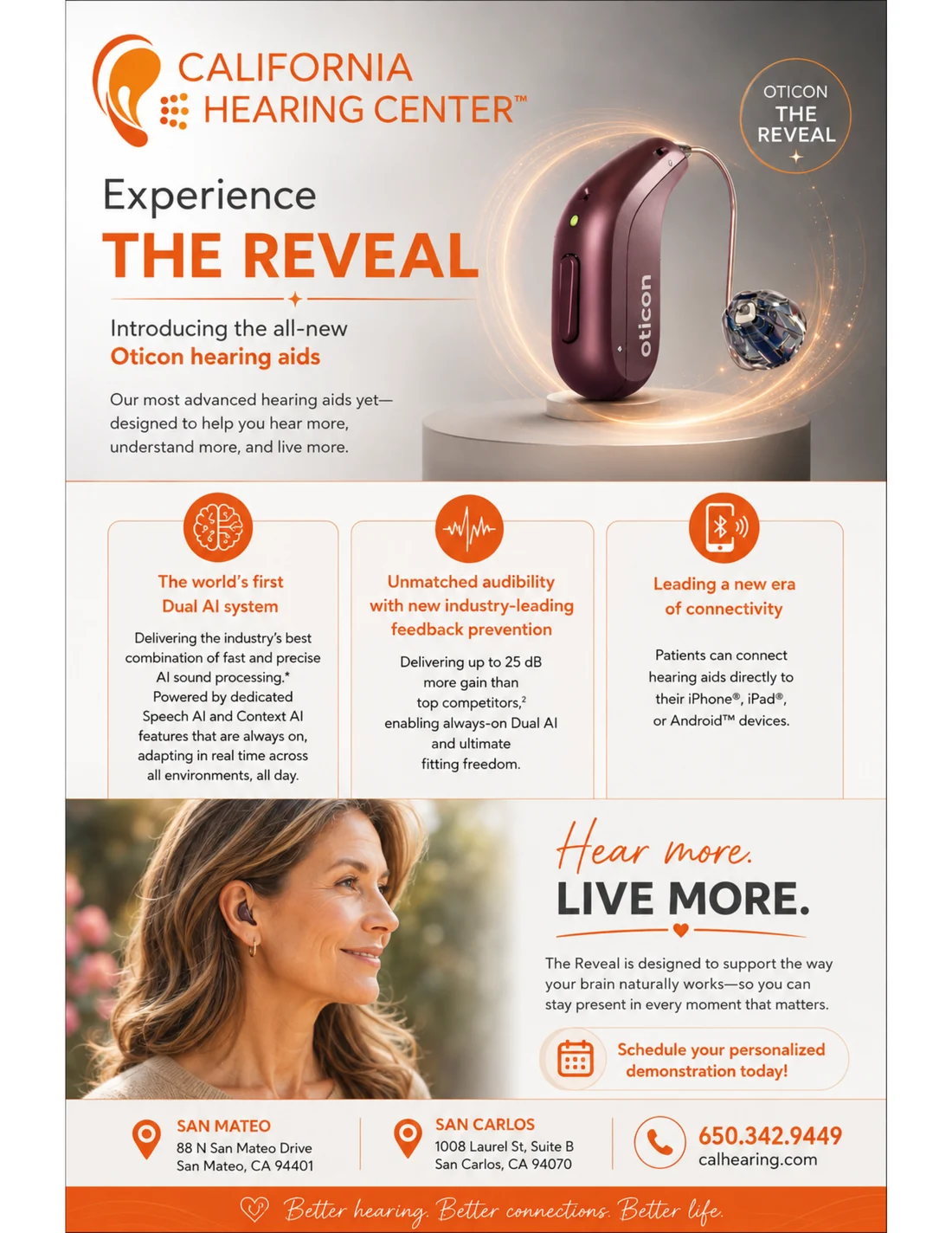
- Oticon Reveal runs Speech AI and Context AI simultaneously. It is the first hearing aid to run two AI systems with opposing objectives, clarifying voices while keeping the ambient cues that orient you in a room.
- Every published performance figure comes from Oticon's own laboratory documents: the 60% brain response, the 25 dB gain, the 91% speech access. No independent lab has measured Reveal yet, and no US price has been announced.
- It launches in one style only, a rechargeable miniRITE R with IP68, LE Audio, Auracast, telecoil and Tinnitus SoundSupport across four technology levels. If you need a behind-the-ear or custom device, Oticon Intent is still the option.
- We fit and verify Reveal with real-ear measurement at our San Mateo and San Carlos offices. Verification usually matters more to your day-to-day result than which platform you choose.
Two AI systems, running at the same time
Previous generations used a single neural network to separate speech from noise. Reveal splits that work: Speech AI concentrates on voices while Context AI holds onto the ambient detail your brain uses to build a picture of the space. Oticon's argument is that suppressing the room to chase the voice costs you orientation, and that keeping both is what makes listening feel less effortful over a long evening. It is a genuine architectural difference. Most competing systems point one AI at one job: pulling speech out of noise, or steering directionality. Reveal is the first to run two with deliberately opposing objectives. Whether that produces a better result for you is a separate question, and one the published evidence cannot yet answer. We explain the wider picture in what Dual AI actually means in hearing aids.
What Oticon claims, and who measured it
Reveal launched with a set of striking numbers. All of them trace back to documents Oticon wrote. We think you should see them alongside their sources rather than as bare facts. Oticon reports a 60% stronger brain response than Oticon Intent, citing Zapata-Rodríguez et al. (2026), a reference whose title, journal, sample size and peer-review status have not been published anywhere we can find. It reports up to 25 dB more available gain than three top competitors, and up to 91% predicted speech access, roughly 10% higher than its closest competitor; both come from a single internal Oticon research brief on the new feedback system, and "predicted" means these are modelled estimates rather than speech tests run on patients. It reports feedback management reacting 30% faster and with four times the precision of its own previous technology, and a Wind & Handling Stabilizer 2.0 attenuating up to 40 dB. It reports that 94% of users prefer Reveal over Intent. Real preference data, but with the methodology unpublished. None of this makes the claims wrong. Laboratory and bench measurements are how hearing aids get engineered, and Oticon has a long record of publishing serious research. It does mean no independent party has verified any of it, and that several figures compare Reveal against Oticon's own earlier products rather than against competitors.
What is genuinely confirmed
Reveal ships as a rechargeable miniRITE R, a small receiver-in-canal device with one push-button. Receiver options cover mild through severe hearing loss. It carries an IP68 rating for dust and moisture. It supports Bluetooth LE Audio with Auracast broadcast audio, is Made for iPhone certified, is optimised for Android with Google Fast Pair, and handles hands-free calls on compatible phones. A telecoil is included for looped venues. Tinnitus SoundSupport is available across every technology level. It works with the Oticon Companion app for volume, programs, streaming control, Find My Hearing Aids and remote adjustments with us between visits, and with the existing Oticon accessory range: ConnectClip, TV Adapter 3.0, EduMic and Remote Control 3.0. A new CROS transmitter launches alongside it for single-sided deafness.
| Oticon Reveal | |
|---|---|
| Released | Announced 11 Aug 2026, orderable 24 Aug 2026 |
| Styles | miniRITE R only, plus a CROS transmitter |
| Independent measurement | Not tested by any independent laboratory |
| Telecoil | Yes, from launch day |
| AuracastHardware that supports Auracast and Auracast that works are not the same thing. | Yes, working from launch day |
| Tinnitus programme | Tinnitus SoundSupport, all four tiers |
| Rechargeable / batteryQuoted hours are manufacturer maxima measured under different feature sets, so two headline numbers rarely compare directly. | Rechargeable only |
| IP rating | IP68 |
| Published price | Not published at any tier |
The four technology levels
Reveal comes in four tiers, numbered 1 through 4, with 1 as the flagship. Dual AI, LE Audio, Auracast, telecoil, Tinnitus SoundSupport and CROS compatibility are included at every level. The tiers differ in how finely the sound is handled, not in what the device can connect to. What changes as you move up is the number of processing channels and fitting bands, the bandwidth the device reproduces, how much noise reduction is available in difficult environments, and whether the 4D Sensor features are included. Oticon has not yet published a level-by-level comparison for the US market, and the specification tables circulating online come from a single trade source that other outlets have not confirmed. We are not going to reprint unverified numbers on a medical page. Once we have Reveal in the fitting software we will publish the confirmed table here. In the meantime, the practical point holds: the differences between tiers show up in complex, moving environments, a busy restaurant or a crowded family gathering, far more than in a quiet one-to-one conversation, and the right tier is the one matched to the situations you actually described in your consultation.
What Reveal does not do yet
This is the part most launch coverage leaves out. Reveal is available in one style only. There is no behind-the-ear model and no custom in-the-ear model, where Oticon Intent offers a miniBTE R. If you need a BTE for a powerful fitting, a custom device for dexterity reasons, or a disposable-battery option, Reveal cannot do it today and Intent remains the current choice. No independent laboratory has tested Reveal's speech-in-noise performance, HearAdvisor included, so its measured performance is simply unknown while several competitors' is published. Oticon has not disclosed a chip name, neural network size or training data figures, which is less technical detail than Phonak or ReSound publish about their AI. And no US price has been announced at any level. Anyone quoting you a Reveal price today is estimating.
How Reveal compares to the other 2026 flagships
Reveal did not launch into an empty field. Phonak's Audéo Infinio Ultra Sphere carries an A grade and a SoundScore of 4.9 out of 5 from HearAdvisor, with a speech-in-noise result of 5.0 out of 5 once tuned, but it has no telecoil and its Auracast support is not yet enabled. See Reveal vs Phonak Sphere Infinio Ultra. Starkey Omega AI ranks second of thirty-six devices tested and comes in custom in-the-ear styles Reveal does not offer. See Reveal vs Starkey Omega AI. ReSound Sensia arrived days before Reveal with the widest style range of any of them, and like Reveal has never been independently measured. See Reveal vs ReSound Sensia. And the original Widex Allure has no neural network at all and still outscores several AI flagships on the bench, though it carries no tinnitus program. See Reveal vs Widex Allure. And Signia MaX arrived two weeks after Reveal running four neural networks instead of two AI systems, with a telecoil and Auracast hardware built into the standard device. Its Auracast is not enabled until 2027, where Reveal's works today. See Signia MaX vs Oticon Reveal. We fit all of these, which is why we can afford to be blunt about where each one loses.
Verified to your prescription, not to the brochure
No platform performs on specification alone. We use real-ear measurement during the fitting to confirm the sound reaching your eardrum matches your prescribed targets across pitches, then schedule follow-up visits to fine-tune as your brain adapts to hearing more again. Manufacturer first-fit settings routinely land well below prescriptive targets, which means an unverified premium device can easily underperform a carefully verified mid-tier one. If your current hearing aids were never verified this way, that may account for more of the difference you are hoping a new platform will fix than the new platform will.
See the Reveal for yourself
We have a patient handout covering the essentials in one page, and Reveal demonstration units at both offices. Bring your most recent audiogram if you have one, or we can test first. A demonstration takes about thirty minutes and costs nothing. You can also download the Reveal handout as a PDF to read or share first. Call 650-342-9449 or request an appointment and tell us which office is easier for you. If you are weighing Reveal against something else, our second opinion visit on a hearing aid quote covers that too. Bring the quote and we will read it line by line with you.
Frequently asked questions
A few questions worth asking
When can I actually get Oticon Reveal?
Oticon announced Reveal on August 11, 2026 and opened it for ordering on August 24, 2026, with wider rollout through the rest of the year. Call us at 650-342-9449 to check current availability and whether it suits your hearing.
How is Oticon Reveal different from Oticon Intent?
Intent uses 4D user-intent sensors that read your movement and listening behaviour to work out what you are trying to hear, running a single neural network. Reveal keeps the sensor idea and adds a second AI, so speech enhancement and context preservation are handled separately and simultaneously. Intent also still offers a behind-the-ear model, which Reveal does not. We compare the two properly on our Reveal vs Intent page.
Is Oticon Reveal better than Phonak, Starkey or ReSound?
Nobody can answer that honestly yet. Independent laboratories have measured the current Phonak and Starkey flagships and published speech-in-noise scores; Reveal has not been tested by anyone outside Oticon. What is fair to say is that Reveal ships with Bluetooth LE Audio and Auracast working on day one, which several competitors have promised but not yet enabled, and that it is the only 2026-generation platform in the group.
How much does Oticon Reveal cost?
Oticon has not published US pricing for Reveal at any technology level. What we can do is explain what actually drives the number, what is included in our fee, and how insurance and financing apply. See what Oticon Reveal costs. We will quote you a real figure once we can stand behind it.
Will it work better than my current hearing aids?
Possibly, but not automatically. A newer platform helps most when it is matched to your audiogram and verified on your ear. If your current devices were never verified with real-ear measurement, that alone may account for more of the difference than the technology does. We can measure both during your appointment.
Does Oticon Reveal help with tinnitus?
Tinnitus SoundSupport is built into all four technology levels, offering broadband and ocean-wave relief sounds that we configure for you and that you can adjust in the Companion app. Sound therapy through hearing aids is one part of tinnitus care rather than the whole of it. Our tinnitus service explains how we approach it.