


Hearing & Health Research
The honest answer is that this study cannot say so. A commentary in the same journal warns against telling patients that hearing aids prolong life on the strength of observational findings alone. The authors also labeled the hearing aid part of their analysis exploratory. This page explains what the researchers did, what they found, and why the result is worth knowing without being a promise.
At California Hearing Center we treat hearing loss to make communication easier today. We do not promise a longer life, and we do not promise a sharper memory. If you live in San Mateo, San Carlos or elsewhere on the Peninsula and conversation has become harder, a hearing test shows where you stand. For other recent research, see our pages on whether hearing aids prevent dementia and on hearing loss and cognitive health.
At a glance
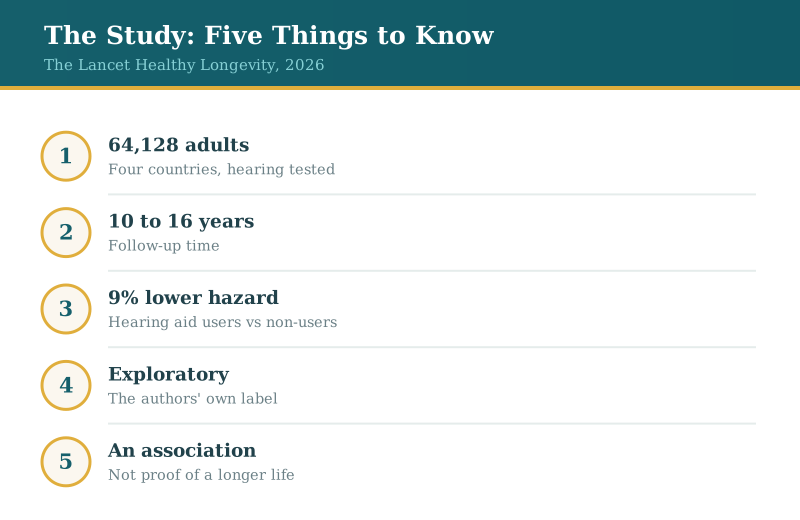
- The study, in The Lancet Healthy Longevity (citation date October 13, 2026), pooled 13,851 adults from Australia, Iceland and the United States. It checked the result in 50,277 adults in Norway. Follow-up ran 10 to 16 years.
- Compared with normal hearing, the adjusted risk of death was 19 percent higher with mild hearing loss, and 55 to 56 percent higher with moderate or worse loss.
- Among people with hearing loss, current hearing aid users had a 9 percent lower adjusted risk of death than non-users (hazard ratio 0.91). The authors labeled this analysis exploratory.
- This is an association. A commentary in the journal says observational findings alone are not a reason to tell patients that hearing aids prolong life. The established benefits are easier communication and less hearing-related disability.
Who did the study and how
The lead author is Chuan-Ming Li, MD, PhD, of the National Institute on Deafness and Other Communication Disorders, working with several co-authors. The team pooled individual-level data from three population studies: the Blue Mountains Hearing Study in Australia, the AGES-Reykjavik Study in Iceland and the U.S. National Health and Nutrition Examination Survey. That gave 13,851 adults aged 20 to 97, with an average age of about 62. The team then repeated the analysis in 50,277 adults in Norway. Every study measured hearing with an audiogram, and hearing loss was graded by the better ear. The researchers adjusted for age, sex, education, smoking, body mass index, cardiovascular conditions, diabetes, stroke and noise exposure. HearingTracker reported the study on October 15, 2026, and we rely on its report and the journal citation for these details.
What it found about hearing loss
Compared with normal hearing, pooled all-cause mortality was 19 percent higher with mild hearing loss, 55 percent higher with moderate loss and 56 percent higher with moderately severe or worse loss. Cardiovascular mortality was also higher. The Norwegian replication supported the overall findings, with smaller associations. These are hazard ratios, which compare the rate of deaths over time between two groups. They are relative figures. They are not the share of people who died. Earlier work points the same way. A 2015 study of 1,958 U.S. adults aged 70 and older, followed for eight years, found a 20 percent higher adjusted hazard of death with hearing impairment. A 2022 review of 26 observational studies with over 1.2 million participants found a 13 percent higher all-cause hazard and a 28 percent higher cardiovascular hazard.
What it found about hearing aid use
Among people with hearing loss, current hearing aid users had a 9 percent lower pooled hazard of death from any cause than non-users. The hazard ratio was 0.91, with a 95 percent confidence interval from 0.83 to 0.99. The upper end sits just under 1, so the result is modest and close to the edge of no difference. Cardiovascular mortality was 15 percent lower in the pooled data. In Norway the hazard was 15 percent lower for all causes and 16 percent lower for cardiovascular causes. The authors classed the hearing aid analyses as exploratory. The table below sets the figures side by side.
| Comparison | Death from any cause | Cardiovascular death |
|---|---|---|
| Mild hearing loss vs normal hearing | 19% higher | Also higher |
| Moderate hearing loss vs normal hearing | 55% higher | Also higher |
| Moderately severe or worse vs normal hearing | 56% higher | Also higher |
| Hearing aid users vs non-users, among people with hearing loss (exploratory) | 9% lower (hazard ratio 0.91; 95% CI 0.83 to 0.99) | 15% lower |
| Norway replication: hearing aid users vs non-users | 15% lower | 16% lower |
Why this is an association and not proof
People who use hearing aids may differ from people who do not in income, access to health care, thinking and physical function, social life and willingness to seek care. Any of these can affect how long a person lives. A general problem in this kind of study is that people who take up a health habit are often healthier to begin with. The study also measured hearing aid use from survey answers. That could not capture how many hours a day people wore their aids, for how many years, how much they helped, or when treatment began. Hearing was assessed at one point in time. The authors say future studies need repeated hearing tests and more detail about hearing aid use. In a commentary in the same journal, Janet S. Choi, MD, an otolaryngologist at the University of Southern California, praised the study's size and consistency. She also warned that associations like these should not lead clinicians to tell patients that hearing aids prolong life. We agree with that.
What is well established
Whatever future studies show about lifespan, the benefits that are established are practical ones. Treating hearing loss improves communication, reduces hearing-related disability and supports social connection. Those gains arrive now, in daily life. Our pages explain the benefits of treating hearing loss, the link between untreated hearing loss and social isolation in seniors, how hearing and heart health connect and the real cost of untreated hearing loss for Bay Area families. None of them promises a longer life, and neither do we.
How this fits with the dementia research
The same careful reading applies to the dementia studies we have covered. A January 2026 Neurology study found an association between a hearing aid prescription and lower dementia risk, but its authors did not claim prevention. Our page on whether hearing aids prevent dementia walks through that study and the ACHIEVE trial. Our older pages on hearing loss and dementia and hearing loss and cognitive health give more background. Taken together, the research keeps pointing to hearing loss as worth treating. It does not yet show that treating it changes how long you live.
What to do if you or a parent has hearing loss
You do not need to wait for the research to settle. A hearing test at our San Mateo or San Carlos office takes about an hour and includes a talk about the results. If we fit hearing aids, you have a 45-day trial with no restocking fee, so you can find out how they work in your own life. If you are worried about a parent, our guides on talking to a parent or grandparent about hearing loss and on encouraging a loved one to take a hearing test may help. Start with a hearing test. More news this week: Sony's exit from OTC hearing aids, two fully implantable cochlear implants and the SPI-1005 Ménière's data.
Last updated and sources
Last updated October 19, 2026. What changed: this is the first version. We will update this page if the authors or other researchers publish more detail on hearing aid use. Sources: HearingTracker, Hearing Aid Use Linked to Lower Mortality in Large Multinational Study, October 15, 2026 and the journal article it cites, Li C and others, The Lancet Healthy Longevity, 202600087-5/fulltext). We have not read the full text of the paper. Figures are as reported by HearingTracker.
Medical information notice
This page is for general information only. It is not medical advice, and it does not diagnose or predict your own health or lifespan. If you have questions about your health, talk with your physician. Call 650-342-9449 to book a hearing test at our San Mateo office, 88 N. San Mateo Drive, or our San Carlos office, 1008 Laurel Street.
Frequently asked questions
Questions patients ask us
Do hearing aids help you live longer?
That has not been shown. A large 2026 study found that hearing aid users had a lower rate of death than non-users with hearing loss. The authors called this analysis exploratory, and a commentary in the same journal warns against telling patients that hearing aids prolong life.
What did the Lancet Healthy Longevity study find?
It pooled data on 13,851 adults from Australia, Iceland and the United States, and checked the result in 50,277 adults in Norway. Hearing loss went with a higher risk of death, and hearing aid use among people with hearing loss went with a somewhat lower risk.
What does 9 percent lower risk mean?
It is a relative difference in the rate of death over follow-up, with a hazard ratio of 0.91. It does not mean 9 fewer deaths in 100 people, and it does not estimate extra years of life. The confidence interval runs from 0.83 to 0.99.
Does hearing loss cause earlier death?
The study does not show that. It found an association between hearing loss and higher mortality after adjusting for several factors. Other differences between people could still explain part of it.
Why do researchers say not to promise a longer life?
Hearing aid users may differ from non-users in health, income, social life and access to care. The study also measured hearing aid use from survey answers, which cannot show how long or how well people wore them.
Should I get hearing aids because of this study?
Get your hearing tested if conversation has become harder. Treating hearing loss improves communication and daily life, whatever future studies show about lifespan. A hearing test tells you whether treatment is needed.