


The Evidence
Cochrane updated its review of hearing aids for mild to moderate hearing loss in 2026. This page explains what it found, in plain words, and where the evidence stops. Accurate as of November 24, 2026.
At a glance
- The review found 16 studies with 2,261 adults with mild to moderate hearing loss.
- Hearing aids probably greatly improve listening to others and taking part in everyday situations.
- Hearing aids may make little or no difference to loneliness, and the effect on working memory is unclear.
- The review does not address dementia. We say hearing loss is associated with higher dementia risk, and we never say aids prevent it.
What Cochrane did
Cochrane reviews collect all trials that meet set rules and combine what they find. This update, published in the Cochrane Database of Systematic Reviews in August 2026 (CD012023), is by Ferguson and colleagues. The authors searched for evidence to August 2024 and included studies up to May 18, 2026. Their plain-language summary reports 16 studies with 2,261 adults. Average age ranged from 58 to 83, and studies lasted from four weeks to three years.
What they found
Hearing aids probably cause a large improvement in the ability to listen to other people, based on five studies with 622 people. They probably greatly improve taking part in everyday situations, based on eight studies with 1,683 people, and may slightly improve general well-being. Cochrane concludes the evidence supports the usual practice of offering hearing aids to adults with mild to moderate hearing loss who seek help.
Where the evidence is unclear
The review found hearing aids may make little or no difference to loneliness, based on two studies with 907 people. Effects on working memory are unclear. It is also unclear whether hearing aids cause unwanted effects: one study reported two cases of pain or discomfort. Because hearing aids are visible, blinding is hard, and many studies were short. Results for different ages, sexes and levels of loss are still unclear.
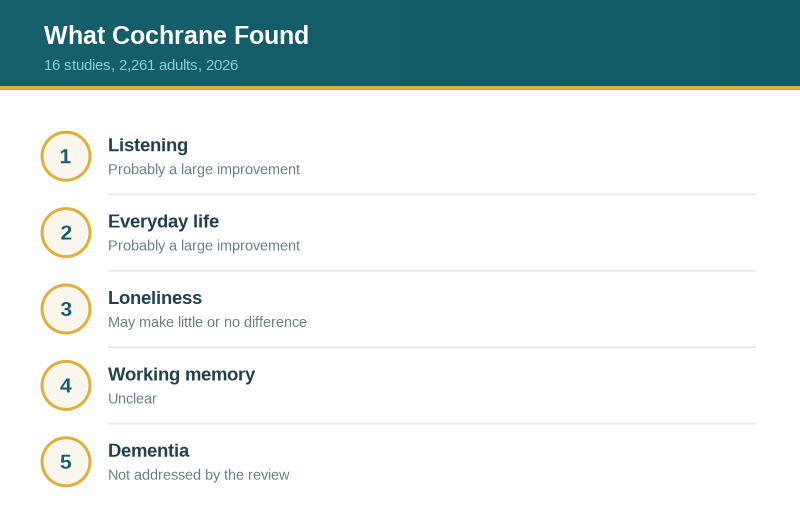
| Outcome | What the review found | Studies and people |
|---|---|---|
| Listening to others | Probably a large improvement | 5 studies, 622 people |
| Everyday participation | Probably a large improvement | 8 studies, 1,683 people |
| General well-being | May improve slightly | 4 studies, 1,558 people |
| Loneliness | May make little or no difference | 2 studies, 907 people |
| Working memory | Unclear | 3 studies, 910 people |
| Dementia | Not addressed | Not studied |
What it does not say about dementia
The plain-language summary does not address dementia. Large observational studies link hearing loss with higher dementia risk. That is an association, not proof. Read our pages on hearing loss and cognitive health and hearing loss and dementia. Nothing in this review shows that aids prevent dementia or memory loss.
What this means when you choose
A hearing aid helps most when it is fitted to your loss, worn daily and adjusted. Start with a hearing test, then a fitting with follow-up. Related reading: one hearing aid or two, hearing loss and falls, your first 30 days and how hearing aids work.
Status and last update
Last updated November 24, 2026. What changed: this is the first version. We will update this page when new evidence or rules change the picture. Sources: Cochrane: Hearing aids for mild to moderate hearing loss in adults (CD012023, plain-language summary), Ferguson MA, et al. Hearing aids for mild to moderate hearing loss in adults. Cochrane Database Syst Rev 2026;8:CD012023.
Medical information notice
This page offers general information. It is not a diagnosis or treatment plan. Want to know where your hearing stands? A full hearing evaluation usually takes about an hour. Call 650-342-9449 to book at our San Mateo office, 88 N. San Mateo Drive, or our San Carlos office, 1008 Laurel Street.
Frequently asked questions
Your questions, answered
Do hearing aids really work?
For adults with mild to moderate hearing loss, a 2026 Cochrane review found they probably greatly improve listening and everyday participation.
Do hearing aids prevent dementia?
No review here shows that. Hearing loss is associated with higher dementia risk, and the Cochrane summary does not address dementia.
Do hearing aids reduce loneliness?
The review found they may make little or no difference to loneliness, based on two studies.
Are there side effects?
It is unclear. One study reported two cases of pain or discomfort, and none reported noise harm.
Is the evidence about severe loss?
No. The review covers mild to moderate hearing loss in adults.