


Hearing & Brain Health
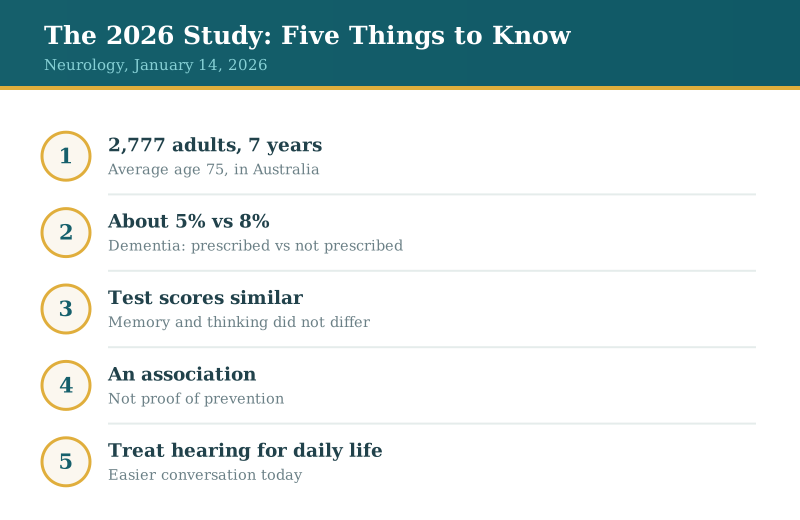
The study, published in Neurology on January 14, 2026, followed 2,777 adults in Australia for seven years. About 5 percent of those prescribed hearing aids developed dementia, compared with about 8 percent of those who were not. Yet memory and thinking test scores did not differ between the two groups. That mix of results is why we think it needs a careful read.
Below we set out what the researchers did, what they found, what they could not show, and where this sits beside an earlier trial and the Lancet Commission's list of risk factors. If you want the broader background, see our pages on hearing loss and dementia and hearing loss and cognitive health. Nothing here is a reason to panic, and nothing here is a promise.
At a glance
- The study, in Neurology on January 14, 2026, from Monash University, followed 2,777 Australian adults with an average age of 75 for seven years.
- About 5 percent of those prescribed hearing aids developed dementia, against about 8 percent of those not prescribed. This was reported as a 33 percent lower risk after adjustment.
- Memory, language and processing speed test scores were similar in both groups. The authors say most participants had good cognitive health at the start.
- This is an association, not proof that hearing aids prevent dementia. Our standing view stays the same: untreated hearing loss is among the largest modifiable risk factors, and treating it helps daily communication.
Who ran the study and what they did
The lead author is Joanne Ryan, PhD, of Monash University in Melbourne. The paper appeared in Neurology, the journal of the American Academy of Neurology, on January 14, 2026. It followed 2,777 adults in Australia with an average age of 75. All had self-reported moderate hearing loss, had never used hearing aids and did not have dementia at the start. Of these, 664 were prescribed hearing aids. The group had cognitive tests every year for seven years, and 117 people developed dementia during that time. The work was funded by the US National Institutes of Health (National Institute on Aging), the Australian government and Monash University.
What the study found
People prescribed hearing aids were less likely to be diagnosed with dementia. About 5 percent of them developed dementia, compared with about 8 percent of those who were not prescribed. After adjusting for age, sex, diabetes and heart disease, the researchers reported a 33 percent lower risk. They also looked at cognitive impairment, which includes cognitive decline and dementia. It occurred in about 36 percent of the prescribed group and about 42 percent of the others, a 15 percent lower risk. The reports also say that more consistent hearing aid use went with a steadily lower dementia risk. The table below sets the main numbers side by side.
| Outcome | Prescribed hearing aids | Not prescribed |
|---|---|---|
| People in the study | 664 | The rest of the 2,777 |
| Developed dementia | About 5% | About 8% |
| Dementia risk, adjusted | 33% lower (reported) | Comparison group |
| Cognitive impairment (decline or dementia) | About 36% | About 42% |
| Memory, language and processing speed scores | Similar | Similar |
What the study did not find
Average scores on memory, language and processing speed tests were similar between the two groups, and hearing aids were not linked to better scores. Ryan said one reason may be that most participants had good cognitive health when the study began, which leaves little room to improve. She also said further studies are needed to understand how hearing aids may support memory, thinking and brain health. So the result is mixed. Fewer diagnoses of dementia in one group sits beside no difference in test scores.
Why this is an association and not prevention
Two groups can differ in ways that a statistical adjustment does not fully capture. People who seek out and get prescribed hearing aids may differ in income, health habits, social life or access to care. In this study the groups were defined by prescription, not by confirmed daily use. The authors note that the findings show an association, not proof that hearing aids reduce risk, and that the results may not apply to people who are less healthy or already have memory problems. We agree, and we do not tell patients that hearing aids prevent dementia.
How this fits with the ACHIEVE trial
ACHIEVE was a randomized controlled trial in the United States, led by Frank Lin of Johns Hopkins, with 977 adults aged 70 to 84 who had untreated hearing loss. For three years, one group received hearing aids, a self-management toolkit and counseling with an audiologist. The other group received health education sessions. In the whole group the trial did not show a cognitive benefit over three years. In a subgroup of 238 people from a heart-health study, who had more dementia risk factors and faster decline, the hearing intervention slowed cognitive decline by 48 percent. The researchers called this encouraging and in need of further investigation. In both groups the hearing intervention improved communication, social functioning and loneliness.
Where the Lancet Commission list stands
The 2024 Lancet Commission on dementia prevention names 14 risk factors that can be changed and estimates that about 45 percent of dementia cases could potentially be prevented by addressing them all. Hearing loss is among the largest, at 7 percent in the Commission's estimates, tied with high LDL cholesterol. These are estimates for whole populations, not a personal risk, and they do not prove that treating hearing loss will remove the share attributed to it. We use the wording "among the largest modifiable risk factors" for that reason. Our page on the Lancet numbers and the link with hearing shows the full chart.
Why word recognition scores matter here
Most hearing tests report how softly you can hear tones. A separate measure, the word recognition score, shows how clearly you understand speech once it is loud enough. Two people with the same tone results can differ a lot on this. If the aim of treatment is to make speech easier to follow, which is the plain benefit of hearing aids, then this score and how it changes with a good fitting are worth knowing. Our page on the word recognition score explains the test. We do not claim a particular score predicts dementia.
What this means if you or a parent has hearing loss
You do not need to wait for the science to settle before acting. A hearing test is quick and low risk, and treatment tends to make conversation easier today. A well-fitted hearing aid is measured in your ear and checked at follow-up visits, which is why we describe our hearing aid fitting in detail. Our page on what recent research means for Bay Area patients gives more background, and our guide to insurance in California explains how Medicare, Medi-Cal and private plans treat hearing care. Book a hearing test at our San Mateo or San Carlos office if you want a starting point.
Last updated and sources
Last updated October 16, 2026. What changed: this is the first version. Sources: Newswise, American Academy of Neurology release: Hearing aid prescriptions not associated with changes in memory and thinking, ScienceDaily, February 2026, the original paper, Ryan J and others, Treating Hearing Loss With Hearing Aids for the Prevention of Cognitive Decline and Dementia, Neurology 2026;106(3), DOI 10.1212/WNL.0000000000214572, Hearing Review summary of the study, Alzheimer's Association AAIC 2023 release on the ACHIEVE trial, University of Cambridge summary of the 2024 Lancet Commission and Alzheimer Europe on the 2024 Lancet Commission. We read the news and summary sources above; we could not open the journal abstract page, so the study figures come from those reports.
Medical information notice
This page offers general information about research. It is not a diagnosis, a prediction of your own risk or a treatment plan. If you worry about memory, talk to your physician. A full hearing evaluation usually takes about an hour. Call 650-342-9449 to book at our San Mateo office, 88 N. San Mateo Drive, or our San Carlos office, 1008 Laurel Street.
Frequently asked questions
Your questions, answered
Do hearing aids prevent dementia?
No study to date shows that they do, and the January 2026 study does not claim it. It found that people prescribed hearing aids had a lower rate of dementia diagnoses. The authors describe this as an association.
What did the January 2026 Neurology study find?
It followed 2,777 Australian adults, average age 75, for seven years. About 5 percent of those prescribed hearing aids developed dementia, against about 8 percent of those not prescribed. Memory and thinking test scores did not differ between the groups.
Why were memory test scores the same if dementia rates differed?
The study does not fully explain it. The lead author said most participants had good cognitive health at the start, which may leave little room for scores to improve. She said more research is needed.
Is hearing loss a risk factor for dementia?
The 2024 Lancet Commission lists hearing loss among 14 changeable risk factors and puts it among the largest, at 7 percent. These are population estimates. They do not show that treating hearing loss prevents dementia in one person.
What was the ACHIEVE trial?
It was a randomized trial of 977 adults aged 70 to 84 with untreated hearing loss. Overall it showed no cognitive benefit over three years. In a higher-risk subgroup, cognitive decline slowed by 48 percent, which the researchers called encouraging but in need of more study.
Should I get hearing aids because of this study?
Get your hearing tested if conversation has become harder. Hearing aids can make listening easier and help you stay connected, whatever the dementia research eventually shows. A hearing test will tell you if treatment is needed.