


Hearing & Health Research
The review appeared in Diabetes/Metabolism Research and Reviews. Its lead author, Dr. Mehwish Nisar of the University of Queensland School of Public Health, says in a university news release that a simple hearing test should be part of every diabetes check-up. Most of the studies in the review looked at type 2 diabetes. All of them were observational, so they show a link, not a cause.
At California Hearing Center we test hearing. We do not diagnose or treat diabetes. If you live with diabetes, a hearing test at our San Mateo or San Carlos office takes about an hour, and it gives you a starting point to compare against later. Our older page on how diabetes and hearing health connect gives the plain-language background. This page covers the new research.
At a glance
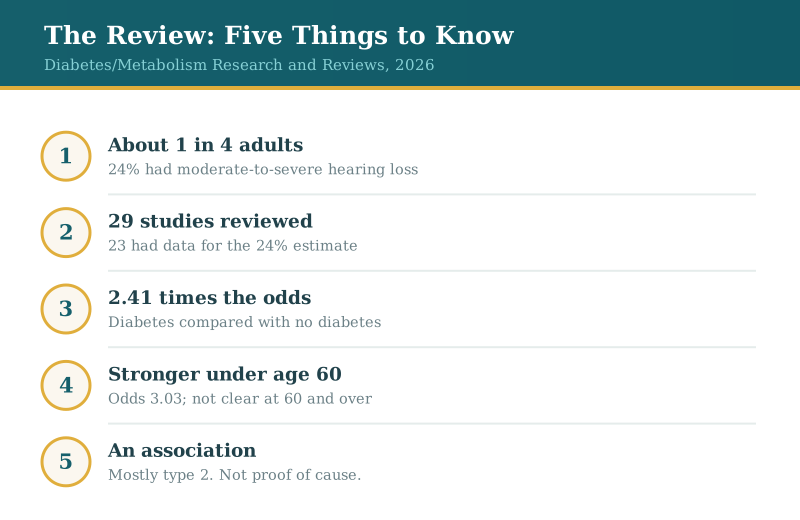
- A 2026 meta-analysis found that about 24% of adults with diabetes had moderate-to-severe hearing loss (40 dB or worse). The 95% confidence interval runs from 19% to 30%.
- Adults with diabetes had about 2.4 times the odds of hearing loss compared with adults without diabetes. The link was stronger under age 60.
- The review is observational. It shows an association. It does not show that diabetes causes hearing loss, and it did not test whether hearing tests or hearing aids change any health outcome.
- Almost all of the studies covered type 2 diabetes. Only one included prediabetes, so the review gives no separate figure for prediabetes.
- A baseline hearing test is quick and low risk, and it makes later changes easier to see.
The headline finding
The review searched 3,490 records and found 29 studies that qualified. It pooled 23 of them, with 5,221 people, to estimate how common hearing loss is among adults with diabetes. The answer was 24%, or about 1 in 4. Here, hearing loss means moderate-to-severe loss, a threshold of 40 dB HL or worse. That is the range where conversation gets hard without help. The University of Queensland, where the lead author works, published its own summary on July 2, 2026. It quotes Dr. Nisar: "we need to sound the alarm and add a simple hearing test to every diabetes check-up." The study design matters as much as the number. Every study in the pool was observational, and results varied widely from one study to the next.
How to read the numbers
The table below lists the main results exactly as the review reported them. The first row counts how many people had hearing loss. The other rows compare adults with diabetes to adults without it. An odds ratio of 1 would mean no difference. A higher number means hearing loss was more common in the diabetes group.
| Measure | Result | What it covers |
|---|---|---|
| How common is moderate-to-severe hearing loss (40 dB or worse) in adults with diabetes? | 24% (95% CI 19% to 30%) | 23 studies, 5,221 people |
| Odds of hearing loss with diabetes compared with no diabetes | 2.41 times (95% CI 1.62 to 3.60) | 11 studies |
| Adults under age 60 | 3.03 times | Statistically clear |
| Adults aged 60 and over | 1.52 times (95% CI 0.72 to 3.22) | Not statistically clear |
| Diabetes for less than 10 years | 2.68 times | Subgroup result |
Why diabetes and hearing may be connected
Researchers believe that high blood sugar over many years can harm the small blood vessels and nerves that feed the inner ear. The eyes and kidneys can be affected in a similar way. This is a plausible explanation, not a proven one. This review did not test it. Hearing can also change for other reasons at the same time, such as age, noise, medicines and family history, so no test can tell you that diabetes alone is the cause of your own hearing loss. For more on this, read our overview of hearing loss risk factors and our page on kidney disease and hearing loss.
Why age matters in this review
The link was strongest in younger adults. Among people under 60, the odds of hearing loss were about three times higher with diabetes (odds ratio 3.03). At age 60 and over, the odds ratio was 1.52, and the range around it (0.72 to 3.22) includes 1. That means the result at older ages was not statistically clear. It does not mean older adults have no extra risk. It means this review could not tell. For working-age adults, the message is that hearing changes can begin earlier than most people expect. A separate six-year study from Busselton, Western Australia, followed 3,596 adults aged 45 to 70. It found that hearing thresholds worsened in every age group. Pre-diabetes was one of several factors linked to faster decline, along with higher body weight, smoking, tinnitus, chronic ear infection, noisy work and high blood pressure. These are also associations. Both studies point the same way: midlife is a good time for a first hearing test.
Signs your hearing may be changing
Hearing loss usually arrives slowly, and most people adapt without noticing. These are the signs people tend to report first. If more than one sounds familiar, take the short hearing check below.
Six signs worth noticing
Hearing loss is easy to miss because it builds slowly. Do any of these sound like you?
- You ask people to repeat themselves.
- The television volume keeps creeping up.
- Phone calls are harder to follow than they used to be.
- Restaurants and group conversations wear you out.
- You hear ringing or buzzing in your ears.
- You feel tired after a long day of listening.
What a baseline hearing test includes
A hearing test at California Hearing Center starts with a talk about when you first noticed a change, your medical history and the medicines you take. An audiologist then looks in your ears with an otoscope. You listen for tones in a quiet booth, and we measure how clearly you understand speech, including speech in background noise. We sit down with your audiogram, the chart of your results, and explain it in plain language before you leave. Read the full list of steps on our hearing testing page, or see what to expect at a hearing test. The visit takes about an hour. It is a hearing evaluation only. We do not screen for or manage diabetes, so keep going to your regular diabetes visits.
What this means for you
If you live with diabetes, a hearing test can sit on the same list as your eye exam and your foot check. Hearing usually changes slowly, and a baseline test now gives you a reference point, so any later change is easier to see. If the signs above sound familiar, you do not need to wait for your next diabetes review. Book a hearing test at our San Mateo office or our San Carlos office, or call 650-342-9449. If the test shows hearing loss that needs treatment, we explain your options, and our hearing aids come with a 45-day trial and no restocking fee.
More on hearing and your health
Diabetes is one of several health conditions linked to hearing. See how hearing connects to your wider health. A large 2026 study of hearing aids and mortality shows how to read research like this carefully. If you notice ringing in your ears along with hearing changes, read about tinnitus and how to tell whether you have it with our guide to do I have tinnitus. If someone you love may be affected, here is how to encourage a loved one to take a hearing test.
Last updated and sources
Last updated October 20, 2026. What changed: this is the first version. Sources: Nisar M, Karatela S, Rajagopal A, Ahmed BN, Dawes P. Hearing Loss in Adults With Diabetes and Prediabetes: A Systematic Review and Meta-Analysis. Diabetes/Metabolism Research and Reviews, 2026. doi:10.1002/dmrr.70195, University of Queensland News, July 2, 2026: Hearing loss: the hidden epidemic in diabetes patients, Medical News Today: 1 in 4 adults with type 2 diabetes experience hearing loss, Smit AL, Eikelboom RH, Mao Y, Hunter M, Atlas MD, Swanepoel DW, Stegeman I. Change in hearing loss and its association with general health in a community-based longitudinal study of middle-aged individuals: the Busselton Healthy Ageing Study. PLOS One, 2026. doi:10.1371/journal.pone.0360651.
Medical information notice
This page offers general information. It is not medical advice, and it does not diagnose or predict your own health. Talk with your physician about your diabetes care. A hearing test does not replace it. To book a hearing test, call 650-342-9449 for our San Mateo office, 88 N. San Mateo Drive, or our San Carlos office, 1008 Laurel Street.
Frequently asked questions
What patients often want to know
Does diabetes cause hearing loss?
This review does not show that. It found that hearing loss was more common in adults with diabetes, which is an association. Researchers believe damage to small blood vessels and nerves may play a part, but that idea was not tested here. Other things, such as age and noise, also affect hearing.
Should people with diabetes get a hearing test?
The review's lead author says yes, as part of routine diabetes care. We agree that a baseline hearing test is a sensible, low-risk step. It is quick, and it shows whether anything has changed. Your physician manages your diabetes. We test your hearing.
Does this apply to prediabetes?
Not directly. Almost all the studies in the review covered type 2 diabetes, and only one included prediabetes. The review gives no separate figure for it. The Busselton study did link pre-diabetes to faster hearing decline, but that is a different study and an association.
How often should someone with diabetes have a hearing test?
Many adults check every year or two, and an audiologist may suggest a different pace after your first results. If you notice a change between visits, do not wait for the next scheduled test. Sudden hearing loss in one or both ears needs prompt medical attention.
Do hearing aids help if diabetes affects my hearing?
This review did not test treatment. In general, hearing aids make speech easier to follow for most adults with sensorineural hearing loss, and a careful fitting matters. We cannot say that treating hearing loss changes any diabetes outcome. The benefit is easier communication.
What does 40 dB HL mean?
It is a measure of the quietest sound you can hear. Hearing loss of 40 dB or worse is in the moderate range. At that level, normal conversation can be hard to follow without help, especially in noise.