


Hearing Aid Technology
We name five that people search for in 2026: Phonak (the Audéo Infinio line and the new EON), Oticon Reveal, Signia Pure Charge&Go MaX, ReSound Sensia and Fortell. We do not rank them. Most of the performance figures that appear in their materials come from the companies' own studies, and we say so. Where a statement is a claim, we call it a claim.
If you want our fuller notes on individual launches, see Oticon Reveal, Phonak EON, Signia MaX and Fortell. For the idea behind two AI systems working together, read what dual AI means in hearing aids.
At a glance
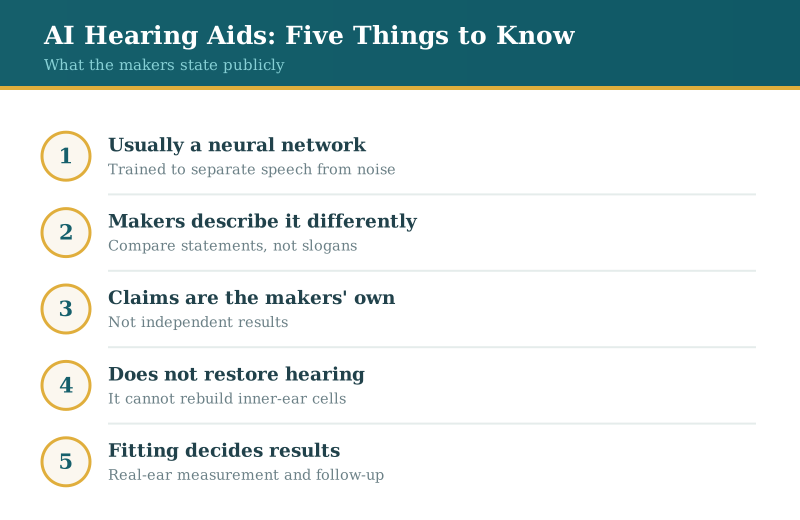
- In current flagship hearing aids, the AI is usually a deep neural network trained to separate speech from background noise in real time. The companies describe their versions differently.
- The table below lists only what each company states on its own site or in its own release. The performance claims are the companies' own and are not independent results.
- AI does not restore normal hearing, and it does not replace a careful fitting. Real-ear measurement and follow-up visits shape the result you get.
- When you compare, ask what has been tested independently, what the style and battery options are, whether there is a telecoil, and what follow-up care is included.
What AI means in a hearing aid
A hearing aid takes in sound with microphones, processes it, and plays it through a small speaker in your ear. In older designs, the processing followed rules set by engineers. A deep neural network is different. It is a computer model trained on large numbers of sound examples, so it can learn to tell speech from other sounds. Makers say this lets the hearing aid lift the voices you want and reduce other sound. How well it works depends on the model, the chip, the training and, above all, how the device is set for your hearing. Some products described as AI use simpler automatic features instead of a neural network, which is why we suggest asking exactly what is meant.
What each company states publicly
The table lists statements from the manufacturer's own site or release, with the date or source. These are claims, not test results. We did not add availability or price where the source does not give one, and none of the companies we read states a US price in the material we reviewed. For Fortell, the company site states little about the technology, so the table says that.
| Platform | What the maker states about its AI | What the maker states about availability |
|---|---|---|
| Phonak Audéo Sphere Infinio | DEEPSONIC, a dedicated AI chip described as separating speech from noise. Claims footnoted to Phonak and Sonova studies. | Not stated on the page we read |
| Phonak EON | HYPERSONIC chip. Spheric Speech Clarity 3.0 uses deep neural network processing to separate speech from background noise in real time. | Available to order by licensed hearing care professionals in the US from August 24, 2026 |
| Oticon Reveal | Dual AI: Speech AI enhances speech, Context AI balances surrounding sounds. Always on, in real time. | Release of August 12, 2026 says it launches that day. No date or price given. |
| Signia Pure Charge&Go MaX | Four deep neural networks: Speech Detection, Own Voice Detection, Scene Analysis, Noise Processing. | Launched August 24, 2026 in the US, Germany and the Nordics |
| ReSound Sensia | DNN noise reduction with AcoustIQ environment classification and a four-microphone beamformer, to lift the speech the wearer faces. | Available in the US from August 20, 2026 |
| Fortell | Site states AI hearing aids for adults, prescription use, US only. Technology is not explained on the site. | Site lists offices including Palo Alto and San Francisco. No price stated. |
Phonak: Audéo Infinio and EON
Phonak's page for the Audéo Sphere Infinio describes DEEPSONIC as a dedicated AI chip, expanded as Deep Sound Optimized Neural Integrated Chip, for separating speech from noise. Its claims carry footnotes to Phonak and Sonova studies, and one figure is limited to a quiet listening situation in adults with moderate to severe hearing loss. The newer EON, announced in a Sonova release dated August 24, 2026, runs on a chip called HYPERSONIC. Phonak says its Spheric Speech Clarity 3.0 uses deep neural network processing to separate speech from background noise in real time, and that users are twice as likely to understand every word from any direction. The footnote says that comparison is against the same settings without that feature, from a 2024 Phonak field study. It is not a comparison against other brands.
Oticon Reveal
Oticon's release, dated August 12, 2026, describes Dual AI. Speech AI identifies and enhances speech from people around you, and Context AI recognizes and balances the surrounding sounds. Oticon says both are always on, in all listening environments, in real time. The performance claims in the release cite Oticon's own references or internal documents. We read the same figures when we wrote our Oticon Reveal page, and we keep to what we said there: no independent laboratory has published results, and Oticon has not given a US price. If you are choosing between Oticon models, our Reveal vs Intent comparison sets out the differences.
Signia Pure Charge&Go MaX
Signia's release, dated August 24, 2026, calls MaX a platform with four deep neural networks, under the name Acoustic Intelligence. It lists them as Speech Detection, Own Voice Detection, Scene Analysis and Noise Processing, and says they share information as one system. Signia states that the first device, Pure Charge&Go MaX, is a receiver-in-canal model with Bluetooth Classic, LE Audio, telecoil and Auracast, and that it launched on August 24, 2026 in the United States, Germany and the Nordics. Its processing-power and efficiency figures are Signia's own comparisons with earlier chips. See also our Signia MaX page and MaX vs Oticon Reveal.
ReSound Sensia
ReSound's release, dated August 10, 2026, says Sensia is built on a new AI platform and uses deep neural network noise reduction. It describes three parts working together: AcoustIQ, which classifies the sound environment, a four-microphone directional beamformer, and DNN denoising. ReSound says the aim is to lift the speech the wearer wants to focus on, which the wearer chooses by facing the speaker, rather than the loudest voice. The release says Sensia was available in the US from August 20, 2026. Some of its claims, including battery life and efficiency, appear without a footnote in the release. Our Reveal vs ReSound Sensia page goes further.
Fortell
Fortell sells AI hearing aids for prescription use by adults, in the United States only, according to its site. The site says the aids are clinically proven, and says they earned record scores at HearAdvisor, an independent lab; the chart on the site is dated September 15, 2026. It does not explain how the technology works and does not state a price. It lists offices in Boston, Greenwich, New York, Palm Beach, Palo Alto and San Francisco, with a banner saying it is now serving Boston, the Bay Area and Greenwich. Hearing Health Matters reported earlier that Fortell sells through its own clinics rather than independent audiologists, and described source separation and four listening modes. We cover what we know in our Fortell page. If you are in the Bay Area and are weighing it, ask about follow-up care, because that is where a company-run clinic and an independent practice differ.
What AI does not do
AI does not restore normal hearing. Hearing loss usually involves damage to the inner ear, and a hearing aid can make sound audible and clearer but cannot rebuild what was lost. It does not remove all noise, and it cannot know for certain which voice you want. ReSound, for example, says you choose the voice by facing it, and a guess based on where you face can be wrong. AI also does not make a fitting unnecessary. A device set from your hearing test alone, without checking in your ear, can fall short of what its specification suggests. And none of the sources we read states that its aid stops hearing loss from progressing or lowers any health risk. Read our page on hearing aids and dementia if that question brought you here.
Why fitting and follow-up decide results
Every hearing is different, and so is every ear canal. A good fitting begins with a full hearing test, then uses real-ear measurement to check the sound reaching your eardrum against targets set for your loss. Follow-up visits let us adjust as your brain adapts. These steps are described in our page on hearing aid fitting. A newer platform that was never verified can do worse than an older one that was. If you already have a quote from somewhere else, our second opinion visit reviews it with you.
How to compare: questions to ask
These questions help with any brand, and none assumes an answer. Is the AI a neural network on its own chip, or automatic adjustment? Which claims were tested by someone other than the maker, and where is that published? What styles and battery options exist for my hearing loss and my hands? Does it have a telecoil, if I use loops in a theater or place of worship? Which phone and Auracast features work today, and which are promised later? What does the price include: fitting, follow-up, repairs, a trial period and what happens if I return it? If a company cannot answer, that is information. Our guide to hearing aid cost explains what usually sits behind a price.
Last updated and sources
Last updated October 16, 2026. What changed: this is the first version. We will revise it when independent results or company statements change. Sources: Phonak, Audéo Sphere Infinio, Sonova, Phonak EON media release, August 24, 2026, Oticon, Introducing Oticon Reveal, release of August 12, 2026, Signia, Introduces MaX powered by Acoustic Intelligence, release of August 24, 2026, ReSound, Sensia press release, August 10, 2026, Fortell, and Hearing Health Matters, Inside Fortell's push into the prescription hearing aid market. We could not open Oticon's own product page, so the Oticon statements come from its release as distributed by a news wire. The Signia release is reproduced on a news site.
Medical information notice
This page offers general information. It is not a diagnosis or treatment plan, and it does not recommend a brand. A full hearing evaluation usually takes about an hour. Call 650-342-9449 to book at our San Mateo office, 88 N. San Mateo Drive, or our San Carlos office, 1008 Laurel Street.
Frequently asked questions
Questions patients ask us
What does AI do in a hearing aid?
In current flagship models it is usually a deep neural network trained to pick out speech from other sound. The aid then lifts speech and reduces what the model treats as noise. Each maker describes its own version differently, and most performance figures come from the makers.
Do AI hearing aids restore normal hearing?
No. They can make speech clearer and easier to follow, but they cannot rebuild damaged inner-ear cells. Results depend on your type and degree of hearing loss and on how well the device is fitted.
Which AI hearing aid is best?
We do not rank them. Independent test results exist for some models and not for others, and a hearing aid has to suit your hearing, your ears and your daily life. A hearing test and a fitting with real-ear measurement tell you more than a brand name.
Is Fortell the same as the other AI hearing aids?
Fortell sells through its own clinics and says its aids use source separation. Its site does not explain the technology. Our Fortell page explains what we know.
Do AI hearing aids still need adjusting?
Yes. Real-ear measurement checks the sound at your eardrum against targets for your loss, and follow-up visits fine-tune it as you adapt. An unverified premium device can underperform a verified simpler one.
What should I ask before buying an AI hearing aid?
Ask what the AI actually is, which claims were tested independently, what styles and batteries are offered, whether there is a telecoil, and what follow-up and trial terms are included. Get the answers in writing.