


Hearing Aid Technology
It also arrived on the same morning as Signia's new flagship, which is not something that happens often. Two of the biggest manufacturers in hearing released their best work within hours of each other, and the trade press has spent the day republishing both press releases.
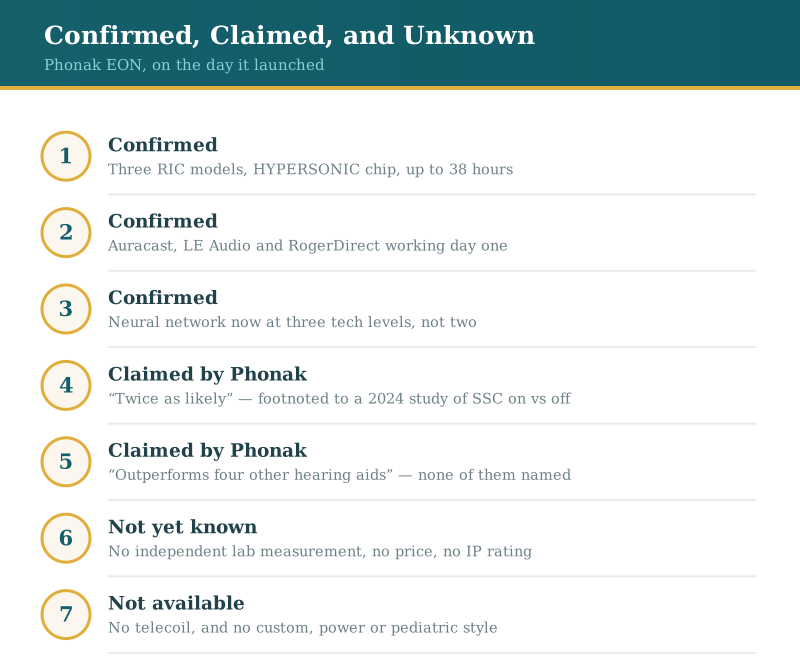
We followed the footnote behind the number every article is quoting today. It leads to a Phonak study published in 2024, on the platform EON replaces, measuring that platform's neural network against the same feature switched off. Reading the footnotes took an afternoon and turned out to be the most useful part of the launch. Every other performance figure attached to EON also comes from a document Phonak wrote, nobody independent has measured it, and no price exists. We fit Phonak at both our offices and have done for years.
Here is the honest version: what is confirmed, what is claimed and by whom, what nobody knows, and who we think should and should not be interested. The full specification page is at Phonak EON.
At a glance
- EON launched August 24, 2026 in three rechargeable receiver-in-canal models, built around a new chip Phonak calls HYPERSONIC.
- The most quoted claim, twice as likely to understand every word from any direction, is footnoted to a 2024 study of the previous platform's neural network, measured against the same feature switched off.
- Phonak is not claiming EON understands speech in noise better than Infinio Ultra. The gains it does claim are size, weight, efficiency, Auracast and reach down the price list.
- Auracast, LE Audio, Bluetooth Classic and RogerDirect all work from day one. There is no telecoil on any EON model, and no custom, power or pediatric style yet.
The idea, in one paragraph
Phonak's previous flagship carried two chips: a main processor and a dedicated coprocessor called DEEPSONIC that did nothing but run a neural network separating speech from noise. It worked, and it cost power and space to do. EON replaces both with a single new chip called HYPERSONIC, and the argument is efficiency rather than raw capability. It runs the same kind of real-time neural processing in a device Phonak says is 25% smaller, 20% lighter, and drawing 37% less power. Notice what that is not. It is not a claim to hear better than the last one. It is a claim to do the same difficult thing more cheaply, in a smaller shell, and far enough down the price list that Phonak could put the neural network at three technology levels instead of two. That last part has real consequences. For a practice that fits a lot of people who cannot justify a top-tier device, that is the most significant thing in the entire launch.
The claim everyone is quoting, and what it actually says
Every article about EON published today contains the line that wearers are twice as likely to understand every word from any direction. It is the headline number, and it appears in Sonova's press release with a footnote marker attached. We followed the footnote. It leads to a Phonak Field Study News by Wright and colleagues, published in 2024. It is a study of Spheric Speech Clarity, the previous generation of the feature, on the previous platform. The footnote also defines the comparison, and it is worth quoting the sense of it exactly: hearing aids using Spheric Speech Clarity, against the same hearing aids with the same settings and the feature switched off. So the claim is real and it is honestly footnoted. It is just not a claim about EON. It is a two-year-old finding that Phonak's neural network beats the same hearing aid with the neural network disabled, which was not seriously in doubt. It is not a comparison against Infinio Ultra, not a comparison against another manufacturer, and not a comparison against whatever you are wearing right now. If you already wear an Infinio Sphere, that footnote describes a benefit you have had since 2024.
The other numbers, and where they come from
Phonak states that the Audéo EON Sphere outperforms four other hearing aids for clear speech in loud noise. That cites Ulloa Sanchez and colleagues, 2026, published as a Phonak Insight, the company's own in-house series, not a peer-reviewed journal. The four competitors are never named and no protocol is given. Phonak states that WindBlock 2.0 reduces wind noise by up to 50 dB and can improve the signal-to-noise ratio by up to 30 dB; the footnote defines the comparison as WindBlock 2.0 switched off, and the supporting preference study ran with nineteen experienced wearers. The size, weight and power figures are footnoted as comparisons against Infinio Ultra and the previous Sphere generation. Those are baselines rather than studies, which is the correct way to state an engineering specification. And one footnote on Phonak's own product page says simply that a claim rests on Sonova internal data, and invites you to email the company if you want to know more. None of this makes Phonak wrong, and we want to be clear about that. Internal validation and bench measurement are how hearing aids get built, and Phonak's research group is a serious one that publishes more than most. It does mean nobody outside Sonova has checked any of it, and that the numbers doing the most persuasive work describe silicon rather than what you will hear across a restaurant table.
What is genuinely confirmed
The hardware is clear and it is good. Three models, all receiver-in-canal and all rechargeable, fitted from mild through profound loss, with a CROS version for single-sided hearing. Up to 38 hours of battery on a charge, with an honest footnote that runtime depends on your loss, your environment and how much you stream. Early hands-on reports put a heavy day with around eight hours of streaming at roughly 22 hours. Two chargers, one of them portable with a battery of its own. Eight colours. Receivers in the standard S, M, P and UP powers plus a MAV option. Connectivity is where EON is strongest: Bluetooth Classic, LE Audio, RogerDirect and Auracast in one device, with Auracast working from launch day. You join a broadcast by scanning a QR code in the myPhonak app. On the fitting side, Phonak Target 12.0 brings a new prescription approach and adds support for the NAL-NL3 formula, and an updated feedback test gives us more headroom before whistling limits how much gain we can give you. The United States got EON on announcement day; Germany, France, the UK and Australia follow in September.
The caveat nobody is printing
Read the launch material carefully and something becomes visible that no coverage has mentioned: Phonak is not claiming a step change in speech understanding over the platform it is replacing. In the single area where the company has spent two years building a genuine competitive lead, the language is careful and the comparisons are all against the feature switched off rather than against Infinio Ultra. That is not a criticism. It is arguably a sign of a company being disciplined about what it can support. But it changes the upgrade question completely. If you are wearing verified Infinio Sphere hearing aids, the case for moving to EON is a case about a smaller, lighter device with Auracast, not a case about hearing better. We would rather you knew that before somebody sold you the upgrade.
What nobody knows yet
No independent laboratory has measured Phonak EON. HearAdvisor has published nothing, and neither has anyone else; testing is reportedly under way, and based on previous launches the results will take months rather than weeks. Phonak has not published a price at any technology level. It has not stated an IP rating for dust and moisture in the launch materials. And it has not mentioned tinnitus anywhere, which is odd given that the Tinnitus Balance noise generator has been standard across the Audéo line for years. We expect it carries forward and we are not going to promise it until we have opened the fitting software. We will update this page when we have.
The limitation most coverage leaves out
Every EON is a receiver-in-canal device. There is no custom in-the-ear model, no powerful behind-the-ear instrument, no pediatric model, and no titanium in-the-canal shell on the platform. Those all remain on Infinio, Lumity and Paradise, which Phonak still sells. And there is no telecoil, on any EON, which is not new for the Audéo line but is worth stating plainly, because a great many theatres, houses of worship and civic buildings around San Mateo County still broadcast through hearing loops rather than Auracast. Meanwhile the platform being replaced has something EON will not have for months: HearAdvisor gave the Phonak Sphere Infinio Ultra an A grade and a SoundScore of 4.9 out of 5, second in its category among the 36 prescription hearing aids the lab has tested. Phonak has not discontinued it either. Infinio Ultra R, Infinio Ultra Sphere, Virto R Infinio and CROS Infinio are all still catalogued alongside EON.
The number that matters more than any of this
Buried in that same HearAdvisor report is the most useful figure we have read all year. Measured at Phonak's own initial-fit settings, the Sphere Infinio Ultra scored 3.1 out of 5 for speech in noise. Measured again after being properly tuned, the same device on the same bench scored 5.0. The average across all 36 prescription hearing aids the lab has tested is 1.96. In other words, the difference between an out-of-the-box fitting and an adjusted one was larger than the entire gap between an average hearing aid and a good one, and the only variable was whether somebody had done the work. That is what real-ear measurement is for, and it is why we are unenthusiastic about upgrade conversations with people whose current hearing aids were never verified. Fix that first. It is cheaper and it will do more.
Who should be interested, and who should not
If you are wearing hearing aids from the Lumity generation or earlier, moving to a current platform will make a real difference, though that argues just as well for a discounted Infinio Ultra as for EON. If you hear from one side only, EON is the flagship that launched with a CROS option and Signia's did not. If Auracast matters to you specifically, EON has it working now. If a Roger microphone would change your working life, with meetings, lectures and loud restaurants every week, that has always pointed to Phonak and still does. If the size or weight of your current hearing aids is why you do not wear them consistently, a quarter smaller and a fifth lighter is a real difference, and consistent wear predicts outcome better than almost anything we can measure. But if you are wearing verified, working Infinio Sphere hearing aids, we would not move you, and we will say so in the appointment. And if you need a custom or power fitting, EON cannot do it yet.
What we are doing about it locally
We will have EON in the fitting software and available to demonstrate at our San Mateo and San Carlos offices, and we are glad to set it up next to Phonak Infinio, or next to Signia's new flagship, which landed the same day and which we compare on our EON versus Signia MaX page. We can do that in a single appointment, in a noisy room rather than a quiet booth. It takes about thirty minutes and costs nothing. We will also update this page as real information arrives: pricing, the IP rating, tinnitus confirmation, and independent measurements when a laboratory finally publishes them. Call 650-342-9449 or request an appointment. EON was one of five AI flagships launched in about seven weeks, and our Signia MaX page tabulates them. Phonak also announced Roger On Sphere, an AI remote microphone, on October 14, 2026. See our Roger On Sphere explainer.
Frequently asked questions
Questions patients ask us
When did Phonak EON launch?
Phonak announced EON on August 24, 2026 and released it in the United States the same day. Germany, France, the UK and Australia follow in September 2026. Availability at any particular practice depends on stock and fitting software updates. Call us at 650-342-9449 and we will tell you exactly where we are.
What is the HYPERSONIC chip?
It is the new processor at the centre of EON, replacing the two-chip arrangement Phonak used on the Infinio Sphere. Phonak's claim for it is efficiency rather than raw power: the same real-time neural-network speech processing while drawing 37% less power, which is what allows the device to be 25% smaller and 20% lighter and the feature to run at a third technology level.
Does Phonak EON have a telecoil?
No, and no EON model does. Phonak's Audéo line has not offered one for several years. EON does support Auracast, which is intended to replace loop systems eventually and which works on EON today, but most looped venues are still loops. If a particular theatre, lecture hall or place of worship matters to you, tell us which one and we will find out what it actually broadcasts before you choose.
Has Phonak EON been independently tested?
Not as of late August 2026. HearAdvisor has published nothing on it and neither has any other independent party; testing is reportedly under way. Every figure currently in circulation comes from Phonak's own Field Study News and Insight documents. The platform EON replaces has been measured and scored very well: an A grade and 4.9 out of 5.
Should I upgrade from Phonak Infinio to EON?
For most people, no. At least not for sound quality, because Phonak is not claiming EON understands speech in noise better than Infinio Ultra. Upgrade if Auracast, or a noticeably smaller and lighter device, is what you want. We go through it properly on our EON versus Infinio page, and we would rather verify the hearing aids you own than sell you a replacement for them.
Can I get EON in a custom in-the-ear style?
Not yet. All three EON models are receiver-in-canal. Phonak's custom devices, including the rechargeable Virto R Infinio and the titanium in-the-canal shells, remain on the Infinio platform, and the power behind-the-ear and pediatric instruments sit on Infinio, Lumity and Paradise. For patients who need those, the older platforms are the right answer rather than a compromise.