


Hearing Aid Technology
Signia announced MaX, short for Multi-adaptive Xperience, on August 24, 2026, and released it in the United States the same day. It is the company's new flagship, taking over from Signia IX, and it arrived with a specific and unusual pitch: not one artificial intelligence but four, each trained on a different part of the problem, running together.
Signia's own launch footnote says full Auracast does not switch on until a firmware update due by March 2027, and the feature lists we have read today print Auracast without that qualification. The rest of the launch material runs the same way. The performance numbers Signia publishes come from its own white papers, and the platform launched in one style out of the dozen Signia makes. When we first wrote this page, no independent lab had measured MaX and no price had appeared. HearAdvisor has since scored the top tier, and HearingTracker lists prices, as the update below explains. None of this means MaX is a bad device. It means the evidence base is still thin, and you deserve to know that before you make a decision costing thousands of dollars. We fit Signia at both our offices and have done for years.
So here is the honest version: what is confirmed, what is claimed and by whom, what remains unknown, and who we think should and should not be interested. The full specification page lives at Signia MaX.
At a glance
- MaX runs four deep neural networks, for speech detection, own-voice detection, scene analysis and noise processing, coordinated as one system Signia calls Acoustic Intelligence.
- Signia's own figures come from unpublished white papers or a chip comparison against Signia IX. HearAdvisor has scored the top MaX 7 tier at 4.3 out of 5, with a SoundGrade of A, according to HearingTracker.
- Telecoil, Bluetooth Classic, LE Audio and Auracast are all in the standard device, but full Auracast is not enabled until a firmware update due by March 2027.
- It launched in one style. Signia IX still covers custom, instant-fit, slim, behind-the-ear and CROS fittings, and unlike MaX it has independent laboratory scores.
The idea, in one paragraph
Almost every hearing aid advertising artificial intelligence runs a single neural network trained to do one job: separate speech from noise. Signia's position with MaX is that one network is being asked to make too many decisions at once. Is this a conversation or background chatter? Is the voice it just found yours or somebody else's? Did the room change? A network optimised for noise reduction does not necessarily know, and when it guesses wrong it does the wrong helpful thing. It mutes a restaurant while you are trying to hear across the table, or ducks your own voice as you speak. So MaX splits the work across four purpose-trained networks and coordinates them. Signia calls the result Acoustic Intelligence. It is a genuine architectural position rather than marketing dressing, and it is different from the bet Oticon made two weeks earlier with Reveal, which runs two AI systems with deliberately opposing goals. We compare the two on our MaX versus Reveal page.
The claims, and where they come from
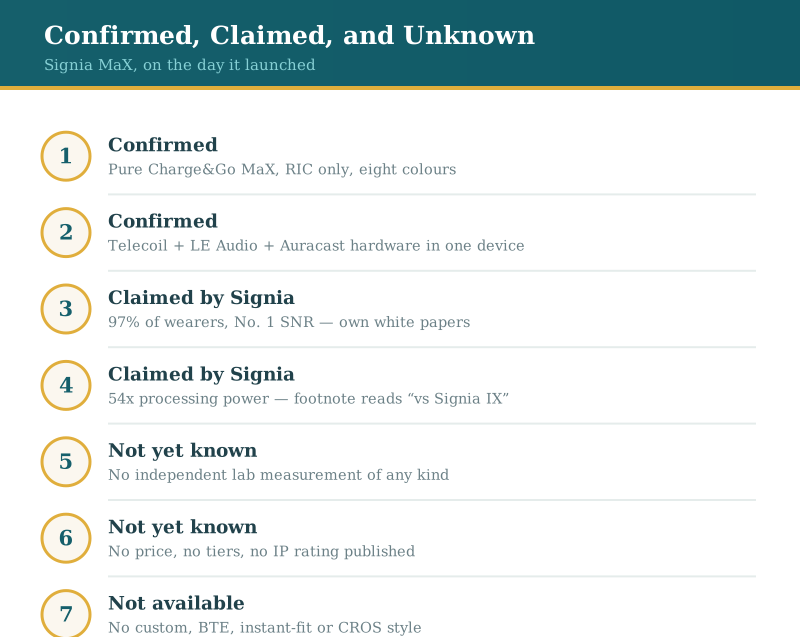
Signia reports that 97% of wearers perform better with MaX in noisy group conversations than with key competitors, and that MaX ranks first in signal-to-noise ratio performance in group conversation in noise. Both figures cite white papers by Jensen and colleagues, dated 2026. We went looking for those papers. They are Signia's own documents, not peer-reviewed publications, and they are not available to read anywhere we can find. The competitors are never named. The sample size, the test protocol and the outcome measure are not disclosed. Then there are the chip figures: 54 times more processing power, 50% greater energy efficiency, twice the memory. The footnote attached to that sentence reads, in full, "Compared to Signia IX." That is not a citation. It is a baseline. And the claim that RealTime Conversation Enhancement now processes 75% more data points per second than IX carries no footnote at all. None of this makes Signia wrong. Internal validation and bench measurement are how hearing aids get engineered, and Signia's research group has a long and serious record. It does mean nobody outside the company has checked, and that the most impressive-sounding numbers describe silicon rather than what you will hear in a restaurant.
What is actually confirmed
The hardware picture is clear. MaX launched with one model, the Pure Charge&Go MaX, a rechargeable receiver-in-canal device in eight colours, in the United States, Germany and the Nordic markets on August 24, with most remaining markets following later in 2026. The UK and Ireland followed on September 4, and Signia held a US launch event for hearing care professionals at COSM Dallas on September 18. The pocket-sized charger holds up to four full charges, takes four hours to fill a device, and returns about six hours of use from a thirty-minute top-up. Connectivity is the genuine standout. Signia calls it OneConnect, and it puts Bluetooth Classic, Bluetooth LE Audio, a telecoil and Auracast hardware into a single device. That matters more than it sounds: on Signia IX, wanting a telecoil meant choosing a particular variant, so a patient who needed loop access in a theatre or place of worship gave something up to get it. On MaX there is no such trade-off. Own Voice Processing has also dropped the in-clinic calibration step IX required, so the device gets your own voice right from the moment it goes on. Signia says its own-voice AI was trained on 1.5 million voice samples, which is a company claim. Reported battery life differs by source: Signia's UK launch material cites up to 28 hours including five hours of streaming, and HearingTracker lists around 30 hours per charge.
The Auracast caveat nobody is printing
Auracast is on every MaX feature list, and the hardware is there, but it does not fully work yet. Signia's own launch footnote states that full Auracast functionality arrives in a firmware update by March 2027. Until then MaX is Auracast-ready rather than Auracast-capable. We flag it because broadcast audio is being marketed hard across the entire industry right now and very few people are distinguishing between hardware that supports it and hardware on which it currently functions. If receiving audio directly in a public venue is a reason you are buying, ask about it by name. For MaX the honest answer today is "soon, and the telecoil covers most venues in the meantime". That is a reasonable answer, but it is not the same as yes.
What is now known, and what still is not
When MaX launched, no independent laboratory had measured it. That has changed in part. HearingTracker's listing shows a HearAdvisor SoundScore of 4.3 out of 5 and a SoundGrade of A for the top MaX 7 tier, with an Expert Choice award. The same listing shows speech in noise at 2.1 out of 5 with the first fit and 2.8 out of 5 after professional tuning, which it says is above the prescription category average. Those are good numbers, and they belong to the top tier only. HearingTracker says MaX 5 and MaX 3 have not been rated separately. A bench score still says little about your ears, and results for AI flagships vary: the original Widex Allure has no neural network in its sound path at all (the newer Allure AI RIC adds an AI co-processor, per Widex) and still outscores several AI flagships on the bench. Price has moved too. We have not seen Signia publish one, but HearingTracker lists MaX 7 from $3,298 a pair, MaX 5 from $2,798 and MaX 3 from $2,698, and notes that prices vary by provider and by included services. Ask us for a real quote, because what we charge depends on your fitting. HearingTracker also describes the tiers: MaX 7 has three Dynamic AI Focus Streams and 48 processing channels, MaX 5 has one focus stream and 36 channels, and MaX 3 has 32 channels and one HD Music program. Still unconfirmed: a fitting range and receiver power options, an IP rating for dust and moisture, and whether tinnitus therapy carries over from IX, since no launch material mentions it. There is also a naming inconsistency in Signia's own materials about which app controls the device.
The limitation most coverage leaves out
MaX exists in one form. There is no custom in-the-ear model, no behind-the-ear model, no Silk instant-fit device, no Styletto, no Motion, and no CROS option on the platform. Signia IX offers every one of those. So if you need a powerful behind-the-ear fitting, a custom device because handling a small receiver is difficult, an instant-fit tip, or a CROS solution for single-sided deafness, IX is not a downgrade. It is the only Signia that can do the job. And IX has a longer independent record: HearAdvisor scored the Pure Charge&Go BCT IX at 4.4 out of 5 and placed the Active Pro IX in the top five percent of everything the laboratory has tested, while only the top MaX 7 tier has a score so far. Signia has not discontinued IX either; it added a new IX model in July 2026, a month before the MaX announcement.
Who should be interested, and who should not
If your hearing aids are five years old or more, moving to a current platform will make a real difference, but that is true of IX as much as MaX, and the choice should turn on style, budget and evidence rather than launch date. If you are buying Signia for the first time, a receiver-in-canal device suits your ears, and you want the newest platform with the longest runway ahead of it, MaX is a reasonable choice provided you are comfortable being early. If group conversation in busy rooms is specifically what defeats you, MaX is aimed hardest at that problem, and that is also the claim with the least independent support, so demonstrate it rather than trust the number. If you are wearing verified, working Signia IX today, we would not move you, and we have set out why on our MaX versus IX page. And if what you want is the best measured performance available, we cannot tell you it is MaX. Its one independent score, 4.3 out of 5 for the top tier, is strong but sits just below the 4.4 HearAdvisor gave the Pure Charge&Go BCT IX.
Five AI flagships in seven weeks, plus Widex
MaX did not launch alone. Between August 10 and October 1, 2026, ReSound, Oticon, Phonak, Signia and Starkey each introduced a new flagship built around neural networks, about seven weeks in all. Widex is in the table too, but it belongs outside that window: Widex announced its Allure AI RIC on May 20, 2026, and says the full US launch is November 1, 2026. The table lists them as the companies describe them. The number of networks tells you little about how a device sounds, so read it as a description, not a score. For the others, see our pages on Oticon Reveal, Phonak EON, ReSound and Starkey, and for the idea behind them our explainer on dual AI in hearing aids. Our sister practice, Audiology Associates of Westchester, compares these six makers in its six-maker guide to the new AI hearing aids of fall 2026 and covers Signia MaX too. Widex takes an on-demand route with Clarity Boost. See Widex Allure AI RIC with Clarity Boost.
| Announced | AI approach (company descriptions) | Auracast | |
|---|---|---|---|
| ReSound Sensia | Aug 10 (US from Aug 20) | DNN noise reduction plus a four-microphone beamformer, automatic on the top level | Working at launch, per HearingTracker |
| Oticon Reveal | Aug 12 (orderable Aug 24) | Dual AI: Speech AI and Context AI | Supported |
| Phonak EON | Aug 24 (US orders from Aug 24) | DNN speech separation plus AI that reads the environment | Supported at launch |
| Signia MaX | Aug 24 (US, Germany, Nordics) | Four DNNs: speech, own voice, scene and noise | Hardware ready. Full function by a firmware update due by March 2027, per Signia |
| Starkey Omega AI+ | Oct 1 | Quad DNN architecture and a DNN dual compressor | Supported. Rollout details not given |
| Widex Allure AI RIC | May 20 (before the window; full US launch Nov 1, per Widex) | Widex says an AI co-processor (Clarity Boost) runs an audio-specific neural network, with up to 6 dB better output SNR than AI-denoising competitors. Widex's own claim | Sources differ: Widex lists LE Audio, Hearing Health Matters says Auracast-ready, HearingTracker says no Auracast |
What we are doing about it locally
We will have MaX in the fitting software and available to demonstrate at our San Mateo and San Carlos offices, and we are happy to set it up next to Signia IX, or next to whatever you are wearing now, in the same appointment, in a noisy environment rather than a quiet booth. We do not recommend one brand over another up front. After your hearing test, and once we understand your situation and needs, your audiologist works out which device serves you best, and that may not be a Signia. A demonstration takes about thirty minutes, costs nothing, and settles the question better than any specification comparison. We will keep updating this page and our specification page: tinnitus feature confirmation, our own pricing once we can stand behind it, and scores for the MaX 5 and MaX 3 tiers if a laboratory publishes them. Call 650-342-9449 or request an appointment.
Last updated and sources
Last updated October 8, 2026. What changed: we added HearAdvisor's score for MaX 7, the tier details and listed prices from HearingTracker, the UK and US launch timeline, own-voice and battery details labeled as reported, and the flagship table, now with Widex. Sources: Signia press release via Business Wire, Audiology Worldnews, ENT & Audiology News, Hearing Health Matters on the COSM Dallas launch, HearingTracker listing for MaX, HearingTracker on ReSound Sensia, Hearing Health Matters on Oticon Reveal, Hearing Review on Phonak EON Hearing Health Matters on Starkey Omega AI+, Widex release via AudiologyOnline and Hearing Health Matters on Widex Allure AI. Prices and scores are third-party listings, not Signia's, and may change.
Frequently asked questions
What patients often want to know
What does Signia MaX stand for?
Multi-adaptive Xperience. It follows Signia's naming convention: IX was Integrated Xperience, AX was Augmented Xperience. MaX is the 2026 generation and sits above IX as the new flagship.
When is Signia MaX available?
Signia announced MaX on August 24, 2026 and released it in the United States, Germany and the Nordic markets that day, the UK and Ireland followed on September 4, and most remaining markets come later in 2026. Availability at any particular practice depends on stock and fitting software updates. Call us at 650-342-9449 and we will tell you where we actually are.
Has anyone independently tested Signia MaX?
In part: HearingTracker's listing shows a HearAdvisor SoundScore of 4.3 out of 5 and a SoundGrade of A for the top MaX 7 tier only, and MaX 5 and MaX 3 have not been rated separately. Signia's own figures still come from its own white papers, and Signia IX has a longer independent record.
What styles does Signia MaX come in?
One at launch: the rechargeable Pure Charge&Go MaX, a receiver-in-canal device offered in eight colours. There is no custom in-the-ear, behind-the-ear, instant-fit, slim or CROS version on the platform yet. Signia IX covers all of those.
Does Signia MaX support Auracast?
The hardware does, alongside Bluetooth Classic, LE Audio and a telecoil in what Signia calls OneConnect. But full Auracast functionality is not switched on until a firmware update Signia has scheduled for March 2027. The telecoil works today and covers most looped venues in the meantime.
Is Signia IX discontinued now?
No. Signia still catalogues the full IX family alongside MaX and released a new IX model, the Active Mini IX, in July 2026. Firmware, repairs, accessories and fitting support all continue.
Should I wait for Signia MaX or buy now?
If you are struggling to hear now, the benefit of being fitted and verified properly today almost certainly outweighs waiting for a platform whose real-world performance is still only partly measured. If you are comfortable with your current hearing aids, there is no urgency. We are happy to talk it through without pressure at either office.