


New Hearing Technology
Below, we explain what Phonak says it does, where the numbers come from and what nobody has measured yet. Phonak plans release in most markets in mid-November 2026. It has given no US date and no price, so we cannot book you for one today. This page is accurate as of October 14, 2026.
At a glance
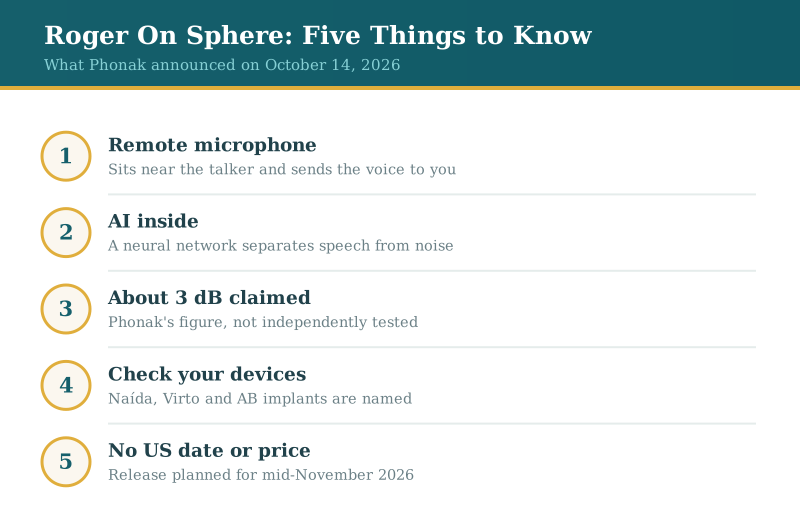
- Roger On Sphere is a remote microphone. You place it near the person you want to hear, and it sends that voice to your hearing devices.
- Phonak says it is the first remote microphone with a deep neural network (a type of AI) that separates speech from noise in real time.
- Phonak claims about 3 dB more signal-to-noise benefit than the previous Roger On. That figure comes from Phonak's own publication.
- Release is planned for most markets in mid-November 2026. No US date and no price have been announced.
What a remote microphone does
Hearing aids pick up sound where you are. In a loud room, that includes the clatter at your own table. A remote microphone moves the pickup point. You place it near the talker, and it sends their voice to your hearing devices over a wireless link. Roger is Phonak's version of this idea, and Phonak says Roger has helped people in demanding listening situations for nearly two decades. Roger On Sphere is the newest model. It follows the Roger On V3, which came out in August 2024.
What is new: AI inside the microphone
Phonak calls Roger On Sphere the world's first remote microphone powered by a deep neural network (DNN). A DNN is a type of AI trained to tell speech from noise. Phonak says it combines the Sphere technology from its hearing aids with the Roger wireless protocol, and that it analyzes the room all the time. It says the speech-from-noise separation works in every microphone mode and at every noise level. The microphone adapts on its own to meetings, lectures, online calls, restaurants, family gatherings and car journeys, so you do not have to change settings. Phonak calls the software RogerSense OS.
The numbers, and where they come from
Phonak says Roger On Sphere gives an additional 3 dB of signal-to-noise ratio (SNR) benefit over the previous Roger On. Phonak describes 3 dB as about 50% less noise power, which it says allows use in a room with twice the noise. Its footnote says the figure is based on a 3 dB SNR benefit in the typical operating range. The cited source is Roh, Gigandet and Sans (2026), Expand your world, with Roger On Sphere, in Phonak Insight, a Phonak publication. The release gives no test conditions or noise levels, and we found no independent test. Treat the figures as a manufacturer claim until independent data appears.
| Claim | Where it comes from | What is missing |
|---|---|---|
| About 3 dB more SNR benefit than the previous Roger On | Phonak press release; Phonak Insight (Roh, Gigandet, Sans, 2026) | Test conditions, noise levels, independent testing |
| About 50% less noise power; twice the noise | Phonak's translation of 3 dB | Holds only in the typical operating range |
| AI separates speech from noise in every microphone mode | Phonak press release | Technical detail on how the network works |
| Works with Naída, Virto and Advanced Bionics implants | Phonak press release | A list for other hearing aid brands |
| Release in most markets in mid-November 2026 | Phonak press release | A US date and a price |
Who it may help in the Bay Area
Phonak aims it at people with hearing loss who struggle in restaurants, meetings, family gatherings and social events, over distance and in groups, even with well-fitted hearing aids. In the Bay Area that list is familiar: loud restaurants in San Francisco and on the Peninsula, open offices, video calls and long drives. Phonak also names cochlear implant users. A remote microphone is an add-on, not a replacement. It helps most when one voice matters most, such as the person across the table or the speaker at the front of a room. Phonak lists group conversations among its targets, but we have not seen detail on how many talkers it handles at once.
What it works with
Phonak names its own Naída and Virto hearing aids and Advanced Bionics cochlear implant systems as compatible. Sonova says most Phonak and Advanced Bionics users need no extra receiver. We have not seen a compatibility list for other brands, so we cannot tell you yet whether your hearing aids qualify. Bring your current devices to your visit and we will check. The new Advanced Bionics Integro cochlear implant processors connect to Roger On Sphere directly. See our explainer on Advanced Bionics Integro.
Do you still need one if you have AI hearing aids?
It depends on the room and on how far away the talker is. AI in a hearing aid works on the sound that reaches your ears, noise included. A remote microphone works on the sound next to the talker's mouth. Those are different jobs, and they can work together. Our advice: do not buy a remote microphone first. Get a hearing test, learn what your hearing aids already do, then decide. See our guides to what dual AI in hearing aids means and Phonak EON, and our page on Phonak hearing aids.
What we do not know yet
Phonak has not announced a US release date or a price. The release does not state battery life, charging, size, weight or how the microphone is worn. It does not state how far the wireless link reaches. No independent test of the 3 dB figure exists yet. Phonak encourages clinics to demonstrate the device, but we have no demonstration date to give you. We will update this page when Phonak or independent testers publish more.
How California Hearing Center helps
We do not recommend one brand first. We run a hearing test, learn how you live, and then work out which tools fit. For some people that is hearing aids alone. For some it is hearing aids plus a remote microphone. A hearing test visit with counseling takes about an hour. If you choose hearing aids, you get a 45-day trial with no restocking fee. Use the notify box below and we will tell you what we learn about availability. Or request a hearing test at our San Mateo or San Carlos office. You can also read about our hearing aid fitting and our hearing aid second opinion visit.
More from this week's launches
Two other launches landed the same day: the Widex Allure AI RIC with Clarity Boost and the Advanced Bionics Integro cochlear implant processor. Our sister practice in New York looks at Roger On Sphere from the dinner-table side, with questions to ask before buying any remote microphone: Roger On Sphere at Audiology Associates of Westchester.
Status and last update
Last updated October 14, 2026. What changed: this is the first version. We will update this page when Phonak announces US availability and price, or when independent testing appears. Sources: Phonak press release, October 14, 2026 (GlobeNewswire), HearingTracker: Roger On Sphere brings AI speech separation to remote microphones, Hearing Health & Technology Matters: Phonak launches Roger On Sphere, TipRanks: Sonova pushes AI hearing technology beyond aids with new Roger and Integro systems.
Medical information notice
This page offers general information. It is not a diagnosis or treatment plan. Want to know where your hearing stands? A full hearing evaluation usually takes about an hour. Call 650-342-9449 to book at our San Mateo office, 88 N. San Mateo Drive, or our San Carlos office, 1008 Laurel Street.
Get one email when we know more about Roger On Sphere.
We will write once when Phonak announces US availability and price, or if we can offer a demonstration. We will send nothing else.
Frequently asked questions
Questions patients ask us
What is Roger On Sphere?
It is a wireless remote microphone from Phonak that uses AI to separate speech from background noise in real time. Phonak announced it on October 14, 2026.
When can I get Roger On Sphere in the US?
Phonak plans release in most markets in mid-November 2026 and has not given a US date. Use the notify box and we will tell you what we learn.
How much does Roger On Sphere cost?
Phonak has not announced a price. Insurance coverage for hearing accessories varies by plan, so call our office and we will help you check your options.
Will it work with my hearing aids?
Phonak names its Naída and Virto hearing aids and Advanced Bionics cochlear implants. We have not seen a list for other brands. Bring your devices to your visit and we will check.
Is 3 dB a big improvement?
Phonak says it equals about half the noise power, which it says allows twice the noise. That is a company claim for a typical operating range. How much it helps you depends on your hearing and the room, which is why we test with you.
Do I need a hearing test first?
We suggest it. A hearing test shows what your hearing aids can do alone and where a remote microphone might add something. The visit takes about an hour.