


OTC vs Prescription
A 2025 randomized trial gives the best current evidence. It compared audiologist-fitted aids with over-the-counter aids in adults 55 and older with mild to moderate loss. We summarize what it found below, and we say plainly where the trial does not answer your question.
For cost, see what hearing aids cost in 2026. For a practical bay-area view, see hearing aids versus over-the-counter devices.
At a glance
- OTC aids are for adults who perceive mild to moderate loss. They are not for children or for severe loss.
- A 2025 randomized trial found audiologist-fitted aids beat over-the-counter aids on its main measure.
- The same trial found no significant difference between high-end and low-end prescription-level aids.
- A hearing test first tells you which path fits.
- Sudden loss, one-sided loss, pain or dizziness need a medical check before any device.
The two paths side by side
The chart compares the two paths on who they suit, what is included and what to watch for. It is a general guide. Your own hearing test is the final word.
| Question | Over-the-counter | Prescription (fitted) |
|---|---|---|
| Who it is for | Adults who perceive mild to moderate loss | Any degree of loss, any age, including complex cases |
| How you start | Buy and set up yourself, often with an app | A hearing test and a professional fitting |
| Measured in your ear? | Usually not | Yes, when real-ear measurement is used |
| Follow-up | Varies by seller | Visits and adjustments, depending on the provider |
| Best when | Loss is mild, both ears, no red flags, you like to self-adjust | Loss is more than mild, one-sided, or you want support |
| Watch for | Overestimating how mild your loss is | Terms: ask for trial, return and warranty in writing |
What the 2025 trial found
Wu and colleagues ran a randomized trial at two sites, published in JAMA Otolaryngology in 2025. It analyzed 245 adults aged 55 and older with mild to moderate loss and no earlier hearing aid experience. Audiologist-fitted aids beat over-the-counter aids on the main outcome. Separately, high-end aids at about $4,400 a pair and low-end aids at about $1,100 a pair showed no significant difference. In short, the service model mattered more than the technology tier.
What the trial does not tell you
The trial covers adults 55 and older with mild to moderate loss and no earlier experience. It does not cover severe loss, one-sided loss, younger adults or experienced users. It also tested particular devices and service arrangements, so it cannot rank every product. Treat it as strong evidence about the value of support, not as a verdict on every OTC aid.
Who can start with OTC
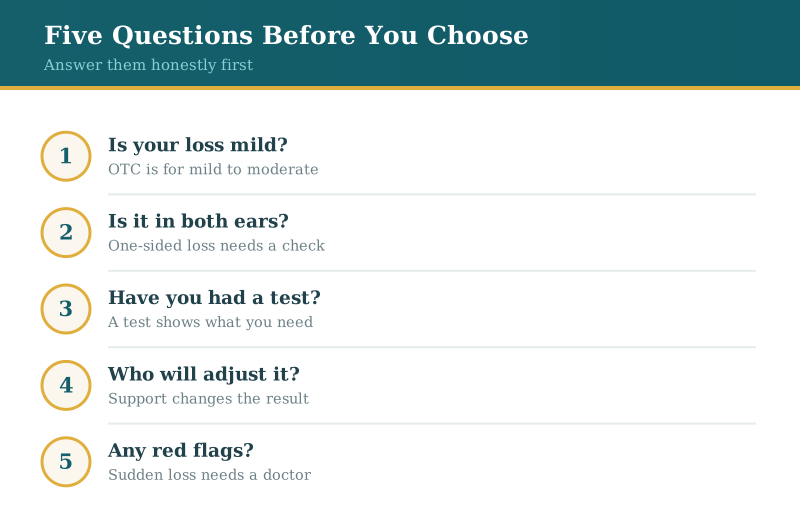
An OTC aid may suit you if you are an adult, you notice mild to moderate difficulty in both ears, you are comfortable with an app and fine adjustment, and you have no red flags. A hearing test first still helps, because it tells you whether your loss really is mild to moderate.
When to see an audiologist first
See a professional before any device if you have sudden loss, loss in one ear only, ear pain, drainage, dizziness, or ringing in one ear. Also see one if your loss seems more than mild, if you have tried OTC aids and they did not help, or if you want verified fitting and follow-up. Our page on signs you need hearing aids lists more.
What you gain with a fitted aid
A professional fitting means a full hearing test, a measurement inside your ear, programming to your results and follow-up visits as your brain adapts. HearAdvisor's lab scored a Phonak flagship 3.1 of 5 for speech in noise at the maker's first fit and 5.0 after tuning, which shows how much the fitting step can change one device. See our fitting process.
Book a visit
Call 650-342-9449 to book at our San Mateo or San Carlos office. A hearing test tells you which path fits.
Last updated and sources
Last updated November 4, 2026. What changed: this is a new guide. Sources: Wu and colleagues, JAMA Otolaryngology 2025 (https://pmc.ncbi.nlm.nih.gov/articles/PMC12082484); HearingTracker on HearAdvisor results.
Medical information
This page gives general information. It is not medical advice. Sudden hearing loss, hearing loss in one ear, ear pain or dizziness need prompt medical care.
Frequently asked questions
Questions patients ask us
Are OTC hearing aids as good as prescription ones?
For adults 55 and older with mild to moderate loss, a 2025 trial found audiologist-fitted aids beat OTC aids on its main measure. OTC aids can still help some people. A hearing test shows which path fits.
Who should not buy OTC hearing aids?
Anyone with sudden loss, loss in one ear, ear pain, drainage, dizziness, or more than mild loss should see a professional first. OTC aids are not for children.
Do I need a hearing test before buying OTC aids?
The rules do not require it, but a test helps. It shows whether your loss really is mild to moderate and rules out medical causes.
Does a more expensive hearing aid work better?
The 2025 trial found no significant difference between high-end and low-end aids. The service around the aid mattered more.
Can you adjust OTC hearing aids?
Call us before you bring one in. We can say what is possible for your device and your needs.
How do I choose?
Start with a hearing test. It tells you the degree and type of loss, and it shows which path suits you.