


Balance & the Inner Ear
Balance is a team effort. Your eyes, the sensors in your muscles and joints, and the vestibular organs of the inner ear all report to the brain, which blends the signals into a steady sense of where you are. When one source sends bad information, often the inner ear, the result can be spinning, swaying, or a lightheaded haze. The National Institute on Deafness and Other Communication Disorders groups these under balance disorders, and several of the most common ones trace back to the same ear that handles hearing.
That overlap is why an audiologist belongs in the conversation. At our San Mateo and San Carlos offices we test how well the hearing and balance systems are working, help rule things in or out, and coordinate with your physician when a symptom points somewhere else. If dizziness has become part of your week, contact our offices and let's find out why.
At a glance
- Dizziness is a broad word — vertigo, lightheadedness, and unsteadiness are different sensations with different causes.
- Many balance problems begin in the inner ear, the same organ responsible for hearing.
- An audiologist can evaluate the hearing and balance systems and coordinate care with your physician.
- Sudden severe symptoms, like new weakness, slurred speech, or sudden hearing loss, need emergency care, not a wait-and-see.
Vertigo, lightheadedness, unsteadiness — not the same thing
It helps to name what you feel. Vertigo is a false sense of motion, usually spinning, as if the room is turning around you. Lightheadedness is the woozy, about-to-faint feeling, often tied to blood pressure or standing up too quickly. Unsteadiness is trouble staying balanced on your feet with no spinning at all. Telling these apart matters, because they point toward different causes, and describing yours precisely gives whoever evaluates you a real head start.
How the inner ear keeps you upright
Tucked beside the hearing organ is the vestibular system, a set of fluid-filled canals and sensors that track the movement and position of your head. When you turn, tip, or nod, that fluid shifts and tells the brain what your head is doing. Because this balance apparatus and the hearing organ share the same neighborhood and the same nerve, a problem in the inner ear can affect both at once. That is why dizziness and hearing changes so often show up together, sometimes alongside the ringing you can read about on our tinnitus pages.
The balance disorders we see most
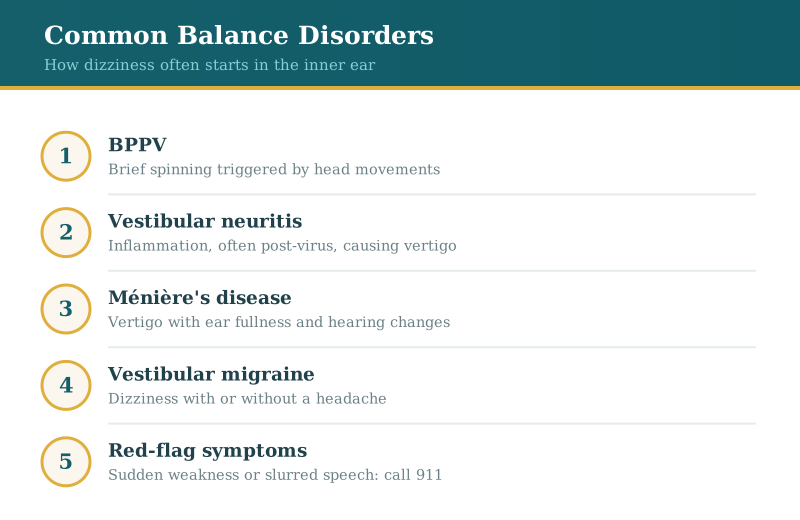
A handful of named conditions account for a large share of inner-ear dizziness. Benign paroxysmal positional vertigo, or BPPV, produces brief, intense spinning triggered by head movements like rolling over or looking up; it comes from tiny crystals drifting out of place inside the ear. Vestibular neuritis and labyrinthitis are inflammations, often following a virus, that can cause days of strong vertigo. Ménière's disease brings episodes of vertigo along with ear fullness, fluctuating hearing, and tinnitus, usually in one ear. Vestibular migraine causes dizziness that may arrive with or without a headache. Figuring out which pattern fits you is the point of an evaluation.
Why an audiologist is part of the balance picture
Because the inner ear does double duty, checking your hearing is a window into the balance system too. An audiologist can measure how each ear is working, look for the signatures of conditions like Ménière's, and perform or arrange vestibular testing that maps how the balance organs respond. Not every dizzy spell is an ear problem — some come from blood pressure, medications, or the brain — so part of the work is recognizing when your symptoms belong with a physician, a neurologist, or an ENT, and pointing you there without delay. For news on a drug being studied for Ménière's disease, see SPI-1005: what the Phase 3 data show.
What an evaluation involves
It starts with your story: when the dizziness hits, how long it lasts, what sets it off, and whether your hearing has changed. From there we check your hearing and, depending on the picture, test how your eyes and inner ear respond to movement. Something as simple as impacted earwax can cause a plugged, off-balance feeling, so we rule out the easy explanations first. The goal is not just a label; it is a clear next step, whether that means a repositioning maneuver, a referral, or a plan to manage symptoms. Our audiologists will walk you through what each result means.
When dizziness is an emergency
Most dizziness is unpleasant rather than dangerous, but some symptoms need care right now. Call 911 or go to an emergency room if dizziness comes with a sudden severe headache, slurred speech, weakness or numbness on one side, double vision, trouble walking, fainting, chest pain, or a sudden loss of hearing in one ear. Those can signal a stroke or another urgent problem, not an inner-ear glitch. Dizziness also raises the risk of falls, so it is worth addressing promptly rather than adapting around it; if you are an older adult, our hearing care for seniors keeps that risk in mind. Once anything urgent is ruled out, a calm evaluation is the right path.
Frequently asked questions
A few questions worth asking
What is the difference between vertigo and dizziness?
Vertigo is a specific false sense of motion, usually the feeling that the room is spinning. Dizziness is a broader term that also covers lightheadedness and unsteadiness. Describing which one you feel, and what triggers it, helps point toward the cause.
Can an ear problem really make me dizzy?
Yes. The inner ear houses the balance organs right beside the hearing organ, so conditions there can cause vertigo, unsteadiness, and often hearing changes at the same time. That is why a hearing and balance evaluation is a sensible starting point.
When should I go to the ER for dizziness?
Seek emergency care if dizziness comes with a sudden severe headache, slurred speech, weakness or numbness on one side, double vision, trouble walking, fainting, chest pain, or sudden hearing loss in one ear. These can signal a stroke and should not wait.
Do I need a referral to be evaluated?
You can start with a hearing evaluation at our San Mateo or San Carlos office. If your symptoms point beyond the ear, we coordinate with your physician or the right specialist so you are not left figuring out the next step alone.