


Hearing & Health Research
This is a research-funding story, not a new treatment. No clinical advice changes because of it. The part that matters for patients now is monitoring: a baseline hearing test and regular follow-up make changes visible while there is still time to act. This page explains the research, the numbers and what you can do.
At California Hearing Center we perform hearing evaluations. We do not give chemotherapy advice, and decisions about cancer treatment belong to your oncology team.
At a glance
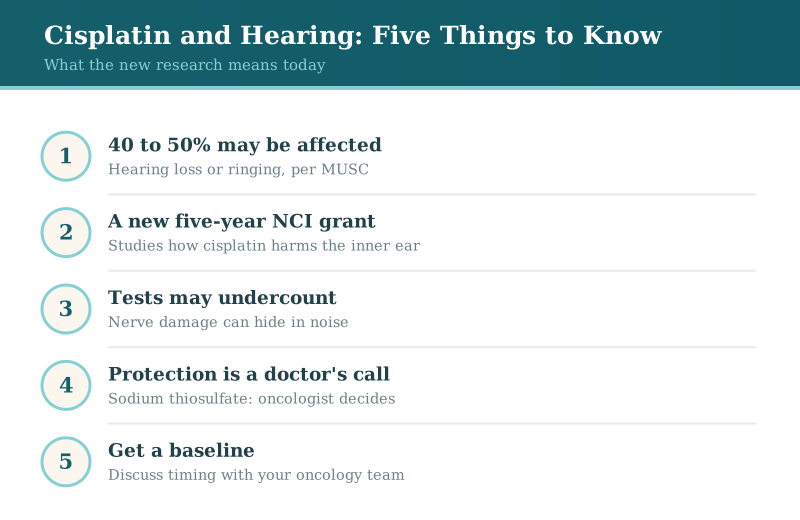
- MUSC Hollings says research suggests 40% to 50% of patients treated with cisplatin experience hearing loss or ringing in the ears. That is a population estimate, not a prediction for one person.
- The new five-year NCI grant studies whether cisplatin harms neurons and other cochlear cells, not only the outer hair cells. It uses mouse models and cell-level gene studies.
- Wilkerson notes the true effect on hearing may go beyond what standard hearing tests show, because nerve damage can make hearing in noise harder.
- Sodium thiosulfate can reduce hearing loss in some patients, but it works by binding cisplatin. Whether to use it is your oncologist's decision.
- A baseline hearing test, plus follow-up, is the practical step. Discuss timing with your oncology team.
The news: a grant to study how cisplatin harms hearing
MUSC Hollings Cancer Center published the story on October 22, 2026. Dr. Wilkerson, an assistant professor of otolaryngology, wants to understand why cisplatin causes hearing loss and why some patients are hit harder than others. His team will test hearing in mice during cisplatin treatment and study gene activity in single cells of the inner ear. The aim, in the researchers' words, is knowledge that could one day lead to better ways to protect hearing without interfering with the drug's ability to fight cancer. This is early-stage science. It does not change how anyone is treated today.
Why cisplatin reaches the ear
Cisplatin can build up in the cochlea, the spiral structure of the inner ear that turns sound into nerve signals. Much past research looked at outer hair cells, which act like an amplifier. Wilkerson's team has seen hearing changes that outer hair cell loss does not fully explain, which suggests that nerve cells and other cells may also be injured. In early studies they found broad changes in gene activity across several healthy cell types after cisplatin.
The 40 to 50 percent figure, and why it may undercount
MUSC says research suggests that 40% to 50% of cisplatin-treated patients experience hearing loss or ringing in the ears. Use that as a general guide, never as a forecast for one person. Wilkerson adds that the real impact may extend beyond what traditional tests capture. A standard hearing test finds the quietest beeps you can detect. Damage to hearing nerves can make conversation in a noisy room harder even when those beeps look close to normal. For that reason, a test that includes understanding speech in noise can add useful information.
| Question | What MUSC reports | What it does not say |
|---|---|---|
| How common is hearing loss or ringing with cisplatin? | Research suggests 40% to 50% of treated patients | How likely it is for any one person |
| What does the new grant study? | Whether cisplatin harms neurons and other cochlear cells, not only outer hair cells | Any treatment that is available now |
| How will it be studied? | Mouse models, hearing measures beyond thresholds, single-nucleus gene profiling | Results in patients |
| Can hearing be protected today? | Sodium thiosulfate can reduce hearing loss in some patients | That anyone should use it. It is an oncologist's decision |
| Do standard hearing tests show everything? | Wilkerson says true impact may go beyond what standard tests capture | A specific alternative test for patients today |
What patients can do now
Ask your oncology team whether a baseline hearing test makes sense before or early in treatment, and when to repeat it. Report new ringing, muffled hearing or trouble in noise promptly rather than waiting for the next visit. After treatment, include hearing in survivorship care. Our page on medications and hearing and our page on aminoglycoside antibiotics and hearing loss cover other drugs that can affect the ear. Read how to read an audiogram before your first test, and learn about tinnitus care if ringing begins.
Hearing checklist for chemotherapy patients
Review these with your oncology team and your audiologist.
- Ask whether a baseline hearing test makes sense before or early in treatment.
- Tell your team about any new ringing, muffled hearing or trouble in noise.
- Plan hearing follow-up as part of survivorship care.
- Never start a supplement or change drug timing without your oncologist.
Protecting hearing without protecting the tumor
MUSC notes that sodium thiosulfate can reduce hearing loss in some patients. The catch is that it works by binding to cisplatin, so it must never reduce the drug's effect on the cancer. That balance is exactly why the new research matters, and why the choice is your oncologist's to make. Do not start any supplement or change the timing of any drug on your own.
When to see a doctor quickly
Sudden hearing loss in one or both ears is a medical urgency. Contact your doctor the same week and tell your oncology team. Read our page on sudden-onset tinnitus for related warning signs.
A note for patients
If you or someone you love is starting cisplatin treatment, hearing deserves a line in the plan. A baseline test now makes every later change visible and treatable. And if treatment is behind you and conversations have gotten harder, that is not something to just live with. Survivor care includes hearing care.
What to do next
Book a comprehensive hearing evaluation at our San Mateo office or our San Carlos office, or call 650-342-9449. Tell us about your treatment when you book, and share the results with your oncology team.
Last updated and sources
Last updated October 28, 2026. What changed: this is the first version. We will update this page if the research produces results that change care. Sources: MUSC Hollings Cancer Center, Amplifying our understanding of chemotherapy-related hearing loss, October 22, 2026, NIDCD ear illustration (public domain).
Medical information notice
This page offers general information about published research. It is not medical advice, and it does not diagnose or recommend treatment. Do not change any cancer treatment, drug or supplement without your oncology team. Call 650-342-9449 to book at our San Mateo office, 88 N. San Mateo Drive, or our San Carlos office, 1008 Laurel Street.
Frequently asked questions
What patients often want to know
Can chemotherapy cause hearing loss?
Yes, some drugs can. MUSC reports that research suggests 40% to 50% of patients treated with cisplatin experience hearing loss or ringing in the ears. Other drugs can also affect hearing.
Is cisplatin hearing loss reversible?
The MUSC story does not say. Loss that comes from damaged inner ear cells is generally permanent. A hearing evaluation can show what you have and what can help.
Should I get a hearing test before chemotherapy?
Discuss baseline testing with your oncology team. California Hearing Center provides the hearing evaluation, and a baseline makes later changes easier to see.
Does hearing protection during chemotherapy exist?
MUSC notes that sodium thiosulfate can reduce hearing loss in some patients. It works by binding cisplatin, so using it is an oncologist's decision, never a self-directed step.
Does this research change how I am treated now?
No. It is a research grant to understand the biology. Wilkerson describes it as an early step toward better protection.