


Hearing Aid Brands
The chart comes first so you can compare the flagships side by side. Every description in it is the company's own, and every lab score names its source. We list no practice prices, because a price depends on your fitting and the services included. We fit all six brands, so we have no reason to push one.
Our pages on each launch go deeper. See Phonak EON, Oticon Reveal, Signia MaX, Starkey Omega AI+ and Widex Allure AI RIC.
At a glance
- All six brands sell a 2026 flagship with neural-network features, and the performance claims are the companies' own.
- A trial in adults 55 and older found no significant outcome difference between high-end and low-end aids, but audiologist-fitted aids beat over-the-counter ones.
- HearAdvisor's lab scored one Phonak flagship 3.1 of 5 at the first fit and 5.0 after tuning, so the fitting matters.
- We rank by use case, never one brand as best overall.
- Brands share owners. Phonak and Unitron belong to Sonova, for example, and Signia, Widex and Rexton belong to WS Audiology.
The six brands at a glance
The chart lists each flagship with the company's own description of its AI, its battery claim, its Auracast and telecoil status and any independent lab score we could find. A blank cell reads Not stated, which means the sources we checked did not give it. Dates come from trade press and company releases as of November 4, 2026.
| Brand and flagship | Parent company | AI approach (company description) | Battery claim | Auracast and telecoil | Independent lab result |
|---|---|---|---|---|---|
| Phonak EON | Sonova | Deep neural network speech separation plus AI that reads the environment | Up to 38 hours; about 22 with heavy streaming | Auracast supported; no telecoil model found | HearAdvisor SoundScore 5.0 (tuned fit) |
| Oticon Reveal | Demant | Dual AI: Speech AI and Context AI | Not stated | Auracast supported; telecoil not stated | HearAdvisor SoundScore 5.1 (tuned fit) |
| Signia MaX | WS Audiology | Four neural networks: speech, own voice, scene and noise | Up to 28 hours including 5 of streaming | Telecoil yes; Auracast by update, due by March 2027 | HearingTracker lists SoundScore 4.3 for MaX 7 |
| ReSound Sensia | GN | Neural-network noise reduction plus a four-microphone beamformer | At least 24 hours, up to about 30 | Auracast worked at launch; telecoil not stated | Not stated |
| Starkey Omega AI+ | Starkey (independent) | Quad neural networks and a DNN dual compressor | Up to 51 hours without streaming (RIC RT) | Auracast supported; telecoil not stated | None yet for AI+; Omega AI graded A |
| Widex Allure AI RIC | WS Audiology | AI co-processor (Clarity Boost) running an audio neural network | Up to 32 hours including 6 of AI or streaming | Sources differ on Auracast; telecoil not stated | Not stated |
Who owns whom
Brands are not as separate as their names suggest. Sonova owns Phonak and Unitron. Demant owns Oticon. WS Audiology owns Signia, Widex and Rexton. GN owns ReSound. Starkey is independent. Brands in the same group often share research and chips but sell with different sound philosophies, so common ownership does not make two aids the same product.
Phonak
Phonak's flagship is EON, which launched August 24, 2026 on a chip called HYPERSONIC. Phonak describes deep neural network processing that separates speech from background noise, plus AI that reads the environment. It comes in three models, a CROS version for one-sided hearing and a portable charger with its own battery. HearAdvisor lists EON Sphere at a SoundScore of 5.0 with a tuned fit. Who tends to do well: people whose hardest moment is one talker in a noisy room, and people who want Roger microphones or a CROS option. Trade-off: no telecoil model turned up in the listings we found. Best for: noisy restaurants and one-sided loss.
Oticon
Oticon's flagship is Reveal, announced August 12, 2026. Oticon describes Dual AI, with Speech AI and Context AI always working together. It comes as a rechargeable miniRITE R with four receiver powers covering mild through severe loss. HearAdvisor lists Reveal 1 at a SoundScore of 5.1 with a tuned fit, and 3.3 of 5 for speech in noise. Who tends to do well: people who want to keep the sense of the whole room. Trade-off: one style at launch, and no disposable-battery option. Best for: listeners who value a natural sound scene.
Signia
Signia's flagship is the Pure Charge&Go MaX, which launched August 24, 2026 in the United States, Germany and the Nordic markets. Signia describes four neural networks for speech, own voice, scene and noise. The hardware includes a telecoil and Auracast, but full Auracast waits for a firmware update Signia says is due by March 2027. HearingTracker lists a HearAdvisor SoundScore of 4.3 for the top MaX 7 tier. Who tends to do well: people who use loops and want a telecoil, and people who care about how their own voice sounds. Trade-off: one style at launch. Best for: loop users.
ReSound
ReSound's flagship is Sensia, announced August 10, 2026, with US availability from August 20. ReSound describes deep neural network noise reduction plus a four-microphone directional beamformer, aimed at lifting the voice the wearer faces. GN rates the rechargeable models at at least 24 hours, up to roughly 30 hours depending on use. Auracast worked at launch, per HearingTracker. We did not find an independent lab score for Sensia. Who tends to do well: people who want to choose a voice by turning toward it. Trade-off: untested by the independent labs we checked. Best for: conversations where you can face the speaker.
Starkey
Starkey's flagship is Omega AI+, announced October 1, 2026. Starkey describes a quad neural-network design and a deep-neural-network dual compressor, and says rechargeable models run up to 51 hours without streaming. The earlier Omega AI earned a HearAdvisor grade of A and ranked second of 36, but HearAdvisor has not yet published results for Omega AI+. Starkey also offers disposable-battery versions and rechargeable in-the-canal and in-the-ear models. Who tends to do well: people who want a custom style or a disposable option. Trade-off: no independent result for the new platform yet. Best for: custom styles and long battery claims.
Widex
Widex's flagship is the Allure AI RIC, announced May 20, 2026, with a full US launch on November 1, 2026 per Widex. Widex describes an AI co-processor called Clarity Boost running a neural network that it says gives up to 6 dB better output signal-to-noise than competitors. That is Widex's own claim. It lists up to 32 hours of battery including 6 hours of AI use or streaming. Sources differ on Auracast, so ask. We did not find an independent lab score. Who tends to do well: people who want to try a distinct sound character. Trade-off: receiver-in-canal only. Best for: a different philosophy to compare.
Why the brand matters less than the fitting
Two independent findings matter more than any brand claim. In a two-site randomized trial of 245 adults aged 55 and older with mild to moderate loss, high-end aids at about $4,400 a pair and low-end aids at about $1,100 a pair produced no significant outcome difference. The same trial found that audiologist-fitted aids beat over-the-counter aids on its main measure, so the service mattered more than the price tier (Wu and colleagues, JAMA Otolaryngology, 2025). Separately, HearAdvisor's lab scored the Phonak Sphere Infinio Ultra 3.1 of 5 for speech in noise at the maker's initial fit and 5.0 after proper tuning. The average of 36 prescription aids was 1.96. A proper fit changed the result more than the gap between an average aid and a good one.
Quick picks by use case
Start with the families on the right, then compare them in your own life.
- One talker in a noisy room is your hardest moment: try EON and Reveal and compare.
- You want the sense of the whole room: ask about Oticon Reveal.
- You use hearing loops: ask about a telecoil, which Signia MaX includes.
- You hear from one side only: ask about EON's CROS version, and about an implant evaluation.
- You want a custom style or disposable batteries: ask about Starkey.
- You want to compare a different sound character: ask for a Widex trial.
How to read brand marketing
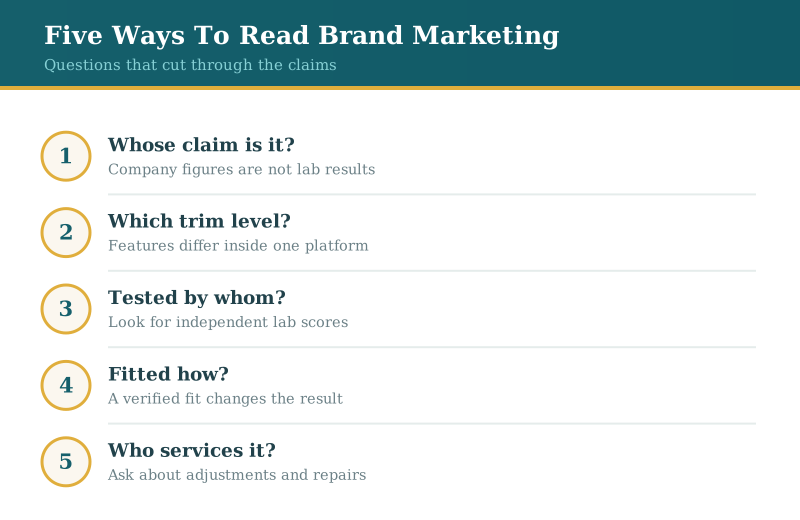
Ask whose claim it is, and ask whether it came from the company or an independent lab. Ask which trim level the number applies to, because features often differ inside one platform. Ask whether the aid was fitted to a target and measured in your ear. Ask what a trial looks like, what adjustments are included and who services the device later. For the questions to ask any seller, see our guide to hearing aid fitting.
Book a visit
We compare flagship models with you and let you try them in the office. Book a hearing evaluation at our San Mateo office at 88 N. San Mateo Drive or our San Carlos office at 1008 Laurel Street, or call 650-342-9449.
Last updated and sources
Last updated November 4, 2026. What changed: this is the first version. Company descriptions are the companies' own. Sources: Hearing Review on Phonak EON, Hearing Health Matters on Oticon Reveal, Audiology Worldnews on Signia MaX, HearingTracker on ReSound Sensia, Hearing Health Matters on Starkey Omega AI+, Hearing Health Matters on Widex Allure AI, HearingTracker's rechargeable guide and Wu et al., JAMA Otolaryngology 2025.
Medical information notice
This page offers general information. It is not medical advice, and it does not diagnose or recommend treatment. Company descriptions and lab scores may change. Sudden hearing loss, hearing loss in one ear, ear pain or dizziness need prompt medical care. Call 650-342-9449 to book at our San Mateo office, 88 N. San Mateo Drive, or our San Carlos office, 1008 Laurel Street.
Frequently asked questions
Questions patients ask us
Which hearing aid brand is best for speech in noise?
No single brand wins for everyone. HearAdvisor's lab gave EON Sphere 4.5 of 5 and Reveal 1 3.3 of 5 for speech in noise in a tuned fit. A lab score is not your experience, so test in your own settings.
Are two brands owned by the same company the same product?
No. Phonak and Unitron belong to Sonova, and Signia, Widex and Rexton belong to WS Audiology, but each sells its own sound philosophy and technology. Common ownership does not make two aids the same.
Does the brand decide the price?
Price depends mostly on the technology level, the features and the services included, not the brand name. Ask for a written quote that lists what is covered.
Can I switch brands later?
Yes, though a new brand means a new fitting and a new adjustment period. Our page on hearing aid fitting explains what that involves.
Do I need the top technology level?
Not always. In a two-site trial of adults 55 and older with mild to moderate loss, high-end and low-end aids gave similar outcomes, though the fitting service mattered. Your own needs decide.
Are the company claims on this page true?
They are the companies' own descriptions, and we label them as claims. Independent lab results, where they exist, are named with their source.