


Hearing Aids & Styles
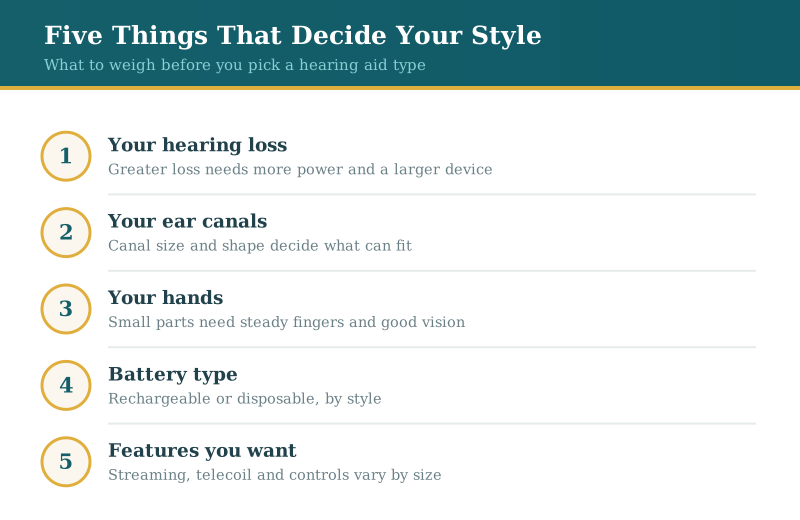
Most people start by asking which style is smallest. A better first question is which style your hearing loss and your ears can actually use. Smaller devices hide well, but they hold less power and fewer features. Larger devices are easier to see and often easier to live with. Neither choice is wrong. The goal is a style you will wear every day.
This guide lays out every style in the same format, so you can compare them side by side. The chart comes first, and the detail follows. Choosing a style is a clinical decision as well as a style decision, and it is easiest to make after a hearing evaluation and an ear exam. Our audiologists in San Mateo and San Carlos can walk you through them.
At a glance
- RIC is the most common style today. It balances a small size, wide fitting range and rechargeable options.
- Smaller styles (CIC, IIC) hide best but hold less power, smaller batteries and fewer features.
- Behind-the-ear styles cover the widest range of hearing loss, including severe and profound loss.
- Price depends mostly on technology level and service, not on style alone. Ask for a written quote that lists what is included.
- Your hearing test, canal shape and dexterity decide what fits. A photo or a website cannot.
Hearing aid styles at a glance
The chart below puts the main styles side by side. Visibility is scored from 1 (hardest for others to see) to 5 (easiest). Loss ranges are typical, not promises: your own test results and ear anatomy decide what is realistic. Under the chart, a short list of quick picks points you to a starting style for the most common concerns. For the full set of guides, see hearing aids, rechargeable hearing aids, hearing aids for severe hearing loss and Bluetooth hearing aids.
| Style | What it looks like | Typical hearing loss range | Battery | Visibility (1 to 5) | Best for |
|---|---|---|---|---|---|
| Receiver-in-canal (RIC) | Small body behind the ear, thin wire to a speaker in the canal | Mild to severe; power receivers reach further | Rechargeable or disposable | 2 | Most adults who want a small, flexible device |
| Behind-the-ear (BTE) | Larger body behind the ear, tube or wire into the canal | Mild to profound | Rechargeable or disposable | 3 | Severe loss, easy controls, hard-to-fit ears |
| In-the-ear (ITE) | Custom shell filling the bowl of the outer ear | Mild to severe | Often disposable; some rechargeable | 4 | Custom fit with room for features |
| In-the-canal (ITC) | Custom shell, partly in the canal | Mild to moderately severe | Mostly disposable | 3 | Discreet fit with simple controls |
| Completely-in-canal (CIC) | Tiny custom shell, mostly inside the canal | Mild to moderately severe | Mostly disposable | 2 | Discretion and steady hands |
| Invisible-in-canal (IIC) | Smallest custom shell, deep in the canal | Mild to moderate | Mostly disposable | 1 | The least visible custom option |
| Extended-wear (Lyric) | Placed deep in the canal by a clinician, worn for weeks or months | Mild to moderately severe | No battery to change; the device is replaced on a schedule | 1 | Nothing visible and no daily handling |
| CROS / BiCROS | A transmitter on the weaker ear plus a hearing aid on the better ear | One ear with little or no usable hearing | Depends on the devices used | Depends on the devices used | Single-sided hearing loss |
Quick picks: where to start
Use these as a starting point for the conversation at your visit, not as a final answer. Each one names the styles worth asking about first.
Quick picks
If this is your main concern, ask about these styles first.
- You want it nearly invisible: ask about CIC, IIC or Lyric, and expect a check of your canal shape first.
- You have severe or profound loss: ask about power BTE or power RIC styles.
- You want the most popular all-rounder: ask about RIC.
- Small parts are hard for your hands: ask about BTE, or an ITE with a rechargeable option.
- One ear does not hear at all: ask about CROS or BiCROS, and about a cochlear implant evaluation.
- You use loop systems in theaters or places of worship: ask which styles have a telecoil.
Receiver-in-canal (RIC)
A RIC hearing aid, sometimes called receiver-in-the-ear, keeps the main body behind the ear. A thin wire carries sound to a tiny speaker in the ear canal. That keeps the part behind the ear small and leaves the canal fairly open, which many people find natural. RIC now fits the majority of people getting new hearing aids, as our guide to the most common hearing aid styles explains. It suits a wide range of mild to severe hearing loss, and most current models come in rechargeable versions. Power receivers extend the range further for greater loss. The trade-offs are that the speaker sits in the canal, so earwax can clog it, and the small parts behind the ear still show on some people. Best for: most adults with mild to severe loss who want a small, flexible, often rechargeable device.
Behind-the-ear (BTE)
A BTE hearing aid rests behind the ear and sends sound through a tube or thin wire to the ear canal, sometimes into a custom earmold. It is the largest standard style, which is exactly why it is so capable. It has room for the biggest batteries, the strongest amplifiers, extra microphones and controls that are easy to press. The National Institute on Deafness and Other Communication Disorders (NIDCD) notes BTE aids are used by people of all ages for mild to profound hearing loss. The trade-off is visibility: they are the easiest style to notice, although today’s models are slimmer than older ones. Best for: severe or profound loss, people who want big, easy controls, and anyone whose ears or hands make smaller styles hard.
In-the-ear (ITE)
An ITE hearing aid is a custom shell made from an impression of your ear. It fills the bowl of the outer ear, either as a full shell or a smaller half shell. Because the shell is large, it can hold a bigger battery, directional microphones and sometimes a telecoil, which picks up sound from loop systems in theaters and places of worship. NIDCD lists ITE aids for mild to severe loss. The trade-offs are that it is more visible than canal styles, and a custom shell needs to be remade if your ear changes. Best for: people who want something custom and easy to handle, with more features than a canal device.
In-the-canal (ITC)
An ITC hearing aid is a custom-made shell that sits partly in the ear canal and partly in the bowl of the ear. It is smaller than an ITE and less visible. Most ITC models use small disposable batteries. Fewer controls and less room for features come with the smaller size. NIDCD notes that canal aids can be hard to adjust and remove because they are small. Best for: adults with mild to moderate loss who want a discreet device and can handle small parts comfortably.
Completely-in-canal (CIC) and invisible-in-canal (IIC)
These are the smallest custom devices. A CIC sits mostly inside the canal. An IIC sits deeper still, so it is very hard for others to see. A tiny faceplate holds a removal cord, which is how you pull the aid out. Both have the smallest batteries and the least room for features, so many models have limited Bluetooth streaming and few or no external buttons. NIDCD says canal styles are not usually recommended for severe to profound loss. Canal size and shape also decide candidacy: some canals are too small or curve too sharply to hold one. Our full guide to invisible hearing aids goes into the details. Best for: adults with mild to moderate loss, roomy canals and steady hands who put discretion first.
Extended-wear hearing aids (Lyric)
Extended-wear devices such as Phonak Lyric work differently. A clinician places the device deep in the ear canal, and you wear it continuously for weeks or months at a time. You do not change a battery. When the device reaches the end of its wear period, the clinician replaces it. Lyric is offered as a subscription with professional placement, which is a different arrangement from buying a pair of hearing aids outright. Candidacy depends on your canal anatomy and your hearing loss, and we check both first. Best for: adults with mild to moderately severe loss who want nothing visible and no daily handling, and whose canals suit the device.
CROS and BiCROS systems
CROS and BiCROS systems are for people who hear poorly or not at all in one ear. A microphone on the weaker ear picks up sound and sends it wirelessly to the hearing aid on the better ear, so you can hear what is happening on your poorer side. A BiCROS system is used when the better ear also needs amplification. These are not a separate class of device in the way ITE or RIC are. They pair a transmitter with a hearing aid. We fit CROS and BiCROS systems, and when one ear has very little usable hearing we also talk about a cochlear implant evaluation. Best for: single-sided deafness or one ear that a hearing aid cannot help.
How a style is chosen at a fitting
At your visit we start with a full hearing test, then look inside your ears and, for custom styles, measure the canals. Next we talk about the things the test cannot show: how well you handle small parts, what your day looks like, which sounds matter most, and how visible you are willing to let your hearing aids be. Ask to handle sample devices, because size and feel are hard to judge from a picture. Whatever you choose, we measure the sound at your eardrum with real-ear measurement and fine-tune the settings. Our page on hearing aid fitting explains how that works. The goal is a style that fits both your hearing loss and your life.
Care and moisture by style
Every style needs daily care, and the smaller the device, the more it matters. Receiver-in-canal and canal styles put the speaker or microphone ports where earwax and moisture collect, so wiping the device each day and changing the wax guard on schedule keeps it working. Behind-the-ear and in-the-ear styles are easier to clean because the parts you handle are larger. Deep-canal devices and extended-wear aids are the most sensitive to wax, so a clear canal helps, sometimes with professional earwax removal rather than cotton swabs. Open a battery door at night so moisture can escape, and keep devices out of the bathroom.
Why style is not the main driver of price
People often assume smaller means cheaper or more expensive. In practice, price depends mostly on the technology level inside the device, the features it includes and the services that come with it, such as fitting, real-ear verification and follow-up visits. A custom shell can cost somewhat more to make than a stock one, but a premium-level RIC and a premium-level CIC are closer in price than a premium and an entry-level RIC. Whatever the style, ask for a written quote that lists exactly what the price includes. Our guide to hearing aid financing covers payment options.
Styles that are mostly marketing
Some products sold as “mini,” “nano” or “invisible” hearing aids are personal sound amplifiers, not hearing aids. A personal sound amplifier makes everything louder but is not programmed to your hearing test. Over-the-counter hearing aids are a real, FDA-regulated category, but they are intended for adults with perceived mild to moderate hearing loss, and they are not fitted or verified by a professional. A tiny size on its own does not make a device right for you. If you already own a device that is not working well, we are glad to take a look, and our page on hearing aids versus over-the-counter devices explains the differences.
Not sure which style fits your ears?
A hearing evaluation answers that question in one visit. You can start at our San Mateo office or our San Carlos office. Our team also fits all major hearing aid brands, so you are not limited to one manufacturer’s styles.
Last updated and sources
Last updated November 4, 2026. What changed: this is the first version. Style ranges and trade-offs follow the National Institute on Deafness and Other Communication Disorders. Sources: NIDCD, Hearing Aids, U.S. Food and Drug Administration, OTC Hearing Aids: What You Should Know.
Medical information notice
This page offers general information. It is not a diagnosis or treatment plan, and it does not recommend a particular device. A full hearing evaluation usually takes about an hour. Call 650-342-9449 to book at our San Mateo office, 88 N. San Mateo Drive, or our San Carlos office, 1008 Laurel Street.
Frequently asked questions
What patients often want to know
What is the most popular type of hearing aid?
The receiver-in-canal (RIC) style is the most common style fitted today. It is small, covers a wide range of hearing loss and usually comes in a rechargeable version. Your own best choice still depends on your test results and your ears.
Which type of hearing aid is best for severe hearing loss?
Behind-the-ear and power receiver-in-canal styles have the room for the strongest amplification. Canal styles are not usually recommended for severe to profound loss. If hearing aids no longer give you enough clarity, we can also talk about a cochlear implant evaluation.
What is the smallest type of hearing aid?
Invisible-in-canal (IIC) and completely-in-canal (CIC) devices are the smallest custom styles, and extended-wear devices such as Lyric sit deep in the canal too. Small size means smaller batteries and fewer features, and not every ear can wear one.
Which type is easiest to handle?
Behind-the-ear styles are usually easiest because the controls and battery doors are larger. Rechargeable styles can help too, since you drop them in a charger and skip the small batteries.
Do all types come rechargeable?
No. Rechargeable options are common in RIC and BTE styles. Most of the smallest custom styles use disposable batteries because there is little room for a rechargeable cell. Extended-wear devices have no battery for you to change.
How much do the different types cost?
Style alone does not set the price. The technology level, the features and the services that come with the device matter more. Ask for a written quote that lists what is included, and see our guide to financing for payment options.