


Cochlear Implants
TICI UNICO has a European CE Mark and is launching in European markets. It is not sold in the United States, and we have not seen an announced U.S. timeline. If you live in San Mateo, San Carlos or elsewhere around the Bay Area, no clinic can give it to you today. You can still use this news to find out where your own hearing stands.
We are an audiology practice, not a surgical one. At our San Mateo and San Carlos offices we run cochlear implant candidacy workups before surgery and do the mapping, which is the programming of the implant, after it is activated. We refer the surgery out to an implant surgeon. We do not offer TICI UNICO, and nobody in the United States does yet.
At a glance
- MED-EL announced TICI UNICO on September 29, 2026. The microphone and battery sit under the skin, and there is no outside processor.
- It has a CE Mark for Europe. It is not FDA-approved, it is not sold in the U.S., and no U.S. timeline has been announced.
- It is designed for severe-to-profound sensorineural hearing loss. MED-EL reports results comparable to its conventional implants, from small studies.
- No price or long-term results were given at launch, and MRI conditions came later from a trade report. In the Bay Area, the useful step now is a candidacy evaluation for any cochlear implant.
What MED-EL announced
The announcement came in Innsbruck on September 29, 2026. MED-EL said the first four commercial implantations happened on launch day. The device carries a CE Mark, which is Europe's conformity approval, and the company is rolling it out across European markets. A MED-EL co-founder called it a new category of implant. One outside expert quoted by IEEE Spectrum described it as the first meaningful change in cochlear implants in roughly 30 years.
Conventional implant versus TICI UNICO
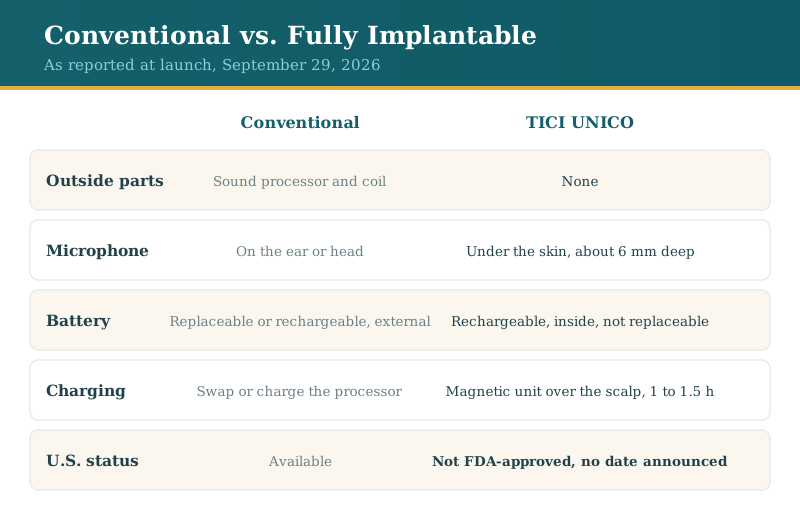
A conventional cochlear implant is built in two halves. A surgeon places the inner half under the skin, with an electrode array that reaches into the cochlea. The outer half is a sound processor worn on the ear or head. It holds the microphone and battery, and it sends sound across the skin to the implant through a magnetic coil. TICI UNICO drops the outer half. IEEE Spectrum reports a system of about 20 grams with four linked parts under the scalp. One is a microphone about as wide as a nickel, sitting roughly 6 millimeters below the skin. Another is a rechargeable battery. The table below sets the two designs side by side.
| Conventional implant | TICI UNICO | |
|---|---|---|
| Outside parts | Sound processor worn on the ear or head, plus a magnetic coil on the scalp | None. All parts sit under the skin |
| Microphone | In the outside processor | Under the skin, about as wide as a nickel and roughly 6 mm below the surface |
| Battery | In the outside processor | Rechargeable and built in. It cannot be replaced |
| Charging | Handled at the outside processor | Through the scalp with a small magnetic unit (GoPod), about 1 to 1.5 hours per charge as reported |
| At night and in water | The processor comes off | MED-EL says it works while asleep, in the shower and while swimming |
| U.S. status | Sold in the U.S. by Advanced Bionics, Cochlear and MED-EL | CE Mark in Europe. Not FDA-approved. No U.S. date announced |
Living without an outside processor
MED-EL says the implant works around the clock. A wearer can hear while asleep, in the shower and in the pool, and can keep hearing while the battery charges. There is no processor to lose, drop or keep dry, and nothing to put on in the morning. That may matter most to people who stop wearing an outside device because of hair, glasses, sport or sleep. The cost is a new daily habit. The battery is charged through the scalp with a small magnetic unit called a GoPod.
Battery and charging, as reported
IEEE Spectrum reports a battery designed to run up to about 40 hours per charge, with a charge taking one to one and a half hours. The battery cannot be swapped out. As reported, MED-EL's design goal is at least 24 hours of use per charge for at least 15 years. These are design targets and early reports, not results from years of daily use. What happens when a battery reaches the end of its life is a question we would want answered before we recommended the device. On October 19, 2026, MD+DI reported that the battery is expected to last 15 years or more, that patients wear an external charger each day and that an external sound processor that works with the implant can be used if the battery weakens.
What the evidence shows so far
In 2025 MED-EL published a feasibility study of six people. It reported safety and hearing results comparable to conventional implants. The launch material points to a larger clinical investigation of about 30 patients. Comparable results in small groups over a short time are encouraging. They are not the same as long-term outcomes across thousands of patients. We read the current evidence as a strong start, not a settled answer.
What MED-EL has not said
The launch release gave no price and gave no MRI details. A later trade report from Hearing Health Matters says the device is MR Conditional at 1.5 and 3 Tesla, under conditions it did not list. It did not explain how a microphone under the skin copes with a noisy room compared with one on the ear. It gave no U.S. regulatory plan. Whether health plans would pay for the device, and on what terms, is unknown. Gaps like these are normal on launch day. We will not fill them with guesses.
Who TICI UNICO is designed for
MED-EL designed it for severe-to-profound sensorineural hearing loss. That means inner-ear or nerve-related loss that hearing aids can no longer make clear. Being a candidate is a clinical finding. It comes from formal testing, medical review and imaging, not from how appealing a device sounds. A person cannot pick an implant for themselves.
When could U.S. patients get it?
In the United States a cochlear implant is a high-risk device, and it needs FDA approval before it can be sold. TICI UNICO does not have that approval. We have not seen a filing date or a U.S. launch date from MED-EL. We do not know when it will arrive, and anyone who names a date is guessing. We will update this page if that changes.
Cochlear implants you can get in the U.S. today
Advanced Bionics, Cochlear and MED-EL each sell implant systems in the United States. Every current U.S. system uses an outside sound processor and coil, although the processors have become smaller and some sit off the ear. For a good candidate, these systems bring large gains in understanding speech, most of all in quiet rooms and on the phone. Waiting also has a cost. The longer an ear goes without useful hearing, the less well it tends to do after implantation.
What we do here, and what we refer out
Our part of the process is audiology. We test both ears, aided and unaided, and run recorded sentence testing while your hearing aids are working and have been checked with real-ear measurement. A common referral screen is a pure-tone average of 60 dB HL or worse with speech understanding of 60% or less. Medicare widened its coverage criteria in 2022, so an evaluation done before then used a stricter rule. After activation we do the mapping. Imaging, the medical assessment and the surgery are done by an ENT surgeon at an implant center. More is on our cochlear implants page and in our explanation of the 60/60 rule.
Could you be a candidate? Five signs to check
None of these proves you need an implant. Two or more is a good reason to get a candidacy evaluation.
- Your hearing aids no longer make speech clear, even in a quiet room.
- You struggle to follow phone calls.
- You ask people to repeat themselves in every setting, not just in noise.
- A hearing test shows a pure-tone average near 60 dB HL or worse, with speech understanding at about 60% or less. That is a common trigger for referral.
- Your hearing has worsened even though your hearing aids are well fitted and have been verified.
Should you wait for TICI UNICO?
No. A candidacy evaluation does not commit you to surgery, and it tells you where you stand. If you qualify now, the evidence favors acting sooner over waiting years. If you do not qualify yet, we will say so plainly and make sure your hearing aids are verified, because an unverified fit can look like a candidacy problem. Your results stay useful if new devices reach the U.S. A good first step is a hearing evaluation. For a side-by-side with Envoy Medical's Acclaim, the other fully implantable implant, read our comparison of TICI UNICO and Envoy Acclaim.
Status and last update
Last updated October 19, 2026. What changed: we added MRI and battery details from Hearing Health Matters and MD+DI, and a link to our comparison with Envoy Acclaim. The first version appeared on September 30, 2026. We will update it if MED-EL announces a U.S. regulatory filing, FDA approval, pricing or MRI information. Our sources: MED-EL's launch release on Business Wire, IEEE Spectrum, Hearing Practitioner News and MED-EL's 2025 feasibility study release).
Medical information notice
This page is for general information only. It is not medical advice, and it does not diagnose or recommend treatment. Whether a cochlear implant is right for you depends on testing and on a conversation with your clinical team.
TICI UNICO is not in the U.S. yet. Get one email the week anything changes.
We will email you if MED-EL announces a U.S. regulatory filing, FDA approval, pricing or MRI information.
Frequently asked questions
Your questions, answered
Does California Hearing Center offer TICI UNICO?
No. The device is not approved in the U.S., so no clinic here can offer it. We do candidacy workups for cochlear implants and mapping after activation.
What happens at a candidacy evaluation in San Mateo or San Carlos?
We test each ear, with and without hearing aids, and run recorded sentence testing. We also check that your hearing aids are set correctly using real-ear measurement. If the results point to an implant, we refer you to an ENT surgeon at an implant center.
What does a cochlear implant cost?
We do not quote prices here. Many insurers, including Medicare, cover implants when their criteria are met, and what you pay depends on your plan. In California, Medi-Cal and private plans vary, so ask for a benefits check before you commit to anything.
Who does the surgery?
An ENT surgeon at an implant center does the surgery. We refer that part out. We handle the hearing tests before surgery and the mapping after the implant is activated.
Does a score of 60 and 60 mean I need an implant?
No. A pure-tone average of 60 dB HL or worse with speech understanding of 60% or less is a common reason to refer you for a full evaluation. The implant team makes the final call after medical and imaging review.
My hearing aids seem to have stopped working. Should I wait and see?
No. First, have your hearing aids checked with real-ear measurement, because a poor fit can look like a candidacy problem. If they are set correctly and speech is still unclear, ask for a candidacy evaluation.