


The Evidence
This page gives the numbers, says what they mean in daily life, and explains how we use them at a visit. Accurate as of November 24, 2026.
At a glance
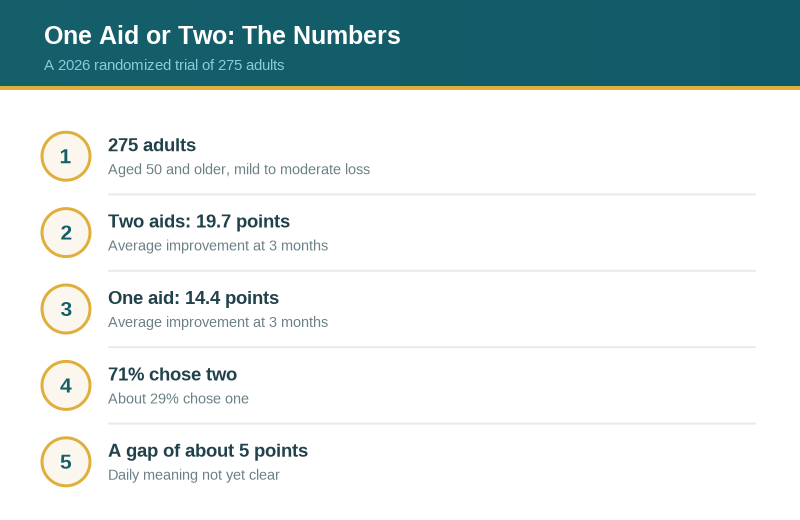
- The trial enrolled 275 adults aged 50 and older with mild to moderate, mostly high-frequency hearing loss.
- After three months, the two-aid group improved by 19.7 points and the one-aid group by 14.4 points, on a 100-point scale.
- At the end, about 71% chose two hearing aids and about 29% chose one.
- The difference was statistically significant. The author says it is not yet clear what 5 points means in daily life.
How the trial worked
The study, in JAMA Otolaryngology-Head & Neck Surgery in 2026, was led by Sherri Smith, an audiologist and researcher at Duke University, and colleagues. It enrolled 275 adults aged 50 and older who were new or nearly new to hearing aids. Most (89%) had mild loss in the better ear. A random draw put each person in a one-aid or two-aid group for three months. People paid for their devices and services, with insurance if they had it. At the end, they could keep their setup, switch or stop.
What it found
The main outcome was a 100-point questionnaire about communication difficulty in daily life. The one-aid group improved by an average of 14.4 points. The two-aid group improved by 19.7 points, a gap of about 5 points. At the end, about 71% chose two aids, about 29% chose one, and fewer than 1% chose none. Roughly 6 in 10 who started with one added a second. One aid helped, and two helped more on average.
| Measure | One hearing aid | Two hearing aids |
|---|---|---|
| Average improvement at 3 months | 14.4 points | 19.7 points |
| Chosen at the end of the trial | About 29% | About 71% |
| Chose none | Fewer than 1% overall | Fewer than 1% overall |
| People in the trial | 275 adults in total | 275 adults in total |
| Who was studied | Adults 50 and older, new or nearly new users | Adults 50 and older, new or nearly new users |
What the numbers do not tell us
A gap of 5 points on a questionnaire is statistically significant, but the author of the HearingTracker review notes that we do not yet know what it means in everyday life. The group average hides individual differences: some people did well with one aid. The trial covered mild to moderate loss, mostly in the high pitches, so it may not apply to other kinds of loss. It also lasted only three months.
How we use this at a visit
We start with a hearing test on both ears. If both ears need help, we usually discuss two aids, because the trial supports it on average. We also listen to your goals, your budget and your preference. If you want to start with one, we explain what to expect and how to add a second later. Our 45-day trial lets you judge how the fit feels in your life. Read about aid types and what to consider when choosing.
Related reading
See do hearing aids really work for the Cochrane review, the first 30 days for what to expect, and hearing loss in one ear options at a second opinion visit.
Status and last update
Last updated November 24, 2026. What changed: this is the first version. We will update this page when new evidence or rules change the picture. Sources: HearingTracker: One Hearing Aid or Two? My Takeaways From a New Clinical Trial, Hearing Health & Technology Matters: One or Two Hearing Aids? What a New Study of 275 Adults Found (November 11, 2026).
Medical information notice
This page offers general information. It is not a diagnosis or treatment plan. Want to know where your hearing stands? A full hearing evaluation usually takes about an hour. Call 650-342-9449 to book at our San Mateo office, 88 N. San Mateo Drive, or our San Carlos office, 1008 Laurel Street.
Frequently asked questions
Your questions, answered
Do I need two hearing aids?
If both ears have hearing loss, two aids gave more benefit on average in a 2026 trial. A hearing test and your own goals decide what is right for you.
Is one hearing aid ever enough?
Yes, for some people. In the trial, one aid helped, and about 29% of people chose to keep one.
How big was the difference?
About 5 points on a 100-point scale. It was statistically significant, but the author says its daily meaning is not yet clear.
Can I start with one and add another?
Yes. About 6 in 10 trial participants who started with one added a second.
Does insurance pay for two?
It depends on your plan. See our insurance page, and ask your plan whether it covers one or two aids.