


Hearing Loss Signs
Hearing loss usually comes on slowly. Your brain adapts, so the change is easy to miss, and family members often notice before you do. That is why a plain checklist helps. Read the ten signs below, count how many sound familiar, and use the score to decide what to do next.
One warning comes first, because it changes the order of things. Sudden hearing loss, hearing loss in only one ear, ear pain, drainage and dizziness need a doctor before a hearing aid. The next section covers them, and the rest of this guide is for gradual changes. You can book a hearing evaluation at either of our offices at any point.
At a glance
- Needing repeats, struggling in noise and turning up the TV are the most common early signs.
- Count how many of the ten signs fit you: 0 to 2 means keep watch, 3 to 5 means book a hearing test, 6 or more means book soon.
- Sudden loss, one-sided loss, pain, drainage or dizziness need a doctor first, not a hearing aid.
- This self-check is a screening aid. It is not a diagnosis, and only a hearing test can confirm hearing loss.
- Hearing aids help you hear. Research links hearing loss to memory and thinking changes, but hearing aids are not proven to prevent dementia.
Start here: when not to wait
Treat these as urgent and see a doctor first: hearing that drops suddenly, all at once or over a few days, in one or both ears; hearing loss in only one ear; ear pain; drainage from the ear; or dizziness or a spinning feeling. The National Institute on Deafness and Other Communication Disorders (NIDCD) says sudden deafness should be treated as a medical emergency, because early treatment improves the chance of getting some hearing back. People often blame allergies, a sinus infection or wax and wait too long. If any of these fit, call your doctor or urgent care today. A hearing aid is not the first step for these. If you notice these signs, read OTC vs prescription hearing aids and hearing aids for severe hearing loss.
The 10-sign self-check
Read each sign below and count the ones that sound like you. There are no right or wrong answers, and there is no need to be sure about any one of them. The detail for each sign follows, so you can see why it happens.
Do these sound like you?
Count each sign that fits you, even a little.
- I often ask people to repeat themselves.
- People seem to mumble, or I hear voices but cannot make out the words.
- My family says the TV is too loud.
- I struggle to follow talk in restaurants or groups.
- I miss doorbells, timers, phone rings or turn signals.
- Phone calls are harder than talking face to face.
- I feel worn out after long social events or meetings.
- My ears ring, buzz or hiss.
- I avoid gatherings, calls or restaurants because of how hard it is to hear.
- Family or friends have said I do not hear well.
What your score means
Add up the signs that fit you. The score is a guide to what to do next. It does not measure how much hearing you have lost.
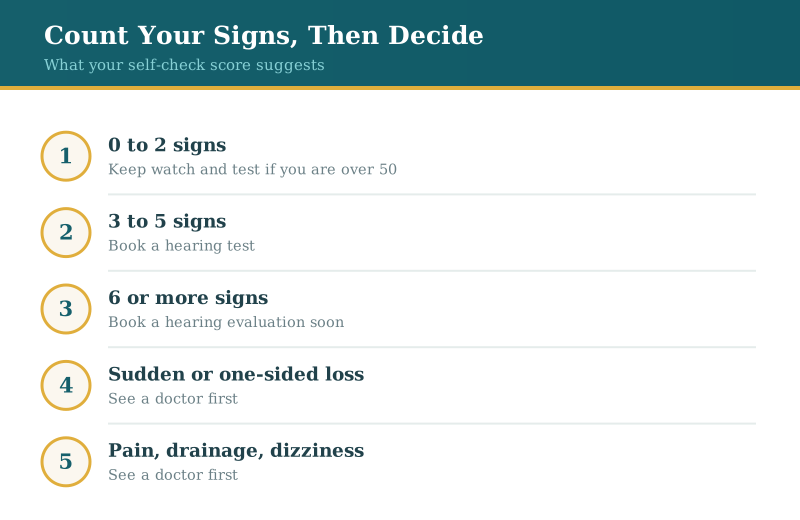
| Signs that fit you | What it suggests | What to do next |
|---|---|---|
| 0 to 2 | Hearing may be fine, or changes may be very mild | Keep watch. Book a baseline hearing test if you are over 50 or exposed to loud noise. |
| 3 to 5 | Worth testing | Book a hearing test. A short visit shows whether you have hearing loss. |
| 6 or more | Likely to benefit from testing soon | Book a hearing evaluation soon. Bring a family member if you can. |
| Any sudden, one-sided, painful or dizzy symptom | Needs a doctor first | See a doctor or urgent care promptly. Do not wait for a hearing aid appointment. |
Sign 1: You ask people to repeat themselves
This is the sign people notice first. You catch part of a sentence and miss the rest, so you say “What?” more often than you used to. It happens because hearing loss usually blurs the quiet, high-pitched parts of speech first, so words reach you but not clearly. A common example is a grandchild’s soft voice or a question from across the kitchen.
Sign 2: Everyone seems to mumble
If other people seem to speak less clearly than they used to, the problem is often your hearing and not their speech. Many people lose high-pitched sounds first, and consonants such as s, f, th and sh live in that range. Vowels still come through, so you hear that someone is talking but cannot make out the words. A typical example is a friend whose voice you hear but whose words blur.
Sign 3: The TV is louder than your family likes
A television volume that others find too loud is a classic early sign. Speech on TV already competes with music and background effects, so it is one of the first things to blur when hearing fades. Turning the volume up is the quickest way to compensate. A common example is a spouse leaving the room or asking for subtitles to be turned on.
Sign 4: Restaurants and group conversations are a struggle
Hearing in a quiet room can feel fine while a busy restaurant feels impossible. Background noise covers the quiet parts of speech, and a damaged ear is less able to pick a voice out of the crowd. People often notice it first at dinners, parties or family gatherings. A typical example is nodding along at a table while following only part of the talk.
Sign 5: You miss doorbells, timers and turn signals
Everyday alerts are often high-pitched, which is the range that goes first for many people. You may stop hearing the microwave beep, the doorbell, a phone ringing in another room or the click of a turn signal. Other people may point these out before you notice them. A common example is a pot boiling over because the timer went off unheard.
Sign 6: Phone calls are harder than face-to-face talks
On the phone you lose the lip movements and facial cues that help your brain fill in gaps. If you follow a conversation better in person than on a call, you may be leaning on lip reading and facial cues without realizing it. A typical example is putting a call on speaker or asking someone else to call for you.
Sign 7: You feel worn out after social events
Listening with reduced hearing takes extra mental effort. Your brain works hard to fill in missing sounds, and that can leave you tired or short on patience after a long meal or meeting. Many people blame age or stress for this. A common example is going home from a family gathering needing a nap or quiet time.
Sign 8: Your ears ring or buzz
Ringing, buzzing or hissing in the ears is called tinnitus. It often goes along with hearing loss, although it can have other causes too. Tinnitus that starts suddenly, shows up in only one ear or comes with dizziness needs a medical check. Hearing aids can help some people with tinnitus, and our tinnitus program covers the options. A typical example is noticing a constant hiss in quiet rooms.
Sign 9: You are avoiding gatherings
Skipping restaurants, parties or phone calls because they are hard work is a sign that hearing is starting to shape your life. People often describe it as being tired of nodding along. Pulling away can look like shyness or lost interest from the outside, so friends and family may not know the real reason. A typical example is turning down an invitation you would once have enjoyed.
Sign 10: Your family noticed before you did
If a spouse, child or friend has told you that you seem to be missing things, take it seriously. Hearing loss is gradual, and the people around you often notice the change first. A common example is a family member repeating what they said or raising the topic more than once. Our page on encouraging a loved one to take a hearing test offers ideas if you are on the other side of this talk.
What happens next
The next step is a hearing evaluation. A first visit usually takes about an hour. It includes a talk about what you notice, a look in your ears, and hearing and speech tests. If hearing aids would help, we explain your options in plain language, including styles of hearing aids. See our guide to what to expect at a hearing test for the full picture. You can book at our San Mateo office or our San Carlos office.
Hearing, memory and thinking: what the research says
Large studies link untreated hearing loss with faster declines in memory and thinking, and we explain this on our page about hearing and brain health. The best trial so far is ACHIEVE, a three-year randomized trial of 977 adults aged 70 to 84, published in The Lancet. In adults at higher risk of cognitive decline, hearing aids slowed that decline by 48 percent over three years. In the healthy volunteers there was no measurable difference in that time. The trial measured memory and thinking, not dementia diagnoses. So it is fair to say hearing aids may help protect thinking in people at higher risk, and it is not fair to say they prevent dementia.
Last updated and sources
Last updated November 4, 2026. What changed: this is the first version. Sources: NIDCD, Sudden Deafness fact sheet, University of Mississippi Medical Center, ACHIEVE trial news release, July 2023.
Medical information notice
This self-check is a screening aid. It is not a diagnosis or treatment plan. Sudden hearing loss, hearing loss in one ear, ear pain, drainage and dizziness need prompt medical care. Call 650-342-9449 to book a hearing evaluation at our San Mateo office, 88 N. San Mateo Drive, or our San Carlos office, 1008 Laurel Street.
Frequently asked questions
What patients often want to know
At what point do you actually need hearing aids?
You need them when hearing loss makes everyday listening hard and a hearing test shows that amplification would help. That can happen with a mild loss if you are struggling in noise or on the phone. A hearing evaluation answers the question, not a single number.
Can I need hearing aids if my test result is mild?
Yes. A mild result can still make restaurants, meetings and phone calls hard, especially for high-pitched speech sounds. The decision depends on what you notice and what you want to change, as well as the test itself.
Do hearing aids slow cognitive decline?
In the ACHIEVE trial, hearing aids slowed cognitive decline over three years in adults at higher risk, and did not show a difference in healthy volunteers in that time. The trial did not measure dementia. Hearing aids are not proven to prevent dementia.
Will wearing hearing aids make my ears lazy?
No. Hearing aids do not weaken your ears. They give your brain clearer sound to work with. If you wait too long, it can be harder to adjust, so earlier is usually easier.
What happens at a first hearing test?
We talk about what you notice, look in your ears, and test how well you hear tones and speech. A first visit usually takes about an hour. We explain the results in plain language and, if you need hearing aids, your options.
Is ringing in my ears a sign of hearing loss?
It can be. Tinnitus often goes along with hearing loss, but it can also have other causes. If it started suddenly, is in one ear only or comes with dizziness, see a doctor promptly.