


Tinnitus Research
Below, we explain the research in plain language: what the team did, what it found, and what it does not show. This page is accurate as of October 12, 2026.
At a glance
- A randomized, placebo-controlled trial in Scientific Reports (published October 5, 2026) tested sound delivered through hearing-aid-style devices for tinnitus.
- Adults had long-lasting, bothersome tinnitus and only mild hearing loss in both ears.
- Tinnitus distress dropped more in the sound-therapy groups than in the placebo group after 12 weeks.
- It is not a cure. It also does not prove that regular hearing aids work better than other approaches.
Who ran the trial and who took part
The first author is Fournier, working with Thai-Van, Reynard and colleagues. The work took place in France. A total of 145 adults enrolled, and 128 had data that researchers could analyze. Their average age was 54. All had chronic tinnitus that scored 38 or more on the Tinnitus Handicap Inventory. Their hearing was better than 35 dB HL on average from 0.5 to 4 kHz. That puts them in the "mild loss" range, where hearing aids are not always suggested. (Hearing Health & Technology Matters describes six specialized clinics. The paper's acknowledgements mention twelve collaborating centers. We cite the paper for the study design and will correct this page if the final version clarifies it.)
Three kinds of devices
Participants were randomly assigned to one of three setups, without knowing which: a placebo device that sent sound with no real amplification. a sound generator, which plays soft, calming sound. a sound generator with amplification, which also makes outside sounds louder. All three groups also got the same counseling about tinnitus. After six weeks, people could work with their clinician to mix programs for six more weeks.
What happened
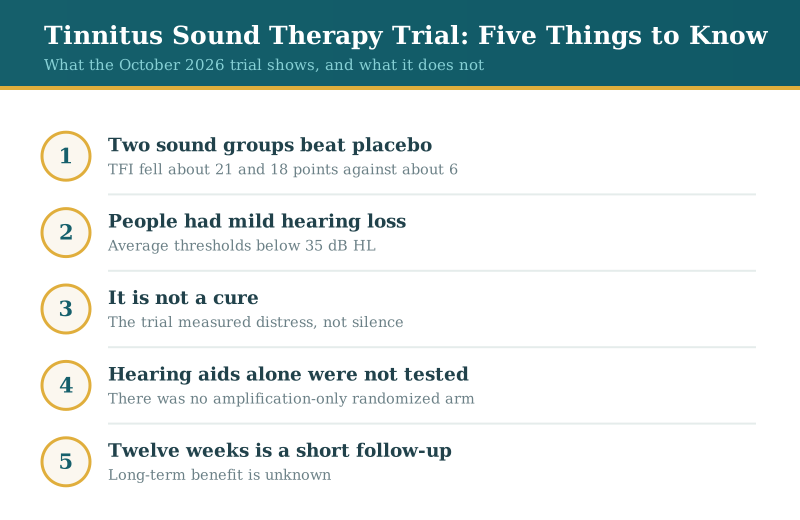
Researchers tracked two things. The Tinnitus Functional Index (TFI) is a questionnaire scored from 0 to 100. People also rated their overall change. A 13-point TFI drop counts as a meaningful change. Sound generator: about 21 points lower, and 88% said they improved. Sound generator plus amplification: about 18 points lower, and 77% said they improved. Placebo: about 6 points lower, and 33% said they improved. Notice that even the placebo group got better. Counseling, attention and the passage of time all help. The trial design let researchers see the extra effect of real sound therapy on top of that.
Reading the numbers fairly
Other limits: the follow-up lasted 12 weeks, so we do not know how long benefits last. The findings apply to chronic, bothersome tinnitus with mild hearing loss in both ears. And the open-access paper is an early accepted-manuscript version. Three manufacturers loaned devices, and the authors report no competing interests. During the choice phase, more than half of the time spent went to amplification-only programs. The authors take this as a sign that personal fitting matters more than one fixed setting.
| Point | What it means |
|---|---|
| "88% improved" | One group, 12 weeks, self-rated. It does not predict your outcome. |
| TFI change | Average across the group. Some people improved more, some less. |
| Placebo response | A third of the placebo group still felt better. Tinnitus responds to attention and support. |
| Sleep, anxiety, depression | These improved about equally in every group. The trial did not find a difference between groups. |
| Hearing aids alone | Not tested as a separate randomized group. |
What this means for you
If you live with tinnitus and a hearing test says your hearing is only slightly reduced, you may still be a candidate for hearing-aid-based sound therapy. We have long used this approach with patients on the Peninsula, and the new trial adds support for it. Start with our pages on sound therapy, hearing aids for tinnitus and habituation. You can also read our earlier answer to can hearing aids help tinnitus. A hearing test tells us what kind of help fits. It is quick and painless. See what to expect at a hearing test. Prestin research made news this week too: ear protein found in the blood of people with tinnitus. Request a hearing test at our San Mateo or San Carlos office.
Status and last update
Last updated October 12, 2026. What changed: this is the first version. We will update this page if the final paper, replication studies or clinical guidance change the picture. Sources: Hearing Health & Technology Matters summary, American Academy of Otolaryngology–Head and Neck Surgery Foundation: clinical practice guidelines, including the 2014 tinnitus guideline.
Medical information notice
This page offers general information. It is not a diagnosis or treatment plan. Want to know where your hearing stands? A full hearing evaluation usually takes about an hour. Call 650-342-9449 to book at our San Mateo office, 88 N. San Mateo Drive, or our San Carlos office, 1008 Laurel Street.
Get one email when the final paper is out.
We will write once if the final paper changes what this page says. We will send nothing else.
Frequently asked questions
Your questions, answered
Can sound therapy make tinnitus go away?
Not for most people. The goal is to make it less intrusive. In this trial, people reported less distress, and they did not report silence.
Is mild hearing loss enough to need devices?
Sometimes. A hearing test, your daily life and your tinnitus symptoms all shape that choice. We talk it through with you before you decide.
What is a sound generator?
It is a small device worn like a hearing aid. It plays gentle sound, such as soft noise, to take the edge off tinnitus.
Do these results apply to me?
They apply best to adults with long-lasting, bothersome tinnitus and mild hearing loss in both ears. If your case differs, results may differ.
Does insurance cover tinnitus sound therapy?
Coverage varies by plan. Call our office and we will help you check your options.
When should tinnitus get a medical check first?
When it starts suddenly, affects one ear, pulses with your heartbeat, or comes with dizziness or sudden hearing loss. See our guide on when to see a doctor.