


Hearing and Health
This page explains what studies show, what they do not show, and a short checklist you can use at home. It is accurate as of November 24, 2026.
At a glance
- NPR reported that older adults with mild hearing loss have more than double the risk of falling, though how hearing loss raises the risk is not clear.
- A 2023 study in the Journal of the American Geriatrics Society, with about 300 people with hearing loss, found hearing aid users reported fewer falls.
- Users who wore their aids at least four hours a day had up to 65% lower odds of falling in that study.
- These are links, not proof of cause. Hearing is one of several things to check.
What the research found
NPR reported on a study by Laura Campos and colleagues, published in the Journal of the American Geriatrics Society in 2023. The team surveyed about 300 people with hearing loss about their hearing aid use and their past falls. People who wore hearing aids reported fewer falls than people who did not, and those who wore them at least four hours a day had up to 65% lower odds of falling. The same report says falls are the top cause of death from injury among people 65 and older.
Why would hearing relate to falls?
Researchers do not know for sure. One idea, quoted by NPR, is that we use hearing to sense space around us, so reduced hearing may blur that sense. Another is that hearing loss may stand in for a problem with the balance system of the inner ear. A third is that hearing loss draws mental effort that is then not available for walking safely. These are ideas, not findings. Read our page on how an audiologist can help with balance problems.
What this study cannot tell us
The survey asked people about past falls, and people recall falls imperfectly. It shows a link between consistent hearing aid use and fewer reported falls. It does not prove that hearing aids prevent falls. People who wear aids every day may differ in other ways, such as activity or health.
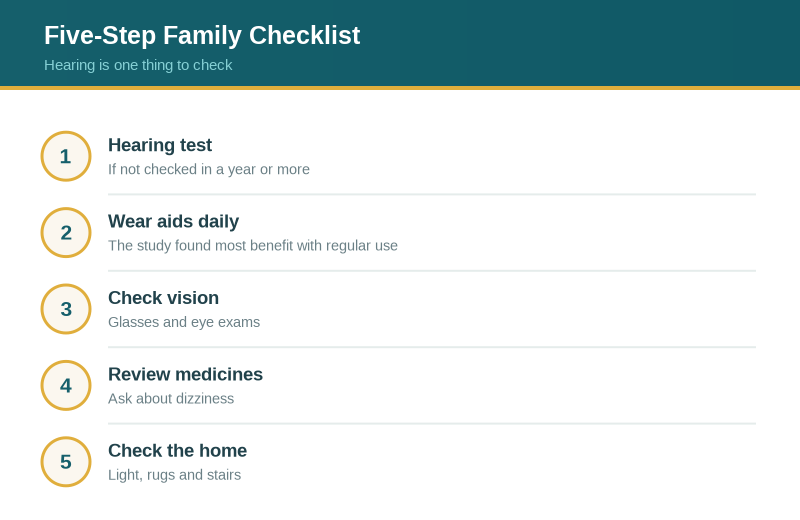
A short checklist for families
First, book a hearing test if hearing has not been checked in a year or more. Second, if aids are prescribed, help your parent wear them every day, since the benefit in the study was greatest with regular use. Third, check vision, because glasses and eye exams matter for balance. Fourth, ask the doctor or pharmacist to review medicines that cause dizziness. Fifth, look at the home: lighting, loose rugs and stairs. Our family guide and our page on hearing aids for seniors can help you start the talk.
| Group | What was reported | Source |
|---|---|---|
| Older adults with mild hearing loss | More than double the fall risk | NPR, Nov 13, 2023 |
| Hearing aid users vs non-users | Fewer reported falls among users | Campos et al., JAGS 2023 |
| Users wearing aids 4 or more hours a day | Up to 65% lower odds of falling | Campos et al., JAGS 2023 |
| Study size | About 300 people with hearing loss, by survey | NPR, Nov 13, 2023 |
Related health links
Hearing also shows up in research on thinking and memory. Read our pages on hearing loss and cognitive health and hearing and your health. Hearing loss is associated with higher dementia risk in studies, but nothing here says aids prevent dementia. For evidence on aids themselves, see do hearing aids really work.
Status and last update
Last updated November 24, 2026. What changed: this is the first version. We will update this page when new evidence or rules change the picture. Sources: NPR: Hearing loss can lead to deadly falls, but hearing aids may cut the risk (November 13, 2023).
Medical information notice
This page offers general information. It is not a diagnosis or treatment plan. Want to know where your hearing stands? A full hearing evaluation usually takes about an hour. Call 650-342-9449 to book at our San Mateo office, 88 N. San Mateo Drive, or our San Carlos office, 1008 Laurel Street.
Frequently asked questions
Questions patients ask us
Does hearing loss cause falls?
Studies link them, but cause is not proven. Researchers have several ideas, including how hearing helps us sense space.
Do hearing aids prevent falls?
One survey found users reported fewer falls, and daily wearers had lower odds. It does not prove hearing aids prevent falls.
How many hours a day should aids be worn?
In the 2023 study, people who wore aids at least four hours a day had the lowest odds of falling. Wear them as your audiologist advises.
What else lowers fall risk?
NPR notes strength and balance exercise as key. Vision checks, medicine review and a safe home also matter.
Should I get a hearing test for a parent who has fallen?
Yes, it is a sensible step to add to the doctor's review. A test is quick and tells you where hearing stands.