


Severe Hearing Loss
Severe loss is a different fitting problem from mild or moderate loss. The device has to push more sound into the ear without whistling, and the settings need checking more often. The chart below compares the three power classes. A final section explains when hearing aids are no longer enough and a cochlear implant evaluation is the right next step, which is not a failure and does not commit you to surgery.
This page is the plain-language front door. For the clinical detail, see our summary of the 2026 guidelines for severe and profound hearing loss, and for what happens at an evaluation, see our page on cochlear implant evaluation and programming.
At a glance
- Severe loss is 61 to 80 dB HL in the better ear, and profound is 81 dB HL or more.
- Power receiver-in-canal, power behind-the-ear and super-power behind-the-ear aids are the main choices, and the right one depends on your test and your ears.
- Measuring the sound in your own ear matters more as power rises, because small errors have larger effects.
- If well-fit aids give you volume but not clear words, ask about a cochlear implant evaluation.
- No hearing aid restores normal hearing, and results vary from person to person.
Why severe loss is a different fitting problem
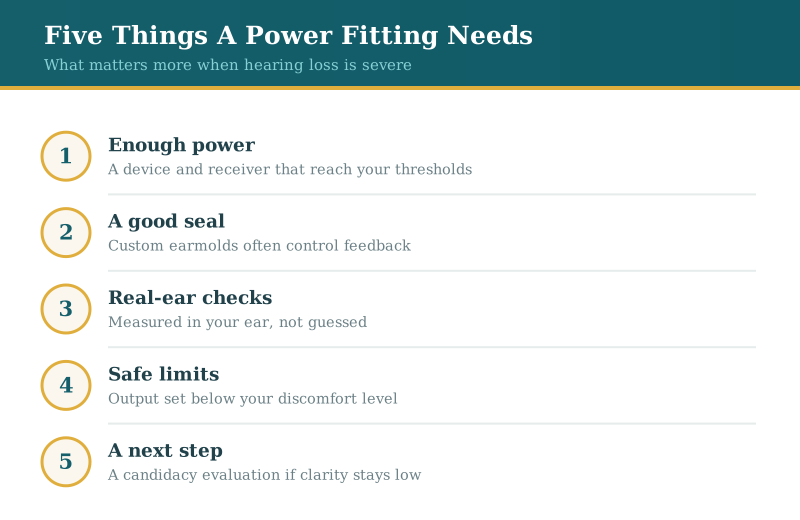
With mild loss, a small device adds a little sound. With severe loss, the device must add a lot, and that raises three problems. Sound leaks from the ear canal back to the microphone and causes whistling, called feedback. The output must stay high enough to help but below the level that is uncomfortable. And the sounds you most need, the high-pitched parts of speech, are often the ones you hear least. The 2026 expert guidelines describe a care pathway that includes verified fitting, custom earmolds, output limiting and outcome measurement, per Hearing Health Matters' summary. Our summary page lists them.
| Power class | Who it tends to suit | Earmold or custom needs | Battery | Streaming and features |
|---|---|---|---|---|
| Power receiver-in-canal | Moderately severe to severe loss, and some profound loss on models that list it | Often a custom or snug-fitting earpiece to limit feedback | Often rechargeable | Usually the full feature set of the platform |
| Power behind-the-ear | Severe to profound loss, hard-to-fit ears, larger controls | Custom earmold in most cases | Rechargeable or disposable, by model | Most platforms offer streaming and telecoil options |
| Super-power behind-the-ear | Profound loss, or severe loss that needs the most output | Custom earmold, made to seal tightly | Usually disposable, rechargeable on some models | Often a reduced feature set compared with standard models |
Receiver-in-canal power aids
A power receiver-in-canal aid keeps the small behind-the-ear body and a thin wire, with a stronger speaker in the ear. It is a good choice for people with moderately severe to severe loss who want a smaller device and use a good-fitting dome or earmold. Makers list how far each model reaches. Phonak lists its EON models for mild through profound loss, and Oticon Reveal offers four receiver powers covering mild through severe loss. Always check the fitting range for the exact model, because ranges differ by model and receiver.
Behind-the-ear and super-power aids
Power and super-power behind-the-ear aids use a larger case with more room for a bigger amplifier and battery, and they connect to the ear through a custom earmold or a tube. They are the usual choice when loss is severe to profound, when ears are hard to fit, or when hands cope better with larger controls. The earmold does a lot of the work. A tight, well-made mold lets the aid deliver more sound without feedback. A super-power aid is not simply a louder aid. It is chosen for the thresholds you have and the output your ears tolerate.
Why measuring in your own ear matters more here
Real-ear measurement places a thin tube microphone in your ear canal and measures what the aid actually delivers. The sound in a severe-loss ear can differ a lot from the manufacturer's prediction because every ear canal has a different size and shape. We measure at fitting and recheck when settings change. Our page explains what real-ear measurement is. Measuring is also how we confirm that loud sounds stay comfortable.
Features that matter: streaming, telecoil and captions
People with severe loss often rely on devices beyond the aid itself. Bluetooth streaming sends phone calls and television straight to your ears. A telecoil connects to hearing loops in theaters and houses of worship. Captions on your phone and television fill gaps that hearing alone cannot. Auracast, a newer broadcast standard, is also arriving in venues. See our guide to whether your aid supports Auracast. Ask which of these your model supports, and test them in the office.
When hearing aids are no longer enough
A cochlear implant bypasses the damaged part of the inner ear and sends signals to the hearing nerve. The question is not whether aids have failed but whether they are still giving you the clarity you need. A common U.S. referral signal is the 60/60 rule: an unaided average threshold of 60 dB HL or worse and an unaided word score of 60 percent or lower in the better ear, from Zwolan and colleagues in Otology and Neurotology (2020). It is a prompt to get evaluated, not a diagnosis. Signs worth acting on include relying on lip reading, struggling to follow speech in quiet rooms, being unable to use the phone, and gaining volume but not clarity when you turn the aids up. Our audiologists do cochlear implant candidacy evaluations and post-activation programming. Surgery is performed by a surgeon we refer to.
Signs aids may not be enough
These do not prove you need an implant. They are reasons to ask for testing.
- I rely on lip reading to follow a conversation.
- I cannot follow speech even in a quiet room.
- I cannot understand people on the phone.
- I turn my aids up and get volume but not clarity.
- I rely on captions for almost everything.
What we cannot promise
No hearing aid restores normal hearing, and we do not promise a specific outcome. Results depend on how much hearing nerve function remains, how long you have had the loss, your ears, your practice and your support. We will measure, adjust and tell you plainly when a device is not giving you enough, even if that means a referral. The guidelines also describe gene therapies for hearing loss as research, not an available treatment.
Book a visit
If you or someone you love has severe loss and is struggling, book a hearing evaluation at our San Mateo office at 88 N. San Mateo Drive or our San Carlos office at 1008 Laurel Street, or call 650-342-9449. Bring your current aids and a list of the situations that are hardest.
Last updated and sources
Last updated November 4, 2026. What changed: this is the first version. Sources: Hearing Health Matters: guidelines for severe and profound hearing loss, Turton et al., Seminars in Hearing 2026;47:175-276, Zwolan et al. 2020, 60/60 guideline, Hearing Review on Phonak EON and Hearing Health Matters on Oticon Reveal.
Medical information notice
This page offers general information. It is not medical advice, and it does not diagnose or recommend treatment. Cochlear implant candidacy is decided at an evaluation. Sudden hearing loss, hearing loss in one ear, ear pain or dizziness need prompt medical care. Call 650-342-9449 to book at our San Mateo office, 88 N. San Mateo Drive, or our San Carlos office, 1008 Laurel Street.
Frequently asked questions
Questions patients ask us
What is the most powerful hearing aid?
Super-power behind-the-ear aids offer the most output, but power is not the only goal. The right device matches your thresholds and stays comfortable at loud levels, and your audiologist chooses it by testing.
Can receiver-in-canal aids work for severe hearing loss?
Yes, on models with power receivers and a snug fit. Makers list the range for each model. Phonak lists EON for mild through profound loss, and Oticon Reveal offers receivers covering mild through severe loss. We check the range against your test.
When should I consider a cochlear implant instead?
Consider an evaluation if well-fit aids give you volume but not clear words. A common U.S. referral signal is the 60/60 rule, but candidacy is decided at an evaluation. Asking does not commit you to surgery.
Will more power damage my remaining hearing?
Poorly set output can be uncomfortable or unsafe, which is why we limit output and verify in the ear. A properly fitted and verified aid is set to stay within safe, comfortable levels. Tell us if loud sounds are ever painful.
Does insurance cover power hearing aids or a cochlear implant evaluation?
Coverage varies by plan. Original Medicare does not cover hearing aids, but it can cover some diagnostic evaluations, and some plans include benefits. Call 650-342-9449 and we will check your benefits before your visit.
What can I do if my aids are not enough for phone calls?
Ask about Bluetooth streaming to your ears, a telecoil, captioned phone services and a clip-on microphone. If clarity stays low even with these, ask about a cochlear implant evaluation.