


Hearing Aid Styles
They look alike in photos. They are not the same product. This page shows what differs and what to check first. Accurate as of November 24, 2026.
At a glance
- OTC hearing aids are for adults 18 and older with perceived mild to moderate hearing loss.
- A custom-made aid is built from an impression or scan of your ear and is set from your hearing test.
- Check the FDA label and registration before you buy any OTC aid.
- Tiny aids can have shorter battery life and fewer features. Ask about both.
What 'invisible' means
Invisible styles sit deep in the ear canal. Makers use names such as invisible-in-canal and completely-in-canal. Small size brings trade-offs: a small battery, less room for extra microphones and controls, and a fit that must suit your canal shape. Read our guide to types of hearing aids for the full range.
OTC in-the-canal aids
Federal rules let adults with perceived mild to moderate loss buy OTC aids without a prescription. You choose and set up the aid yourself, usually with an app. Fit comes from standard sizes of ear tips. Our guide to OTC versus prescription hearing aids and our page on OTC cost cover the details.
Custom-made aids
A clinician takes an impression or scan of your ear, and the maker builds a shell to match. The aid is then set from your hearing test and checked in your ear. Custom aids suit a wider range of hearing losses than OTC. Read about real-ear measurement and our hearing aid fitting.
| Feature | OTC in-canal | Custom-made |
|---|---|---|
| Who it is for | Adults 18+ with perceived mild to moderate loss | A wider range of losses |
| How it is fitted | Standard ear tips, self set-up | Shell built from your ear, set from your test |
| Hearing test needed | No | Yes |
| Ear checks | None unless you seek them | Looked in your ears first |
| Verification in your ear | Not usually | Real-ear measurement available |
| Support | Varies by seller | Follow-up visits with a clinician |
Check before you buy
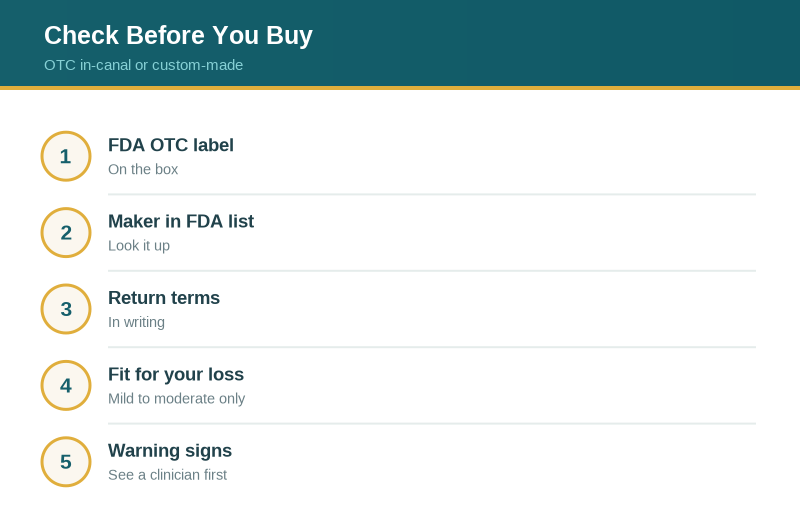
Look for the FDA's OTC label on the box. Look up the maker in the FDA registration list. Read the return terms. Ask if the aid suits your degree of loss. If you have pain, drainage, sudden loss or loss in one ear only, see a clinician first. See our video fitting versus audiologist fitting guide.
Not sure which one?
Book a hearing test. It shows your degree of loss and whether an OTC aid is a fair option. If you have a device you are unsure about, ask for a second opinion visit. Visit our San Mateo or San Carlos office.
Status and last update
Last updated November 24, 2026. What changed: this is the first version. We will update this page when new evidence or rules change the picture. Sources: U.S. Food and Drug Administration: Over-the-Counter Hearing Aids.
Medical information notice
This page offers general information. It is not a diagnosis or treatment plan. Want to know where your hearing stands? A full hearing evaluation usually takes about an hour. Call 650-342-9449 to book at our San Mateo office, 88 N. San Mateo Drive, or our San Carlos office, 1008 Laurel Street.
Frequently asked questions
A few questions worth asking
Are invisible hearing aids OTC?
Some are. Small in-canal styles are sold both over the counter and as custom-made aids from a clinician.
Who can buy an OTC hearing aid?
Adults 18 and older with perceived mild to moderate hearing loss, according to the FDA.
Is a custom aid better than an OTC aid?
It depends on your loss and your needs. A hearing test shows which is a fair option.
How do I check an OTC aid is legitimate?
Look for the FDA OTC label and look up the maker in the FDA registration list.
Can I get a custom aid if I started with OTC?
Yes. Book a hearing test and we will explain your options.