


Bluetooth Hearing Aids
This page explains the three in plain words, shows which of the six major brands have said what about each, and lists what to check before you buy. We list the companies' own descriptions, with dates, and we say Not stated when we could not find a figure.
For the full venue picture, see our guides on whether your hearing aid supports Auracast and on how hearing aids work. For brand details, see hearing aid brands compared.
At a glance
- Bluetooth in a hearing aid means three things: the classic phone connection, LE Audio and Auracast.
- iPhone and Android connect through different routes, so check your own phone before you buy.
- Auracast needs both a supporting aid and a venue that broadcasts. Hardware support alone does not guarantee it works today.
- Signia says MaX gets Auracast by a firmware update due by March 2027.
- A TV often needs a small transmitter, even when the aid streams from a phone.
The three standards in one chart
The chart shows what each of the three does, who it helps and what it needs. These are general descriptions, so ask your audiologist what your specific model supports.
| Standard | What it does | Who it helps | What it needs |
|---|---|---|---|
| Classic phone connection | Streams calls and audio from your phone to both aids | Everyone who uses a phone | A phone that pairs with your aid; the maker's app |
| LE Audio | Newer Bluetooth with efficient sound; makes Auracast possible | People who want newer features and longer battery | An aid and a phone that both support it |
| Auracast | A venue broadcasts one signal to many listeners | People in theaters, gyms, airports and houses of worship | An aid that supports it and a venue that broadcasts |
| Telecoil (older) | Picks up a hearing loop signal | People in venues with loops | A telecoil in the aid and a loop in the room |
Classic connection to your phone
This is the connection most people use today. Apple has its own route for iPhone, called Made for iPhone, and Android phones use a different route. Both stream calls and audio, and both work with the maker's app. Because the routes differ, an aid that works smoothly with one phone can need an extra step on another. Tell us which phone you own, and we test the pairing in the office.
LE Audio
LE Audio is a newer Bluetooth standard. Its goals are better sound quality for the battery used and a common way to connect across brands. It also makes Auracast possible. Support depends on both the aid and the phone, so a new aid does not use it until your phone supports it too.
Auracast
Auracast lets a venue send one audio signal to many listeners, with no loop and no borrowed receiver. A theater, gym or airport can broadcast, and your aids tune in. It needs two things: an aid that supports it, and a venue that broadcasts. Our page on Auracast support tracks the status by brand. We have not verified a Bay Area venue to date, so ask us about the place you care about before you choose an aid.
What six makers have said
As of November 4, 2026, trade press reports Auracast support for Phonak EON, Oticon Reveal and Starkey Omega AI+. ReSound said Auracast worked at the Sensia launch. Signia says MaX gets Auracast by update by March 2027, and sources differ on Widex Allure AI. A telecoil, the older loop receiver, is a separate feature: Signia MaX includes one, and for the other five we found it Not stated.
TV, computers and older phones
Many aids stream TV through a small plug-in transmitter, even when they connect to a phone without one. If you use a computer for video calls, ask whether the aid pairs with it directly. An older phone may not support the newer standards at all, so a phone upgrade can matter as much as an aid upgrade.
What to check before you buy
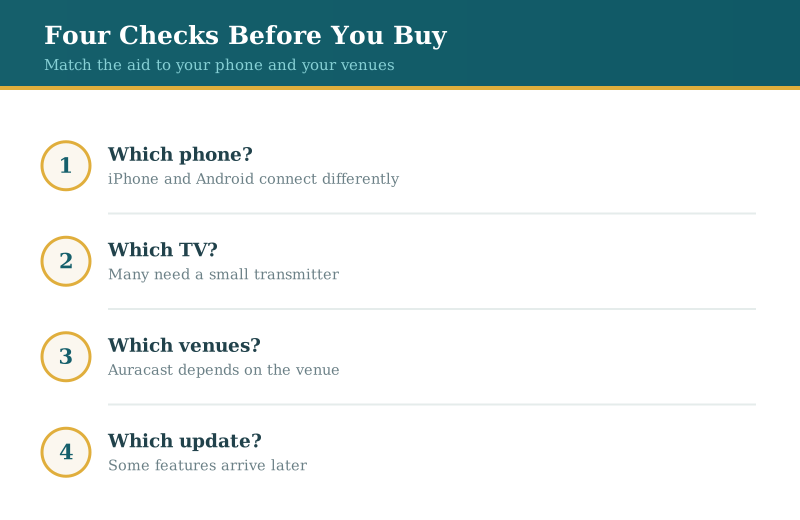
Ask five questions. Which phone will I use? Does the aid stream from a TV, and with what transmitter? Which standards does it support today, and which come by update? Can you test it with my phone in the office? What happens to the connection when my phone updates? Our fitting process includes pairing and a test.
Book a visit
Call 650-342-9449 to book at our San Mateo or San Carlos office. Bring your phone and tell us which TV, car and venues matter.
Last updated and sources
Last updated November 4, 2026. What changed: this is a new guide. Sources: trade press on each launch, including Hearing Review on Phonak EON, Hearing Health Matters on Oticon Reveal and Starkey Omega AI+, and Audiology Worldnews on Signia MaX.
Medical information
This page gives general information. It is not medical advice. Sudden hearing loss, hearing loss in one ear, ear pain or dizziness need prompt medical care.
Frequently asked questions
Your questions, answered
Do all hearing aids have Bluetooth?
Most current aids do, but not all, and the type differs. Some stream only from certain phones. Check your phone and ask what the model supports.
What is the difference between Bluetooth and Auracast?
Bluetooth connects your aids to your own device. Auracast lets a venue broadcast to many listeners at once, and it needs an aid that supports it and a venue that sends the signal.
Will my hearing aids work with an Android phone?
Many current aids do, though the connection route differs from iPhone. Bring your phone and we test the pairing.
Do I need a TV transmitter?
Often yes. Many aids stream TV through a small plug-in device. Ask before you buy.
Can a firmware update add Auracast later?
Sometimes. Signia says MaX gets Auracast by update by March 2027. Ask what your model has today and what is promised.
Is a telecoil still worth having?
If you visit venues with hearing loops, yes. It is a separate feature from Bluetooth, and not every aid has one.