


Hearing Protection
The paper is McCray, Ripp, Nguyen, Pelic, Labadie and Meyer, published in Otolaryngology–Head and Neck Surgery (2026;174:305-316). It covers 28,311 musicians in 21 countries. It found no significant difference between classical and pop or rock players. That ends the idea that this is only a rock musician problem.
California Hearing Center fits custom musician's earplugs and in-ear monitors on the Peninsula. This page explains the numbers, the limits of the study and what protects your hearing. See our service page on musician's earplugs and in-ear monitors and our guide to custom earplugs.
At a glance
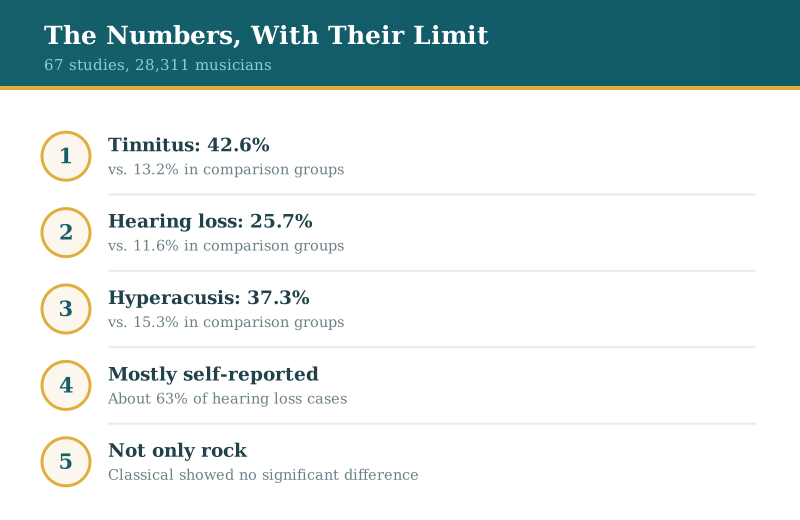
- Pooled estimates: tinnitus 42.6% of musicians vs. 13.2% of comparison groups, hearing loss 25.7% vs. 11.6%, hyperacusis 37.3% vs. 15.3%.
- About 63% of the hearing loss cases rested on self-report and about 37% on hearing tests. These are estimates for groups, not a forecast for you.
- Classical and pop or rock musicians showed no significant difference.
- At 100 dBA, NIOSH's daily noise dose is used up in 15 minutes. Each 3 dB increase halves the safe time.
- Flat-attenuation earplugs lower volume evenly so music stays balanced. A baseline hearing test gives you something to compare against later.
What did the 67-study analysis measure?
The authors pooled 67 earlier studies of musicians and compared their rates of tinnitus, hearing loss and hyperacusis with comparison groups. Hyperacusis means that everyday sounds feel too loud or painful. Musicians had roughly two to three times the rates of the comparison groups: about 3.2 times for tinnitus, 2.2 times for hearing loss and 2.4 times for hyperacusis. Dr. Shaun Nguyen of the Medical University of South Carolina, one of the authors, said in the release: "What we really need now is more personal, musician-entered risk profiling so we can offer practical, tailored advice."
| Condition | Musicians | Comparison groups | Roughly how many times higher |
|---|---|---|---|
| Tinnitus | 42.6% | 13.2% | 3.2 times |
| Hearing loss | 25.7% | 11.6% | 2.2 times |
| Hyperacusis | 37.3% | 15.3% | 2.4 times |
How reliable are these numbers?
The numbers come with a limit that belongs next to them. Among musicians with hearing loss, about 63% of cases rested on self-report and about 37% on objective hearing tests. Nguyen noted that the research often lacks details such as other loud hobbies, the instrument played and whether players wore protection. Self-report can miss loss that a test would find, so the true figure may be higher. It can also differ from test results in other ways. Treat these as estimates for groups of musicians, not as a prediction for you. The paper does not report separate rates by instrument family or by professional versus amateur players, and we do not invent any.
Is this only a problem for rock musicians?
No. The analysis found no significant difference between classical and pop or rock musicians. That matters for orchestra players, music teachers, choir singers and worship band members who assume that only amplified music is risky. Sound level and time matter, and many rehearsal rooms and pits are loud.
How loud is too loud for a rehearsal?
NIOSH, the U.S. agency for workplace safety research, recommends an exposure limit of 85 dBA averaged over eight hours. Every 3 dB above that cuts the safe time in half. At 88 dBA the limit is 4 hours, at 91 dBA it is 2 hours, at 94 dBA it is 1 hour, at 97 dBA it is 30 minutes and at 100 dBA it is 15 minutes. A rehearsal that runs two hours at 100 dBA is well past a day's dose. Your own levels depend on your instrument, your seat and your room. We can talk through what you play and how long you play it.
A quick self-check for musicians
Think about the last month of playing.
- I hear ringing or buzzing after rehearsals or gigs.
- Sounds seem muffled the morning after loud playing.
- I turn my monitor or my own volume up over time.
- Everyday sounds feel too loud or painful.
- I miss words in noisy rooms that I used to follow.
What protects a musician's hearing?
Ordinary foam earplugs muffle the high frequencies more than the low ones, so music sounds dull. Musician's earplugs use flat-attenuation filters that lower sound evenly. The best known options come from the Etymotic tradition and come in several attenuation levels, such as the ER9, the ER15 and the ER25, with the ER15 the most popular. Universal flat-attenuation plugs cost less and fit loosely. Custom plugs are made from impressions of your ears. In-ear monitors help when stage volume is the problem. Protection reduces exposure. It does not make a loud night harmless, so monitoring still matters. See our page on musician's earplugs and in-ear monitors.
Should musicians get a baseline hearing test?
A baseline test gives you a reference for later changes. How often to retest depends on your exposure, your age and any symptoms, and we set that with you at your visit. If you notice ringing after rehearsals, muffled hearing the next day or trouble following speech, do not wait. Read our guides to understanding noise-induced hearing loss and to tinnitus.
What to do next
Book a baseline hearing test at our San Mateo office or our San Carlos office, or call 650-342-9449. Ask about custom musician's plugs and in-ear monitors. Related pages: hearing protection, custom earplugs, and what the new guidelines say when hearing loss is already severe.
Last updated and sources
Last updated November 2, 2026. What changed: this is the first version. We will update it if new analyses change the picture. Sources: McCray et al. (2026), Otolaryngology–Head and Neck Surgery 174:305-316, DOI 10.1002/ohn.70094, Newswise release on the study, February 17, 2026, CDC NIOSH noise and hearing loss prevention.
Medical information notice
This page offers general information. It is not medical advice, and it does not diagnose or recommend treatment. Sudden hearing loss, hearing loss in one ear, ear pain or dizziness need prompt medical care. Call 650-342-9449 to book at our San Mateo office, 88 N. San Mateo Drive, or our San Carlos office, 1008 Laurel Street.
Frequently asked questions
A few questions worth asking
How common is hearing loss in musicians?
A 2026 analysis of 67 studies found hearing loss in 25.7% of musicians, against 11.6% in comparison groups. About 63% of the cases rested on self-report, so treat it as a group estimate.
Do classical musicians lose hearing too?
The analysis found no significant difference between classical and pop or rock musicians.
How loud is too loud?
NIOSH recommends 85 dBA averaged over eight hours, with the safe time halving for every 3 dB increase. At 100 dBA that is 15 minutes.
What earplugs do musicians use?
Many use flat-attenuation plugs that lower sound evenly, in universal or custom-molded form, in a choice of attenuation levels. Your instrument and role shape the choice, and we talk it through at a fitting.
Do custom earplugs ruin sound quality?
Flat-attenuation filters are designed to lower volume evenly so music stays balanced instead of muffled. Foam plugs muffle high frequencies more than low ones.
Do earplugs prevent hearing loss?
They reduce exposure, which lowers risk. They do not guarantee prevention, so a baseline test and periodic checks still help.