


Hearing Research
The paper is Turton, Timmer, Hockley and colleagues, "Updated Guidelines for Best Practice in the Audiological Management of Adults with Severe and Profound Hearing Loss," in Seminars in Hearing (2026;47:175-276), published online October 26, 2026. It builds on the 2020 recommendations and covers evidence through the first quarter of 2026. The full text was access-restricted when we wrote this page, so our summary rests on Hearing Health Matters' coverage, and you should check the paper for exact wording.
The guidelines are expert guidance for clinicians. This page explains them in plain language. It does not say that California Hearing Center has adopted every recommendation. We do cochlear implant candidacy evaluations and post-activation mapping in San Mateo and San Carlos. See our page on cochlear implant evaluation and programming.
At a glance
- The guidelines cover adults 19 and older with sensorineural loss of 61 to 80 dB HL (severe) or 81 dB HL and above (profound) in the better ear.
- New or expanded: cochlear implant candidacy and bimodal hearing, remote services, Auracast, electrophysiology, music listening, accessibility and gene therapy research.
- The summary we read shows no numeric cochlear implant cutoff. The 60/60 rule is a separate U.S. source and is not part of this paper.
- Only about 2% to 12% of U.S. adults who are cochlear implant candidates receive one, depending on how candidacy is defined.
- If well-fit hearing aids give you volume but not clear words, ask about an evaluation. Asking does not commit you to surgery.
What counts as severe and profound hearing loss?
Severe loss is 61 to 80 dB HL in the better ear, and profound loss is 81 dB HL or more, measured on an audiogram. The guidelines cover adults 19 and older with sensorineural loss, meaning loss in the inner ear or hearing nerve. A 2016 analysis of national survey data (Goman and Lin) estimated that 1.8 million U.S. residents age 12 and older had severe loss and 0.4 million had profound loss in the better ear. That is a decade old, so read it as a rough size, not a current count.
What changed in the 2026 guidelines?
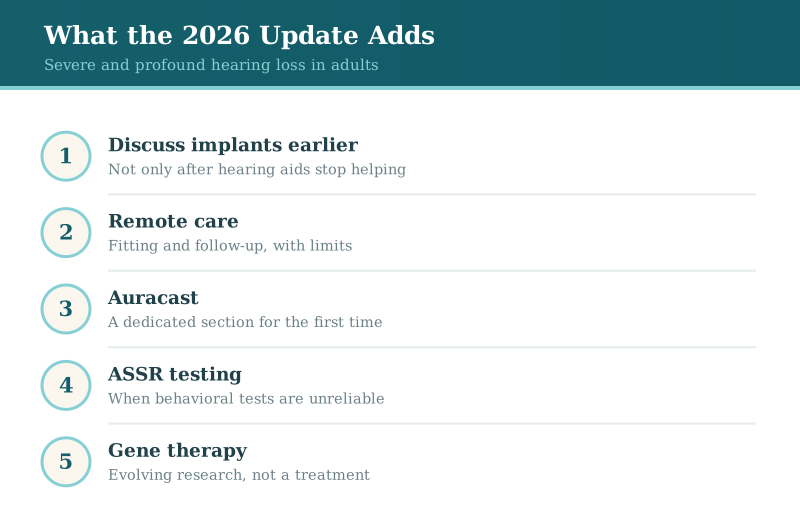
The update formally expands into areas that were peripheral in 2020. The table lists them as Hearing Health Matters summarizes them. The authors say the evidence for this group is limited and that the guidance blends research with expert consensus. We think that candor is a trust signal, and we pass it on.
| Area | What is new or expanded | What it means for you |
|---|---|---|
| Cochlear implants | Candidacy assessment and bimodal hearing (an implant plus a hearing aid in the other ear). Discuss implants within treatment planning | Ask about an evaluation earlier, even if hearing aids still help a little |
| Remote services | Remote fitting and follow-up, with limits, safety and accessibility spelled out | Remote care can help, but not every step suits every person |
| Auracast | A dedicated section, new since 2020 | Ask whether your aids support it |
| Electrophysiology | Considering ASSR, not ABR alone, when behavioral thresholds are unreliable | Matters most when responses to standard tests are hard to get |
| Frequency lowering | Leave it off at first and turn it on only if needed, at minimum effective strength | Your audiologist adjusts it step by step |
| Music | Music listening is its own fitting consideration | Speech settings may not satisfy music. Tell us what you listen to |
| Accessibility | Expanded advice on interpreters, visual tools and staff training | Ask for the communication supports you need |
| Genetic therapies | Discussed as evolving research, not established treatment | Not available as a treatment today |
Do the guidelines say hearing aids must fail first?
No. The update reinforces discussing cochlear implantation as part of comprehensive treatment planning, not waiting until conventional amplification is no longer useful. The summary we read gives no numeric referral cutoff. The numeric rule most U.S. clinics use is the 60/60 rule from Zwolan and colleagues (Otology and Neurotology, 2020), which is a separate source. It suggests referral when the better ear's average unaided threshold is 60 dB HL or worse and the better ear's unaided word score is 60% or lower. Our cochlear implant page explains the 60/60 referral guideline in more detail. Do not treat any one number as a diagnosis, because candidacy is determined at an evaluation.
Signs your hearing aids may not be enough
These do not prove you need an implant. They are reasons to ask for testing.
- I depend heavily on lip reading to follow a conversation.
- I struggle to follow speech even in a quiet room.
- I cannot understand people on the phone.
- I turn my hearing aids up and gain volume but not clarity.
- I rely on captions for almost everything.
Why do so few eligible adults get an implant?
Estimates of how many eligible U.S. adults receive an implant run from about 2% to 12%, depending on how candidacy is defined (Nassiri and colleagues, 2022, and Zhan and colleagues, 2024). The Hearing Review's coverage of implant programs says fewer than 10%. A 2023 study by Naples and colleagues described the barriers, including the belief that hearing aids must fail completely before an implant is considered. The gap is mostly about when the conversation starts, not about the technology.
What does a good care pathway include?
The guidelines cover assessment, verified power hearing aid fitting with real-ear or coupler verification, custom earmolds and output limiting, outcome measurement, counseling and, when it fits, a cochlear implant candidacy evaluation. They also expand remote fitting and follow-up, with limits stated. At California Hearing Center we do hearing tests, hearing aid fittings, cochlear implant candidacy work-ups and mapping. Ask us about any step. For what matters in a power fitting, see our guide to hearing aids for severe-to-profound hearing loss and what real-ear measurement is.
What does Auracast have to do with this?
The 2026 guidelines include a dedicated Auracast section. It did not exist as a clinical topic in 2020. Auracast is a way to send venue or TV audio straight to compatible hearing aids and implants, and it may help access in public places. Support varies by brand and model. See whether your hearing aid supports Auracast, and what an upgradeable implant such as Cochlear Nucleus Nexa means.
Are gene therapies an option today?
No. The guidelines discuss genetic hearing loss and gene therapies as evolving research, not as established alternatives to hearing aids or implants. California Hearing Center does not offer gene therapy.
What to do next
Book a hearing evaluation or cochlear implant candidacy evaluation at our San Mateo office or our San Carlos office, or call 650-342-9449. If you are already implanted or considering it, see what is available now and what is not. For tools that help with calls and TV, see our guide to phones and captions.
Last updated and sources
Last updated November 2, 2026. What changed: this is the first version. We will check the paper's full text and update the page. Sources: Hearing Health Matters: guidelines for severe and profound hearing loss, Turton et al., Seminars in Hearing 2026;47:175-276, DOI 10.1055/s-0046-1827039, Zwolan et al. 2020, 60/60 guideline, Goman and Lin 2016, prevalence of hearing loss by severity, adult cochlear implant utilization survey.
Medical information notice
This page offers general information. It is not medical advice, and it does not diagnose or recommend treatment. Cochlear implant candidacy is decided at an evaluation. Sudden hearing loss, hearing loss in one ear, ear pain or dizziness need prompt medical care. Call 650-342-9449 to book at our San Mateo office, 88 N. San Mateo Drive, or our San Carlos office, 1008 Laurel Street.
Frequently asked questions
Your questions, answered
What are the new guidelines for severe and profound hearing loss?
They are updated best-practice guidelines published in Seminars in Hearing in October 2026 by 18 international contributors. They cover adults 19 and older and build on the 2020 recommendations.
When should I be referred for a cochlear implant evaluation?
The guidelines say to discuss implants as part of treatment planning, not as a last resort. A common U.S. referral signal is the 60/60 rule, which is a separate source. Candidacy is decided at an evaluation.
Do I have to fail with hearing aids first?
No. The 2026 guidelines reinforce discussing implants earlier, rather than waiting until hearing aids no longer help.
Do the guidelines give a numeric cutoff for an implant?
The summary we read does not. The 60/60 rule comes from a 2020 study by Zwolan and colleagues.
Is gene therapy available for hearing loss?
No. The guidelines treat it as evolving research. California Hearing Center does not offer it.
Does California Hearing Center follow these guidelines?
They are guidance for clinicians. We do hearing tests, hearing aid fittings, implant candidacy work-ups and mapping, and we are glad to talk through each step with you.