


Paying for Hearing Care
This page lists what you can usually pay for, what to ask your plan administrator, and how to time a visit before the year ends. It is general information, not tax advice. It is accurate as of November 24, 2026.
At a glance
- The IRS counts hearing aids, batteries and repairs as medical expenses. FSA and HSA plans follow that list, but each plan sets its own rules.
- Many FSA plans end the plan year on December 31. Some give a grace period or a carryover. Ask your administrator which applies to you.
- OTC hearing aids may qualify as well, so check the label and your plan.
- Both of our offices accept HSA, FSA and CareCredit.
What the money can usually pay for
UCSF's hearing health guidance says the IRS lists hearing aids as a medical expense, along with the batteries and repairs needed to keep them working. UnitedHealthcare Hearing adds that parts and accessories such as extra wax traps and dry aid kits can qualify. A hearing test with a licensed professional is medical care, but confirm it with your administrator. If you want custom earplugs, ask whether your plan accepts them, because plans differ.
FSA and HSA: the difference that matters in December
An FSA is tied to an employer plan year. Money you do not use may be lost, unless your plan offers a grace period or a carryover. An HSA, which pairs with a qualifying health plan, is yours to keep from year to year. So the December 31 rush applies mostly to FSAs. NCOA suggests using sale savings to spend remaining FSA funds before year end if the account does not roll over.
A simple plan for the next five weeks
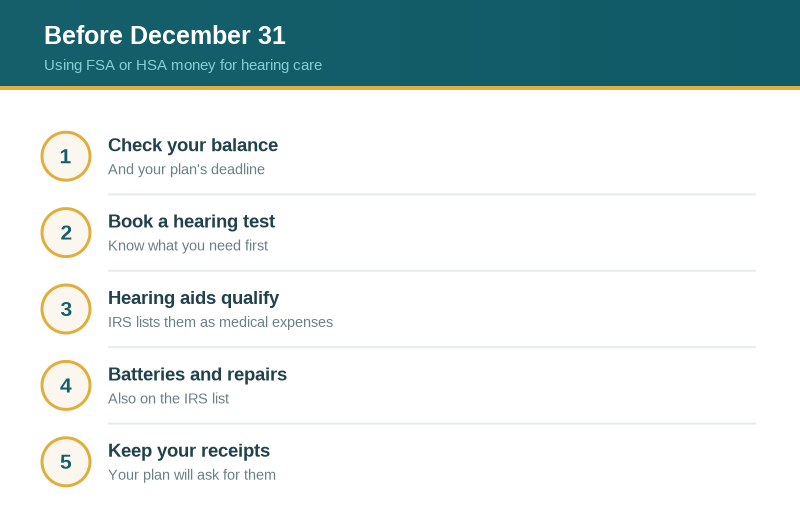
First, log in and find your balance and your deadline. Second, book a hearing test if you have not had one in a year or more. Third, if the test shows you need hearing aids, learn how a fitting works and what the 45-day trial covers. Fourth, ask your plan which receipts it needs. Do not rush a purchase just to spend money. A hearing aid that does not fit your loss helps nobody.
| Item | Usually eligible? | What to confirm |
|---|---|---|
| Hearing aids | Yes, as a medical expense (IRS Publication 502) | Your plan's own rules |
| Hearing aid batteries and repairs | Yes (UCSF; IRS Publication 502) | Receipt requirements |
| Parts and accessories such as wax traps | Often (UnitedHealthcare Hearing) | Whether your administrator lists them |
| OTC hearing aids | Often (UCSF) | The label and your plan |
| Hearing test | Generally medical care | Ask your administrator |
| Custom earplugs | Varies by plan | Ask before you order |
OTC aids and sale season
OTC aids can qualify in many cases, according to UCSF, which also notes that OTC aids are meant for adults with perceived mild to moderate loss. Our Black Friday checklist covers trials and warranties. Our guide to OTC and prescription hearing aids explains who each one suits.
If your FSA does not cover enough
Insurance and Medicare rules differ for hearing aids. Read our pages on insurance, Medicare and hearing aids and Medicare open enrollment, which ends December 7. Both offices take CareCredit as another way to spread a cost.
Status and last update
Last updated November 24, 2026. What changed: this is the first version. We will update this page when new evidence or rules change the picture. Sources: UCSF Hearing Health: Using Pre-Tax Dollars for Hearing Health, UnitedHealthcare Hearing: How to use your FSA or HSA for hearing health expenses, NCOA: Black Friday Hearing Aid Sales (November 20, 2026), IRS Publication 502: Medical and Dental Expenses.
Medical information notice
This page offers general information. It is not a diagnosis or treatment plan. Want to know where your hearing stands? A full hearing evaluation usually takes about an hour. Call 650-342-9449 to book at our San Mateo office, 88 N. San Mateo Drive, or our San Carlos office, 1008 Laurel Street.
Frequently asked questions
Questions patients ask us
Can I buy hearing aids with an FSA?
Often, yes. The IRS lists hearing aids as a medical expense, and FSA plans follow that list. Confirm the rules with your plan administrator.
When does my FSA money expire?
Many plans end on December 31. Some allow a grace period or a carryover, so log in and check your plan's deadline.
Does an HSA expire at the end of the year?
An HSA does not reset each year. Money stays in the account, which is why the deadline matters most for FSAs.
Can I use FSA money for hearing aid batteries?
Yes, batteries and repairs are on the IRS list of medical expenses. Keep your receipts.
Do you take CareCredit?
Yes, both of our offices accept HSA, FSA and CareCredit.