


Hearing Aid Buying Guide
This page gives you five steps to follow before you click Buy. It does not list sale prices or codes, because they change every day and a price tells you little about the fit. It is accurate as of November 24, 2026.
At a glance
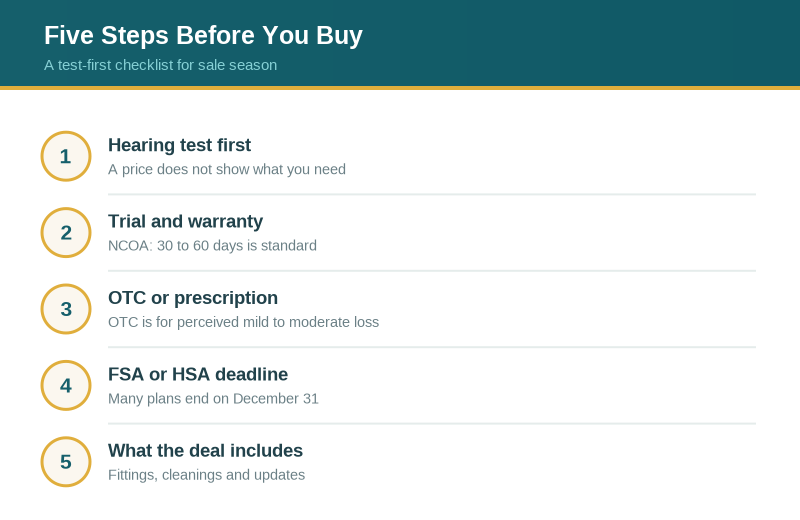
- Get a hearing test first. A sale price does not tell you which hearing aid you need.
- NCOA says the usual trial is 30 to 60 days. Check the trial length, the warranty and who adjusts the aids.
- Find out whether the aid is over-the-counter (OTC) or prescription. OTC aids are meant for perceived mild to moderate hearing loss.
- FSA or HSA money can often pay for hearing aids. Many FSA plans end on December 31, so check your plan's deadline.
Why timing matters, and why it should not rush you
NCOA reports that hearing aids often go on sale around Memorial Day, Labor Day and Black Friday, and that deals can start the week before Thanksgiving. Sales come back every year. Your hearing loss does not wait, but a week of checking costs you very little. The goal is to buy once, with the right aid, and to know who looks after it.
Step 1: Get a hearing test first
Most sale pages skip this step. A hearing test shows the type and size of your loss, and whether a medical problem needs a doctor before any aid. Our guide to what happens at a hearing test walks through the visit. Our hearing test visit, with counseling, takes about an hour. Take the results with you to any seller, so you compare like with like.
Step 2: Check the trial, the warranty and who adjusts the aids
NCOA says to look for a long trial with returns, and gives 30 to 60 days as the standard. At California Hearing Center the trial is 45 days with no restocking fee. Next, compare warranties: how long they last, and whether they cover repairs or loss. Then ask the most important question: who adjusts the aids after the first week? Fine-tuning is where most of the benefit comes from. Read why aids fail in the drawer without follow-up care and what real-ear measurement adds to a fitting.
Step 3: Know whether the aid is OTC or prescription
OTC hearing aids are meant for adults with perceived mild to moderate hearing loss. NCOA lists OTC prices from about $200 to $1,400. A prescription aid is fitted by a professional to your test results. If your loss is more than mild, if one ear hears worse than the other, or if you have dizziness, pain or drainage, start with an audiologist. Our guides explain OTC and prescription hearing aids and how the two compare in cost.
Step 4: Use your FSA or HSA before it expires
NCOA notes that hearing aids are often covered as a medical expense through an FSA or HSA, and that Black Friday savings can help you spend remaining funds before year end. Many FSA plans end on December 31, and some give a grace period, so read your plan. See our page on using your FSA or HSA for hearing care before December 31. Both of our offices accept HSA, FSA and CareCredit.
Step 5: Read what the deal includes
NCOA suggests checking what comes with the aid, such as fittings, cleanings and software updates, and not only the discount. Ask whether the price includes follow-up visits, and for how long. Ask what happens if an aid breaks or the company closes. That last question matters: read what owners of Eargo and Lexie aids can do now.
| Ask this | Why it matters | Source |
|---|---|---|
| How long is the trial, and what does a return cost? | NCOA gives 30 to 60 days as the standard trial | NCOA, Nov 20, 2026 |
| What does the warranty cover? | Compare length, repairs and loss | NCOA, Nov 20, 2026 |
| Is it OTC or prescription? | OTC is meant for perceived mild to moderate loss | NCOA, Nov 20, 2026 |
| Who fits and adjusts it? | Follow-up visits shape the result | Our clinical practice |
| Can I pay with FSA or HSA? | Many plans end Dec 31; check your deadline | NCOA, Nov 20, 2026 |
If you already have a quote
If a seller has already sent you a quote, bring it to a hearing aid second opinion visit. We will compare the aid against your test results, and we do not push you toward one brand. Our cost guide and insurance page can help you plan the budget.
Status and last update
Last updated November 24, 2026. What changed: this is the first version. We will update this page when new evidence or rules change the picture. Sources: NCOA: Black Friday Hearing Aid Sales (November 20, 2026).
Medical information notice
This page offers general information. It is not a diagnosis or treatment plan. Want to know where your hearing stands? A full hearing evaluation usually takes about an hour. Call 650-342-9449 to book at our San Mateo office, 88 N. San Mateo Drive, or our San Carlos office, 1008 Laurel Street.
Frequently asked questions
Questions patients ask us
Should I buy hearing aids on Black Friday?
A sale can help if you already know which type of aid you need. Get a hearing test first, and check the trial, the warranty and who adjusts the aids before you buy.
Are OTC hearing aids on sale good enough?
OTC aids are meant for adults with perceived mild to moderate hearing loss. A hearing test tells you if that describes you. If it does not, an audiologist can fit an aid to your results.
How long should a hearing aid trial be?
NCOA gives 30 to 60 days as the standard. Our trial is 45 days with no restocking fee.
Can I use my FSA or HSA for hearing aids?
NCOA says hearing aids are often covered as a medical expense through an FSA or HSA. Check your plan's rules and deadline with your plan administrator.
Do you match online sale prices?
We do not quote or match sale prices. We can review a quote you bring and compare the aid against your hearing test.