


Buying Hearing Aids
Is the best hearing aid simply the one you pick up during a warehouse-club run, somewhere between the rotisserie chicken and the paper towels? It is a reasonable question, and plenty of people on the Peninsula ask us a version of it. The honest answer is that the store matters far less than what happens after you choose a device. A hearing aid earns its keep through how well it is matched to your ears, not where the box came from.
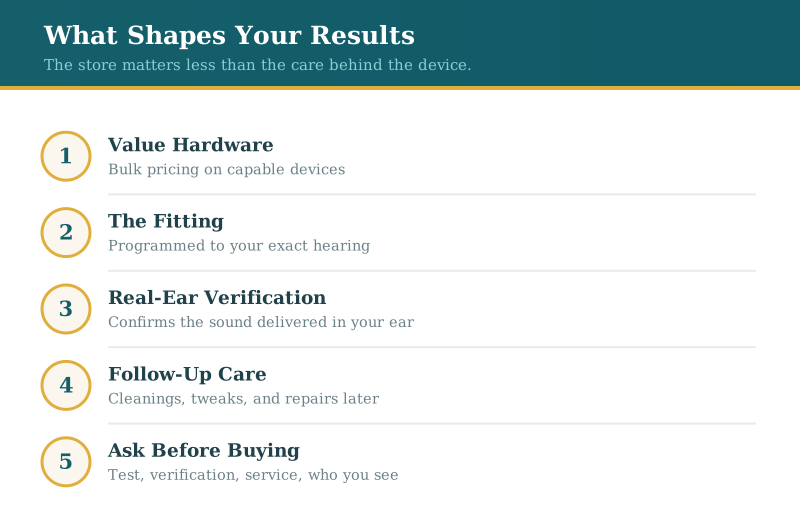
Warehouse clubs can offer genuine value on the hardware itself. Where the differences show up is in the fitting, the verification, and the support you get later. Those pieces are what turn a well-made device into one that helps you follow a conversation at a noisy dinner. As you weigh your options, look past the price tag to the service wrapped around it, whether you shop at a club, a chain, or an independent audiology office.
So the useful question is not which club has the best device this month. It is which combination of device, fitting, and follow-up will help you hear the people you care about. If you would like a second opinion on a purchase you are weighing, or help getting more out of aids you already own, our team in San Mateo and San Carlos is glad to talk it through.
At a glance
- Costco lists four models at starting prices of $1,599.99 to $1,699.99 a pair, as of October 7, 2026. Prices vary by state.
- Warehouse-club hearing aids can be a solid value, especially for simpler hearing needs and tighter budgets.
- How a device is fitted and verified shapes your results more than which store sold it.
- Real-ear verification and ongoing follow-up are worth asking about no matter where you buy.
Where the warehouse-club model keeps costs down
The savings are real, and it helps to know where they come from. High-volume retailers buy in bulk, run lean, and often sell devices that are close cousins of models you would find elsewhere under a different name. For a shopper comparing sticker prices, that can look like a straightforward win. If your hearing needs are simple and your budget is tight, a warehouse-club device may serve you well. The catch is that a hearing aid is not a finished product the moment it leaves the box. Its price is only one part of what determines how much you will hear.
| Model, as Costco lists it | Starting price | What Costco says comes with it |
|---|---|---|
| Philips HearLink 9050 miniRITE & Charger Plus | $1,599.99 | Two rechargeable hearing aids and one charger that gives three full charges |
| Jabra Enhance Pro 30 Micro RIE & Premium Charger | $1,699.99 | Two rechargeable hearing aids and one premium charger that gives three full charges |
| Rexton Reach RIC & Travel Charger | $1,599.99 | Two hearing aids and one travel charger that gives three more days of charge without plugging in |
| Sonite Rise AI Smart RIC + Charger Go | $1,599.99 | Two rechargeable hearing aids and one charger that gives three full charges |
What Costco says the price includes
Costco's Hearing Aid Center page says the price you see is the price you pay. It lists a free hearing test for members 18 and older, free service appointments for hearing aids bought there, and FSA and HSA eligibility. Its information page lists free loss and damage coverage with no deductible, free cleanings and check-ups, and 10 free zinc air batteries per hearing aid purchased, with warranty periods that vary by model. Costco's hearing care page refers to a 180-day return policy. Ask the Hearing Aid Center how that applies to hearing aids before you buy. The pages we read do not say whether real-ear verification is part of the fitting, so ask that too. Our Costco hearing test page explains the test itself.
The part the sticker price leaves out: the fitting
A hearing aid has to be programmed to your specific hearing, your ear canal, and your listening life. That work is the hearing aid fitting, and it does more for your results than the brand printed on the shell. Two people with the same model and very different fittings can have very different days. A careful fitting starts with a full hearing evaluation, then tunes the device across pitches, matches it to how you spend your time, and adjusts as your ears settle in. Where that step gets rushed or skipped, even a capable device can underperform.
Real-ear verification, the step that proves the fit
The most reliable way to confirm a hearing aid is doing its job is real-ear, or probe-microphone, measurement. A thin probe sits near your eardrum and reads the sound the device delivers inside your ear, which is then compared against a target for your hearing. It is a recognized best practice in audiology, yet it is not done everywhere. When you compare where to buy, asking whether real-ear verification is included tells you a great deal about the care behind the price.
What happens after the sale
Hearing changes, wax builds up, tubes crack, and settings need revisiting. The value of a provider shows up in the months and years after purchase, through cleanings, adjustments, and repairs when something goes wrong. Ask how easy it is to get back in for a tweak, who you will see, and what is covered. If a warehouse-club device leaves you wanting closer follow-up, you can still bring it to an independent audiologist for support, and many people do. It also helps to compare the full range of hearing aids and brands before you commit.
Frequently asked questions
Your questions, answered
How much do Costco hearing aids cost?
Costco's Hearing Aid Center page lists four models at starting prices of $1,599.99 to $1,699.99, as of October 7, 2026. Each price is for two hearing aids and a charger. Costco says prices vary by state and that custom earmolds are sold separately. Check Costco for the current price.
Which brands does Costco sell?
As of October 7, 2026, its Hearing Aid Center page lists Philips, Jabra, Rexton and Sonite models. Costco's lineup changes, so confirm with your local Hearing Aid Center.
Does Costco do hearing tests?
Costco's pages list a free hearing test for members 18 and older and say to contact a Hearing Aid Center to schedule it. See our Costco hearing test guide for what it covers and how it differs from an audiology evaluation.
Are warehouse-club hearing aids any good?
Many are genuinely capable, often built on the same platforms as devices sold elsewhere. The hardware is rarely the weak point. What varies more is how carefully the aid is programmed to your hearing and how much support you get afterward, and those are the things worth comparing from one store to the next.
Will a warehouse-club hearing aid pair with my phone?
Most current models offer Bluetooth streaming for calls, music, and video, though the details differ by brand and tier. If phone use matters to you, confirm the specific model's compatibility with your phone before you buy, and ask how streaming gets set up during the fitting.
I bought hearing aids elsewhere. Can you still help?
We regularly see people who bought online or at a retailer and want closer support. Depending on the model, we can often clean, adjust, verify, and repair them, or talk through whether a different device would serve you better. Bringing in what you already own is a fine place to start.
Do I need a hearing test before buying?
It is strongly worth doing. A current hearing evaluation maps exactly where your hearing has changed, which is what any device should be programmed against. Buying without one is a bit like ordering glasses without an eye exam. You might get lucky, but you are guessing.
How much does the fitting really change the outcome?
Quite a lot. The same device can feel muddy or clear depending on how it is tuned and verified for your ears. A thorough fitting, ideally confirmed with real-ear measurement, is often the difference between aids you wear all day and aids that end up in a drawer.
What should I ask before buying anywhere?
Four questions cover most of it: is a full hearing test included, is real-ear verification part of the fitting, what follow-up and repairs are covered, and who will I see when I need an adjustment. Clear answers to those matter more than any single price.