


Tinnitus Guide
We update this guide every January. It is general information, not a diagnosis. You can also get the printable PDF edition with a 30-day checklist and a symptom diary. It starts with the signs that should not wait.
At a glance
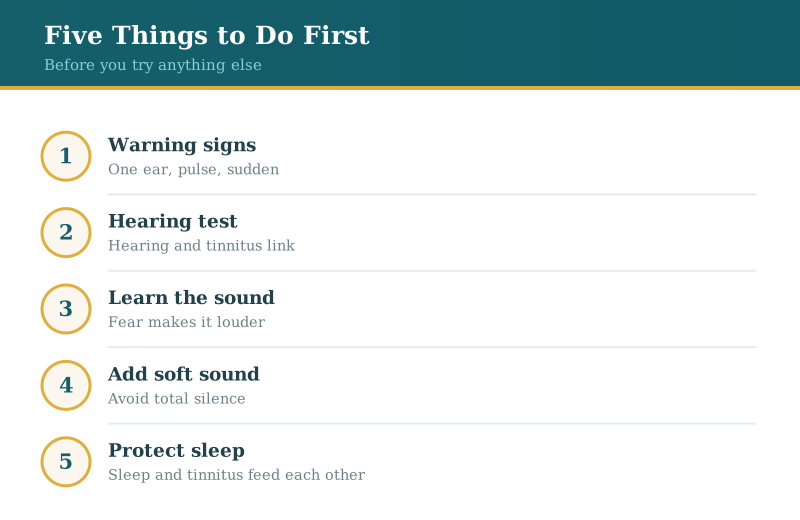
- Check the warning signs first: one ear only, a pulse-like sound, sudden onset with hearing loss, or dizziness, face weakness or numbness.
- Get a hearing evaluation early. Hearing and tinnitus are closely linked, and the result shapes the plan.
- The clinical guideline for tinnitus favors education, counseling, cognitive behavioral therapy, hearing aids when there is hearing loss, and sound therapy.
- The same guideline advises against relying on supplements such as ginkgo, melatonin or zinc for tinnitus.
- Avoid complete silence at night. Soft sound at a low level often helps you sleep.
Step 1: Check for warning signs
Most tinnitus is not dangerous. A few patterns should be looked at promptly by a medical professional. They are tinnitus in one ear only, a sound that pulses in time with your heartbeat, tinnitus that starts suddenly together with sudden hearing loss, and tinnitus with dizziness, weakness in the face or numbness. Our pages on tinnitus in one ear, pulsatile tinnitus, sudden-onset tinnitus and when to see a doctor explain each one. If any of these fit you, call us today. If you have sudden hearing loss, face weakness, numbness or severe dizziness, go to urgent care or an emergency department. In an emergency, call 911.
Step 2: Get a proper evaluation
Tinnitus is a symptom, not a disease. Before any plan, you need to know what may be behind it. A good evaluation starts with a full hearing test, a history of the sound and when it started, and questions about how it affects your sleep, focus and mood. It also checks for earwax, a common and easy-to-fix contributor. See what to expect at a tinnitus appointment. The evaluation is a diagnostic visit, so it is billed to your medical insurance in the same way a hearing test is. We check your benefits before the visit.
Step 3: Learn what the sound is and is not
Understanding tinnitus lowers the fear that makes it louder. Tinnitus is often linked to hearing changes, noise exposure, earwax, some medications, jaw or neck problems, stress and poor sleep. The brain can learn to treat the sound as unimportant, a process called habituation. Education and counseling are a core part of care in the clinical guideline from the American Academy of Otolaryngology–Head and Neck Surgery Foundation. Read what tinnitus is and whether tinnitus can go away.
Step 4: Treat any hearing loss
Many people with tinnitus also have hearing loss, even when they have not noticed it. The guideline advises a hearing aid evaluation when tinnitus comes with hearing loss. Well-fit hearing aids bring back the sounds your brain has been missing, which can make tinnitus less noticeable. Some hearing aids also include built-in sound features for tinnitus. Learn more on our page about hearing aids and tinnitus.
Step 5: Use sound, with care
Sound therapy gives your brain something else to listen to, so the tinnitus stands out less. It does not need to hide the tinnitus. A common approach is to keep sound just below the level of your tinnitus, so you can still hear it. Soft sounds such as a quiet fan, nature sounds, or a sound generator or hearing aid feature all work for some people. Complete silence usually makes tinnitus seem louder. See our pages on sound therapy and tinnitus apps.
Step 6: Protect your sleep
Poor sleep makes tinnitus feel louder, and loud tinnitus makes sleep worse. A steady bedtime, a cool dark room and soft background sound at a low level help many people. If your mind races when the room is quiet, a gentle sound can give it something to settle on. Our page on sleep strategies for tinnitus goes into more detail.
Step 7: Care for stress and mood
Tinnitus and stress feed each other. Cognitive behavioral therapy, often called CBT, does not remove the sound. It changes how you react to it, and the guideline recommends it. Relaxation, movement and time outdoors also help. See tinnitus and stress and managing tinnitus anxiety. If you ever feel hopeless or unsafe, please call or text 988 (the Suicide and Crisis Lifeline) at any time.
What the evidence does not support
The clinical guideline advises against using ginkgo biloba, melatonin, zinc or other dietary supplements as a treatment for tinnitus. It also advises against using medicines such as antidepressants or anti-anxiety drugs as the main treatment for tinnitus itself, although a doctor may treat anxiety, depression or insomnia that goes with it. Be careful of products that promise a cure. Read our pages on medications and tinnitus and diet and lifestyle.
Structured programs and advanced options
Some people need more than education and sound. A structured plan with an audiologist may combine counseling, sound therapy and follow-up visits. Tinnitus retraining therapy is one example. For select candidates, our practice also offers Lenire, a bimodal neuromodulation device. Whether it fits depends on your evaluation. Ask us at your visit.
Your first 30 days
Use the checklist below. It is a starting plan, not a treatment. Bring your notes to your visit.
A simple 30-day starting plan
Do these in order. Stop and call us if a warning sign appears.
- Check the four warning signs. Call us today if any fit you.
- Book a hearing evaluation. Do not wait for the sound to get worse.
- Write down when the sound is loudest and what you were doing.
- Keep a quiet background sound on at night, just below your tinnitus.
- Set a steady bedtime and a wake-up time.
- Cut back on loud noise, and wear ear protection around it.
- Skip supplements that promise a cure.
- Bring your notes and your questions to the visit.
Book a tinnitus evaluation
Call 650-342-9449 to book at our San Mateo or San Carlos office, or request an appointment. We start with your hearing and your story, then build a plan with you.
Last updated and sources
Last updated November 4, 2026. What changed: this is the first edition for 2027. Sources: Tunkel DE and colleagues, Clinical Practice Guideline: Tinnitus, Otolaryngology–Head and Neck Surgery, 2014 (American Academy of Otolaryngology–Head and Neck Surgery Foundation); National Institute on Deafness and Other Communication Disorders, Tinnitus fact sheet, nidcd.nih.gov/health/tinnitus. We review this guide each January.
Medical information notice
This guide gives general information. It is not a diagnosis or a treatment plan. See an audiologist or doctor about your own symptoms.
Frequently asked questions
Your questions, answered
Is tinnitus dangerous?
Most tinnitus is not dangerous. Tinnitus in one ear, a pulse-like sound, sudden tinnitus with sudden hearing loss, or tinnitus with dizziness, face weakness or numbness should be looked at promptly.
Is there a cure for tinnitus?
There is no single cure for most tinnitus. Most people can still make it much less intrusive with education, sound, treatment of hearing loss and support for sleep and stress.
Do I need a hearing test for tinnitus?
Yes, in nearly every case. Tinnitus and hearing are closely linked, and a hearing test shows what may be contributing.
Do hearing aids help tinnitus?
They can, when there is hearing loss. Hearing aids bring back missing sound, and some include sound features made for tinnitus.
Do supplements help tinnitus?
The clinical guideline advises against relying on ginkgo, melatonin, zinc or other supplements to treat tinnitus.
Why do I hear it more at night?
A quiet room removes the sounds that cover tinnitus. Soft background sound at a low level often helps.