


Tinnitus Research
The stent is investigational. It is not approved, and no clinic can offer it outside a trial. What matters for most readers is the lesson underneath the news: pulsatile tinnitus deserves a medical workup first, because it can point to a vascular cause that a hearing aid or sound therapy does not treat.
At California Hearing Center we test hearing and treat ordinary tinnitus. We do not offer or refer for this stent. If your tinnitus pulses, start with the page on pulsatile tinnitus.
At a glance
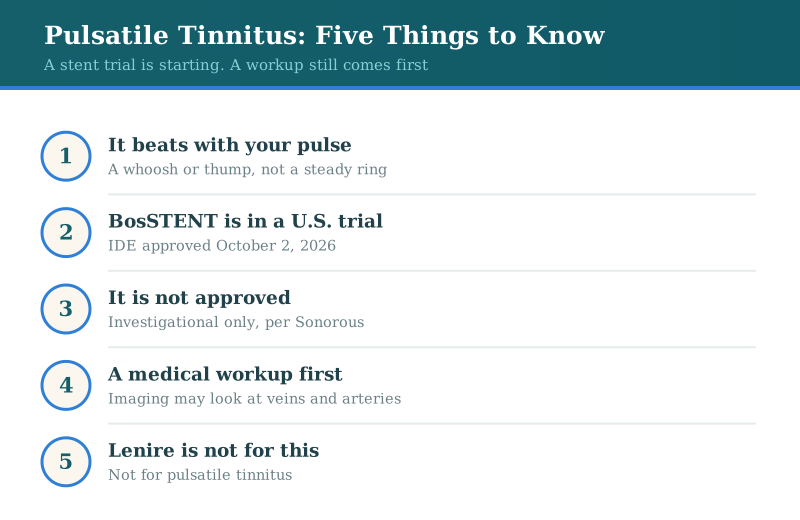
- The FDA approved an IDE on October 2, 2026 for B-SILENT 2, a U.S. pivotal trial of the BosSTENT for pulsatile tinnitus caused by venous sinus stenosis, per Sonorous.
- U.S. enrollment is expected in Q4 2026, per the company. The device is investigational and not approved.
- Venous sinus stenosis is a narrowing of a brain vein. The company calls it the most common cause of pulsatile tinnitus. A workup, not a guess, establishes the cause in any one person.
- Pulsatile tinnitus needs a medical evaluation first. Lenire and other tinnitus sound therapies are not for pulsatile tinnitus.
- Ordinary ringing is a different story, and the 2026 sound therapy trial is relevant there.
What happened
Sonorous Neurovascular announced on October 2, 2026 that the FDA approved its IDE application for B-SILENT 2, which the company calls the first FDA-approved IDE trial of a venous sinus stent for pulsatile tinnitus. It follows an FDA Breakthrough Device Designation for BosSTENT in February 2026. A separate study, B-SILENT, is enrolling at sites in France and Canada to support a European CE Mark. A Breakthrough designation and a trial approval are steps toward review. They do not mean the device works or is cleared for sale.
What pulsatile tinnitus is
Most tinnitus is a steady ring, buzz or hiss. Pulsatile tinnitus is a whooshing or thumping that beats with your heartbeat. It often comes from blood flow near the ear rather than from the hearing system. One cause is venous sinus stenosis, a narrowing in one of the large veins that drain blood from the brain. Sonorous calls it the most common cause of pulsatile tinnitus. Other causes exist, including conditions of the arteries, so the cause in any one person has to be found by a doctor.
What a stent trial tests
A stent is a small mesh tube that holds a narrowed vein open. B-SILENT 2 will test whether the BosSTENT is safe and effective for people whose pulsatile tinnitus comes from symptomatic venous sinus stenosis. It is a procedure with risks, done by specialists, and a trial will tell us more. Until then, nobody can say how well it works. Do not read this page as a recommendation for or against any procedure.
Why a medical workup comes first
Pulsatile tinnitus can signal a blood vessel problem. Sudden onset, one-sided tinnitus, dizziness, headaches or vision changes make a prompt medical review more important. Doctors may order imaging to look at the veins and arteries. Read our page on when to see a doctor about tinnitus for the warning signs. A hearing test is still useful, because it shows how your hearing is and helps the doctor.
Signs your tinnitus needs a doctor first
If any of these apply, do not wait.
- The sound beats in time with your heartbeat.
- It started suddenly or only in one ear.
- You also have dizziness, headaches or vision changes.
- It is getting louder over days or weeks.
Where sound therapy fits, and where it does not
Sound therapy and amplification are for ordinary, non-pulsatile tinnitus. A 2026 trial in France found that hearing-aid sound therapy reduced tinnitus distress in people with mild hearing loss. Read about it in our page on the sound therapy trial. Lenire, a tinnitus device we offer, is not for pulsatile tinnitus. See tinnitus therapy at California Hearing Center and our Lenire page. Pulsatile tinnitus gets a medical workup first.
| Ordinary tinnitus | Pulsatile tinnitus | |
|---|---|---|
| What you hear | Ringing, buzzing or hissing | A whoosh or thump that beats with your pulse |
| Usual first step | Hearing evaluation and a tinnitus plan | Medical workup, often with imaging |
| Sound therapy and hearing aids | May help. A 2026 trial showed benefit with mild hearing loss | Not the treatment for the cause |
| Lenire | A candidacy visit decides | Not for pulsatile tinnitus |
| BosSTENT | Not relevant | Investigational. In a U.S. pivotal trial, enrollment expected Q4 2026 |
A note for patients
If you hear your heartbeat in your ear, do not wait it out and do not self-treat. A medical workup comes first. A hearing evaluation can sit alongside it and give your doctor useful information. And if your tinnitus is the ordinary kind, there is real help to talk about.
What to do next
Book a comprehensive hearing evaluation at our San Mateo office or our San Carlos office, or call 650-342-9449. Tell us if your tinnitus pulses, so we can point you to the right medical review.
Last updated and sources
Last updated October 28, 2026. What changed: this is the first version. We will update the page when Sonorous reports that U.S. enrollment has begun. Sources: Sonorous Neurovascular release via PR Newswire, October 2026, Hearing Health Matters, October 11, 2026, Endovascular Today, October 9, 2026.
Medical information notice
This page offers general information about a clinical trial. It is not medical advice, and it does not diagnose or recommend any procedure. The BosSTENT is investigational and not approved. Pulsatile tinnitus needs a medical evaluation. Call 650-342-9449 to book at our San Mateo office, 88 N. San Mateo Drive, or our San Carlos office, 1008 Laurel Street.
Get one email when U.S. enrollment in this trial begins.
We will write once when there is news on the B-SILENT 2 trial. We will send nothing else.
Frequently asked questions
A few questions worth asking
Is the BosSTENT approved?
No. It is investigational. The FDA approved an IDE so the company can run the U.S. B-SILENT 2 trial, and it has a Breakthrough Device Designation. Neither is approval for sale.
Can I get a stent for pulsatile tinnitus now?
Not as an approved treatment with this device. Venous sinus stenting is a specialist decision made after a workup, and the BosSTENT is available only in studies. California Hearing Center does not offer or refer for it.
Does my tinnitus come from venous sinus stenosis?
Possibly, if it pulses, but only a medical workup can say. Sonorous calls stenosis the most common cause of pulsatile tinnitus, and other causes exist.
Can hearing aids or Lenire help pulsatile tinnitus?
They are not the treatment for the cause. Lenire is not for pulsatile tinnitus. A medical workup comes first.
When will U.S. enrollment start?
Sonorous expects it in the fourth quarter of 2026. We could not confirm that enrollment has begun, and we will update this page.