


Tinnitus Care
You do not need to decide on a treatment today. You only need the next step.
At a glance
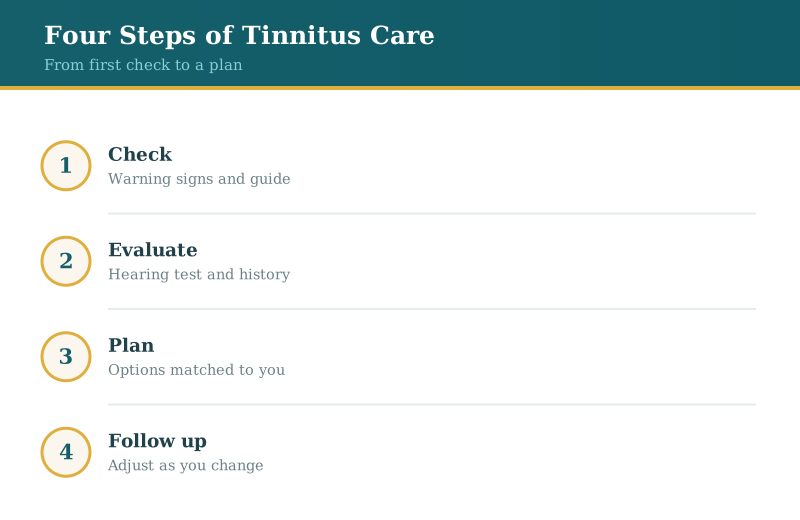
- The path has four steps: check, evaluate, plan and follow up.
- A full tinnitus evaluation takes about 60 to 90 minutes and includes a hearing test.
- Your plan is matched to your goals and may combine hearing aids, sound therapy, counseling and sleep and stress care.
- Tinnitus care continues after the first visit, with follow-ups and adjustments.
- Warning signs such as one-sided, pulse-like or sudden tinnitus should be checked promptly.
Step 1: Check where you are
Start by learning how much tinnitus is affecting your days. Read the Tinnitus Guide for the order of steps we use with patients. Look at the warning signs first: tinnitus in one ear, a pulse-like sound, or tinnitus that began suddenly with hearing loss. If any of those fit you, call us today.
Step 2: Get a full evaluation
A tinnitus evaluation at our offices starts with a conversation, then an ear exam, then painless hearing and tinnitus testing in a sound-treated room. Plan for about 60 to 90 minutes. The evaluation is a diagnostic visit, so it is billed to your medical insurance in the same way a hearing test is. We check your benefits before the visit. For the full walk-through, see what to expect at your tinnitus appointment.
Step 3: Build a plan that fits you
After testing, your audiologist explains what the results mean and which options fit your goals. A plan may combine well-fit hearing aids, sound therapy, counseling, sleep strategies and care for stress. Some patients benefit from a structured program, such as tinnitus retraining therapy. For select candidates, we also offer Lenire. Our tinnitus therapy program page gives more detail.
Step 4: Follow up and adjust
Tinnitus care is a process. Your plan may include follow-up visits to fine-tune settings, check how you are doing, and change the plan as you change. We also refer you to an ENT, a jaw specialist or a mental health professional when that fits. Many people find the sound becomes less bothersome over time, a process called habituation.
What to bring to your visit
Bring a short symptom list, your medicine and supplement list, and your goals. The checklist below makes it easy.
What to bring to a tinnitus evaluation
A little preparation makes the visit smoother.
- When the sound started, and what it sounds like.
- Whether it is in one ear or both, and whether it is constant or comes and goes.
- What makes it better or worse, such as caffeine, noise or stress.
- A list of your medicines and supplements.
- Any recent illness, injury or loud noise.
- Your top goals, such as better sleep or easier conversations.
Which office is closer
Our San Mateo office is at 88 N. San Mateo Drive. Our San Carlos office is at 1008 Laurel Street. Call 650-342-9449 to book at either one, or request an appointment. See also San Mateo and San Carlos.
Last updated and sources
Last updated November 4, 2026. What changed: this is the first version. This page describes our own process. For general background, see the National Institute on Deafness and Other Communication Disorders fact sheet on tinnitus at nidcd.nih.gov/health/tinnitus.
Medical information notice
This page gives general information. It is not a diagnosis or a treatment plan.
Frequently asked questions
Questions patients ask us
How long is a tinnitus evaluation?
Plan for about 60 to 90 minutes. It includes your history, an ear exam, hearing and tinnitus testing and a talk about your plan.
Is the evaluation covered by insurance?
A tinnitus evaluation is a diagnostic visit, so it is billed to your medical insurance in the same way a hearing test is. We check your benefits before the visit and tell you what your plan covers.
Do I need a doctor's referral?
Many plans do not require one, but plans differ. We check when you call.
Which office should I choose?
Choose the one that is easier for you to reach. Both offices offer tinnitus evaluations. Call 650-342-9449 and we help you book.
What if my tinnitus has warning signs?
Call us today. If you have sudden hearing loss, face weakness, numbness or severe dizziness, go to urgent care or an emergency department.