


Hearing Aid Technology
Difficulty understanding speech against background noise is one of the most common reasons people look for help. Research and device design over the past decade have both aimed squarely at this, and the tools inside a current hearing aid look nothing like the simple amplifiers of years past.
If busy rooms have started to wear you down, a conversation with an audiologist is worth more than another online spec comparison. Our team in San Mateo and San Carlos can show you what these features do in the rooms that matter to you, so reach out through our contact page whenever you are ready.
At a glance
- Busy rooms are hard because speech and background noise overlap in pitch and timing.
- Directional microphones favor the voice in front of you and ease off on surrounding noise.
- Noise processing lowers listening effort but does not erase noise or restore perfect hearing.
- A fitting tuned to your hearing test and your typical rooms matters as much as the device itself.
The problem with a crowded room
Speech and background noise often share the same pitch and rhythm, which is why a busy room is the hardest place for any ear to sort out. For someone with hearing loss, the softer consonants that carry meaning, the s, f, and th sounds, tend to get buried first, so a sentence can arrive as a mumble even when you can tell someone is talking. Older analog aids made this worse by turning everything up at once. Today's hearing aids take a smarter approach, treating the voice you want and the clatter around it as two different things.
Directional microphones that follow the voice
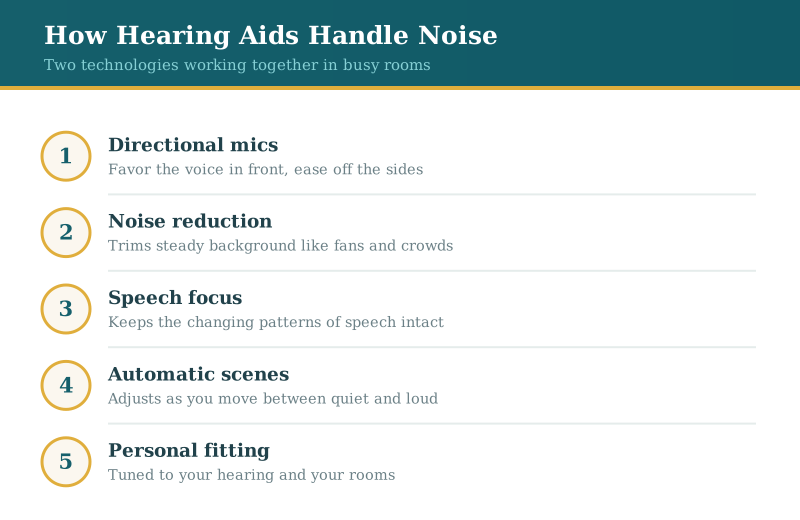
Most current devices carry more than one microphone per ear. By comparing when a sound reaches the front mic versus the back, the hearing aid can estimate where it came from and lean toward sound in front of you, usually the person you are facing, while easing off on noise arriving from the sides and behind. Some models shift this focus on their own as the room changes, widening to take in a group and narrowing when one voice matters most. It is the same instinct you use when you turn to face a friend across a table, handled by the device.
Noise reduction that works on the signal
Alongside the microphones, the processor analyzes incoming sound many times a second and separates the steady drone of a fan, an engine, or a crowd from the shifting patterns of speech. It can trim the constant background while leaving the voice largely intact. This does not erase noise, and it is not meant to. The point is to lower the effort of listening so your brain can spend its energy on the conversation rather than on digging the words out of the din.
When the two systems work together
Directional focus and noise processing are strongest in tandem. The microphones decide where to listen; the processing cleans up what comes through. Newer chips run this loop fast enough to adjust as you move from a quiet hallway into a loud lobby without you touching a thing. A few premium models add machine-learning steps trained on thousands of real sound scenes, though the honest measure of any of this is not the brand name. It is whether speech gets easier to follow where you actually struggle.
Why the fitting matters as much as the hardware
Even the most capable device underperforms if it is not tuned to your ears. During a hearing aid fitting, your audiologist programs the aids to your specific hearing test results and adjusts how aggressively the noise features engage, because a setting that helps one person can bother another. Real-ear measurement confirms the sound reaching your eardrum matches the intended target. This is also where you describe the rooms that give you trouble, so the settings reflect your life rather than a factory default.
What the technology can and cannot do
It helps to know the edges. In a moderately busy restaurant, good directional aids can be the difference between following a table and giving up on it. In a truly deafening space, a loud bar or a packed reception, no device fully pulls one voice out of a wall of others, and anyone claiming otherwise is overselling. Where you sit still counts: putting your back to a wall and your better ear toward the group does real work. The aim is meaningful improvement, not a return to perfect hearing in every setting.
Getting the right match for your rooms
The features that matter most depend on where you spend your time. A quiet home life asks less of noise processing than weekly dinners out or a job full of meetings. Comparing options across brands with an audiologist who has heard your priorities beats guessing from a spec sheet, and for an older listener a straightforward device that performs reliably often serves better than the busiest feature set, something we weigh when we fit hearing aids for seniors. A current hearing test is the starting point, since every one of these settings is built on your results.
Frequently asked questions
Questions patients ask us
Can hearing aids completely block out background noise?
They cannot, and any device sold on that promise is overselling. What good hearing aids do is reduce the steady background and steer toward the voice you are trying to hear, which lowers how hard you have to work to follow a conversation. In a moderately noisy room, that can be the difference between staying in the conversation and bowing out of it.
Do I need the most expensive model to hear in noise?
You do not need the top tier to hear better in a crowd. Premium models tend to adjust faster and handle harder rooms on their own, so they earn their price if you are often in loud settings. If your days are mostly quiet with the occasional dinner out, a mid-range device fitted well may serve you just as happily. The right level depends on your rooms, which is worth talking through at a fitting.
Why do restaurants still give me trouble even with new aids?
A few things could be at play. The settings may need fine-tuning, the room may simply be at the edge of what any device can manage, or where you sit may be working against you. Bring the specifics to your audiologist, since a programming adjustment paired with a small change in seating often makes a noticeable difference.
How much does the fitting affect noise performance?
Quite a lot, because the features only help when they are matched to your ears and your habits. Your audiologist sets how strongly the noise reduction engages and verifies the output with real-ear measurement. Describing the exact rooms where you struggle gives them what they need to tune the aids for your life rather than a generic profile.
Where should I start if noisy places are my main problem?
Begin with a current hearing test so any device can be programmed to your actual hearing. From there, an audiologist can match you with technology suited to the settings you find hardest and explain the trade-offs in plain terms. Our audiologists are glad to walk through the options with you.