


Hearing Test Costs
Here is the honest answer: there is no single national price, because a hearing test is not one thing. A brief screening and a full diagnostic evaluation sit at different points on the scale, and providers set their own self-pay rates. Cost also shifts by region and by how much of your history the appointment covers. Even without coverage, our insurance and payment page and a quick call can tell you what to expect before you commit.
For anyone paying out of pocket, the most useful first step is usually the least expensive one. A short conversation with our office can sort out whether you need a quick screening or the full workup, and roughly what each runs. You can contact our offices to ask before you ever sit in the booth.
At a glance
- There is no single price: a quick screening is often free or low-cost, while a full diagnostic evaluation costs more.
- Without insurance you can still ask about self-pay rates, free screenings, and HSA or FSA payment before you book.
- The value of the test is the professional interpretation of the results, not just the numbers on a chart.
Why there is no single price
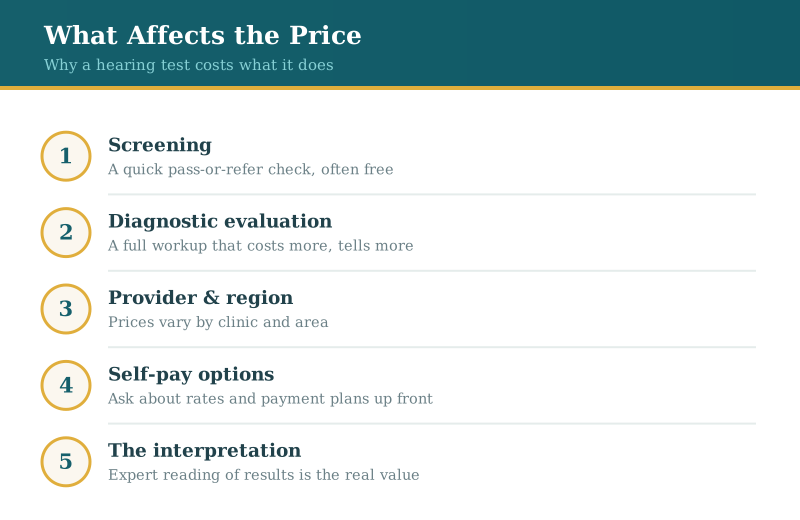
A hearing test can mean several different appointments, which is why quotes vary so widely. A basic screening is a short pass-or-refer check. A comprehensive diagnostic hearing evaluation is longer and measures far more. On top of that, each clinic sets its own self-pay rate, and prices differ from one part of the country to another. So a figure a friend paid across the state tells you little about your own visit. The honest move is to ask the specific provider what their evaluation includes and what it costs without insurance.
Screening or full evaluation: which you need
These two options get confused, and the difference matters for both your wallet and your answers. A screening is quick and often offered at no charge, sometimes at health fairs or as a courtesy; it tells you whether you likely have a problem, not what kind or how much. A full diagnostic evaluation costs more because it does more: it maps the softest sounds you can hear across pitches, checks how well you understand speech, and produces results an audiologist can interpret. A complete evaluation looks at several parts of the hearing system, not just whether you catch a tone; ASHA lists what a full test battery covers. If you only want to know whether to look into this, a screening may be enough. If you want a plan, the evaluation earns its cost.
What the price covers
The number on the invoice is not really about the equipment or the room. You are paying for a trained professional to run the right tests, read them correctly, and tell you what they mean for your daily life. A cheap test with no interpretation can cost you more in the long run if it points you toward the wrong fix. Solid results also feed directly into next steps, whether that is monitoring, hearing aids, or simply peace of mind. That expertise is the part worth paying for.
Keeping it affordable without insurance
Paying out of pocket does not mean paying blindly. Ask each office three things up front: whether they offer a free screening, what a full evaluation costs self-pay, and whether payment plans are available. It is also worth checking your benefits and coverage even if you assume you have none, since some plans include a hearing benefit people forget about, and HSA or FSA dollars can often be used. A brief call to schedule or ask questions usually clears up the cost before you commit to anything.
Why the test is worth it either way
Even setting money aside, catching a change early tends to make everything that follows simpler and less expensive. Waiting rarely lowers the eventual cost of care, and it can let small communication problems grow. For older adults in particular, a baseline test creates a reference point to compare against later, which is one reason hearing care for seniors often starts with a straightforward evaluation. If you are weighing whether it is worth the out-of-pocket cost, our patient reviews show what people got for it. Our team can walk you through the likely price before you ever book, so nothing about the cost catches you off guard.
Frequently asked questions
Questions patients ask us
Is a hearing test ever free?
Often, yes. Many practices offer a no-cost screening, and some community events do too. A free screening tells you whether to look closer, though, not the full picture. A complete diagnostic evaluation carries a fee because it measures and interprets much more.
How is a screening different from a full evaluation?
Think of a screening as a smoke alarm and the evaluation as the inspection that follows. The screening flags a possible problem quickly and cheaply; the evaluation maps exactly what is happening across pitches and how well you follow speech. You pay more for the second because it gives you a plan, not just a yes or no.
Can I use an HSA or FSA if I have no hearing coverage?
In many cases you can, since hearing tests and hearing aids are commonly eligible expenses. Rules vary by plan, so confirm with your administrator first. Our office can also give you an itemized receipt to submit.
Do I need a referral to have my hearing tested?
Usually you can book directly without one. A few insurance plans ask for a referral before they will reimburse, which is worth checking if you hope to file a claim later. Paying out of pocket, you can typically just call and schedule.