


Hearing Evaluations
A licensed audiologist usually holds a clinical doctoral degree and is trained to evaluate, diagnose, and manage hearing and balance conditions. When you book a hearing evaluation, the audiologist is the one who administers the tests, interprets the numbers, and explains what they mean for your daily listening. ASHA's description of the audiologist's role frames that scope in much the same way.
Knowing who does what can spare you a wrong turn and a wasted copay. At our practice, the audiologist you meet handles the full evaluation from start to finish, then talks through your options in plain language instead of handing over a printout of numbers.
At a glance
- Audiologists are the primary providers who administer and interpret diagnostic hearing tests.
- A licensed audiologist usually holds a clinical doctoral degree and can diagnose hearing and balance disorders.
- A full evaluation goes well beyond a beep test, covering speech understanding and middle-ear function.
- An ENT physician and a hearing instrument specialist fill different, narrower roles than an audiologist.
The clinician behind the audiogram
An audiologist is the health professional whose training centers on hearing and balance. The credential usually means a clinical doctorate, supervised clinical hours, and state licensure. In practice, that person is the one who runs your test, reads the audiogram, and turns a page of thresholds into a clear picture of how you are hearing. Their work is diagnosis and management, not a sales pitch, which is why the evaluation comes first and any talk of devices comes later.
The tests an audiologist runs
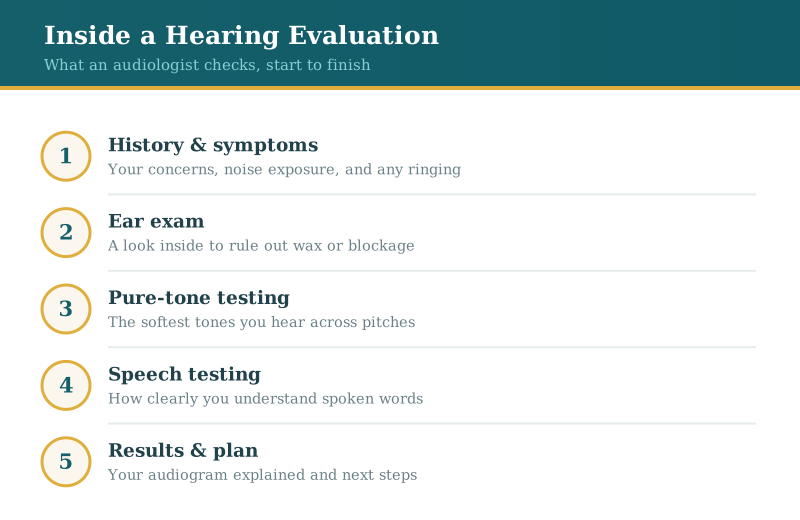
A hearing test is really a small battery of measures, not a single beep check. Pure-tone audiometry maps the softest sounds you can detect across a range of pitches. Speech testing gauges how well you make out words at a comfortable volume, which often matters more in real life than the tones alone. Tympanometry gently varies pressure to see how your eardrum moves and whether the middle ear is clear. Depending on what turns up, the audiologist may add bone-conduction or other measures to locate where a problem sits.
What a full evaluation looks like
Most appointments open with a conversation about your history: when you first noticed a change, which situations give you trouble, any ringing, and your exposure to loud noise over the years. Next comes a look inside the ear with a light, partly to rule out something as simple as a blockage, which earwax removal can often clear on the spot. The testing itself happens in a quiet booth or room. Afterward, the audiologist walks you through the results while they are fresh, rather than mailing a chart you cannot decode.
Audiologist, ENT, or hearing instrument specialist?
These roles overlap in the public mind but differ on paper. An ENT, or otolaryngologist, is a physician who diagnoses and treats medical and surgical conditions of the ear, nose, and throat; you see one for infections, sudden loss, or anything that may need medication or surgery. A hearing instrument specialist is licensed to test for the purpose of fitting hearing aids, but works within a narrower scope than a doctoral-level audiologist. An audiologist bridges the two: full diagnostic testing, non-medical management, and a referral to an ENT when the findings call for a physician.
Why a phone app is not the same
Online and app-based screenings have their place, and they can nudge someone to take a symptom seriously. What they cannot do is calibrate to a known standard, control the background noise, or separate a nerve-related loss from a mechanical one. A screening might tell you something seems off. A diagnostic evaluation tells you what kind of loss, in which ear, and to what degree, which is the information any real plan is built on.
From results to a plan
Your audiogram becomes the starting point for whatever comes next. For some people, the finding is steadying and the advice is simply to protect the hearing they have and retest down the road. For others, results point toward hearing aids, and the same clinician can carry you through the fitting and fine-tuning so the settings match your measured loss. Either way, you leave with specifics rather than a vague sense that you ought to get things checked.
Signs it is worth booking
A few situations deserve prompt attention. Hearing that drops suddenly, especially in one ear, is treated as urgent and warrants a call right away rather than a wait-and-see. Ear pain, drainage, or dizziness alongside a hearing change also points toward a same-week visit. Short of those red flags, the everyday signs are familiar: asking people to repeat themselves, turning the television up, or losing the thread in a busy restaurant. When any of that sounds like you, a hearing test is the direct way to get answers, and you can contact our offices to set one up.
Frequently asked questions
Questions patients ask us
Do I need a doctor's referral to see an audiologist?
In many cases you can book directly without one. Some insurance plans do ask for a referral before they cover the visit, so a quick call to your provider first can save a surprise. Our front desk is glad to help you check what your plan requires.
How long does a hearing test take?
Plan for roughly an hour for a first full evaluation. That window covers your history, the ear exam, the testing itself, and unhurried time to go over the results together.
Is the test uncomfortable or invasive?
The testing is painless from start to finish. You listen to tones and words through headphones and signal when you hear them, while a soft probe checks how your eardrum responds. Nothing goes into the ear canal beyond that gentle tip.
What if the audiologist finds a medical problem?
When something points to a condition better handled by a physician, such as sudden loss, ear pain, or fluid, the audiologist refers you to an ENT and coordinates from there. Testing and medical care work hand in hand rather than in competition.
Can the same audiologist help me with hearing aids afterward?
Yes. If your results point toward amplification, the audiologist who tested you can guide the hearing aid fitting and the follow-up adjustments, so your care stays with one familiar person.