


Hearing Research
Below, we explain the research in plain language: what the team did, what it found, and what it does not show. This page is accurate as of October 12, 2026.
At a glance
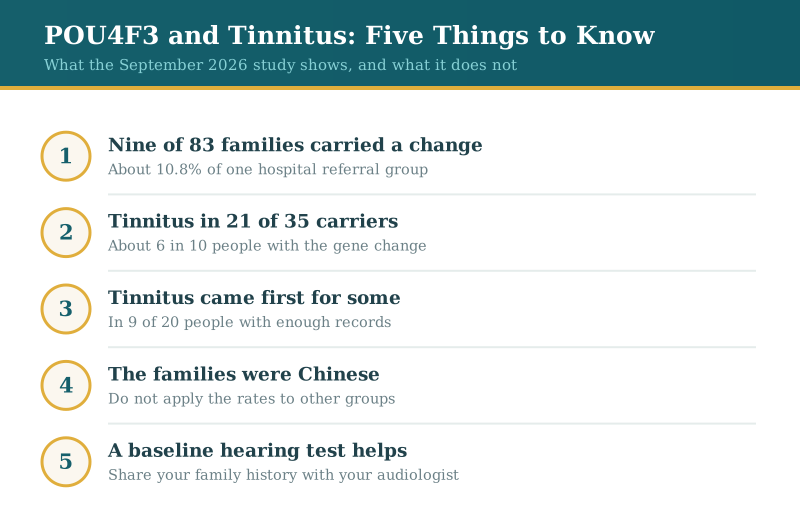
- A study in the Journal of Translational Medicine (September 4, 2026) followed 83 unrelated Chinese families with inherited hearing loss. It found changes in a gene called POU4F3 in 9 of them.
- Among 35 family members who carried a change, about 6 in 10 had tinnitus. In some, tinnitus came first, and hearing loss showed up on tests years later.
- The study was in Chinese families. Do not apply its percentages to other groups.
- We do not offer genetic testing and we do not provide genetic counseling. We can test your hearing, record your family history and refer you on.
The short version
Hearing loss often runs in families. A research team at the Chinese PLA General Hospital looked at one inherited form, called DFNA15, caused by changes in POU4F3. "DFNA" means the loss is passed on in a dominant pattern: a person with the change has a 50% chance of passing it to each child (CDC). The team asked how often tinnitus appeared, and when.
What they found
The authors used extended high-frequency testing. It picks up changes in the highest pitches, which a standard test can miss. The team also noted, as an early idea that needs more work, that changes which cut the protein short may bring hearing loss on sooner. And they suggest a clinical clue: family history of dominant hearing loss, plus gradual high-pitch loss, plus tinnitus. They write that prospective validation is warranted.
| Finding | Detail |
|---|---|
| Families screened | 83 unrelated Chinese families with dominant, non-syndromic hearing loss |
| Method | Whole-exome sequencing, Sanger confirmation, tracking changes through each family |
| Families with a POU4F3 change | 9 (10.8% of this hospital referral group). 4 changes were new and 5 were known |
| Carriers | 35 people; all 35 had hearing loss (100% penetrance in this cohort) |
| Tinnitus | 21 of 35 carriers (60%) |
| Tinnitus before hearing loss | In 9 of 20 people with enough data (45%), tinnitus came first. The gap ranged from 0 to 27 years |
| Hearing pattern | Sloping loss that began in the mid and high pitches, affecting the inner ear |
What the study does not show
It does not give a rate for your family. The 10.8% figure comes from one referral hospital. Other regions reported lower numbers in earlier work (6.5% in Europe, 2.5% in Japan, 2.4% in Korea), but the authors warn against comparing them directly because the groups were recruited in different ways. It does not mean tinnitus signals a gene change. Most tinnitus has no known genetic cause. The group studied was already chosen for inherited hearing loss. A gene change is not a diagnosis by itself. A clinician must interpret results alongside hearing tests and family history. Please do not try to read your own genetic report. Ascertainment may skew results. Of 82 pathogenic or likely pathogenic POU4F3 variants in public records, 72% came from East Asian reports. That may reflect where people have looked, not where the gene matters. Small numbers. Nine families and 35 carriers is a useful start but a small base.
Why this matters even if you never get a gene test
The practical lesson is about timing. If close relatives lost hearing young, and you have tinnitus, a baseline hearing test can show whether your hearing has begun to change. Early results give you a line to compare against. They also let you talk about hearing protection, treatment of tinnitus and, if it fits, a genetics referral.
What a family-history hearing workup looks like at CHC
A comprehensive hearing evaluation. See hearing testing and how to read an audiogram. A family history. Who lost hearing, at what age, and in which pattern. Tinnitus review. What you hear and how much it bothers you. Our tinnitus hub has more. Repeat testing over time, when your history calls for it. Referral. If your history suggests inherited hearing loss, we can refer you to a clinical geneticist or genetic counselor. We do not provide that service ourselves, and we do not offer POU4F3 testing. This topic connects to another thread we follow. Read about the genetic risk and hearing test study and our note on gene therapy and hearing loss. For the broader risk picture, see hearing loss risk factors. Our sister practice in New York covers the same study from a treatment-planning view: tinnitus and family history.
What this means for you
If hearing loss runs in your family and you now hear ringing, do not wait for symptoms to build. Get a baseline test this year. Request a comprehensive hearing evaluation at our San Mateo or San Carlos office.
Status and last update
Last updated October 12, 2026. What changed: this is the first version. We will update this page if the final paper, replication studies or clinical guidance change the picture. Sources: Bioengineer.org summary, CDC: genetic hearing loss, NCBI ClinVar: variant records.
Medical information notice
This page offers general information. It does not diagnose any condition. Talk with your physician or a genetics professional about family risk. Want to know where your hearing stands? A full hearing evaluation usually takes about an hour. Call 650-342-9449 to book at our San Mateo office, 88 N. San Mateo Drive, or our San Carlos office, 1008 Laurel Street.
Get one email if new genetic findings appear.
We will write once if a follow-up study appears or a clinical test for adult hearing loss becomes available. We will send nothing else.
Frequently asked questions
Questions patients ask us
Is tinnitus genetic?
Sometimes. Most tinnitus has no single genetic cause. In families with inherited hearing loss, tinnitus can come with the gene change, and this study shows one example.
What is POU4F3?
It is a gene that helps hair cells in the inner ear form and survive. Changes in it can cause DFNA15, a dominant, progressive hearing loss.
Should I ask for a POU4F3 test?
Not on your own. Testing makes sense when a clinician sees a pattern in your history and hearing results. A genetics professional should order it and explain the result. We do not offer the test.
If my parent has the gene change, will I?
With dominant inheritance, each child has a 50% chance. A genetic counselor can explain what that means for your family.
Does tinnitus before hearing loss mean I will lose hearing?
No. In some carriers in this study, tinnitus came first. That does not mean it predicts loss in people without a family pattern.
Do these numbers apply to people in California?
Not directly. The study group was Chinese. Prevalence in other groups is not established by this paper.