


How Hearing Works
This matters because hearing loss is not one problem in one spot. It can begin in the ear canal, at the eardrum, deep in the inner ear, or along the nerve pathway to the brain, and each location behaves differently. Understanding the chain from air to understanding makes it clearer why two people who both have 'hearing loss' can need very different hearing aids or care.
So it helps to walk the path a sound actually travels. Below, we clear up some common misunderstandings about how the ear and brain work together, from the flap of cartilage on the side of your head to the listening centers deep inside. If any of it sounds like what you are experiencing, our San Mateo and San Carlos team can help you sort it out.
The ears collect, but the brain does the hearing
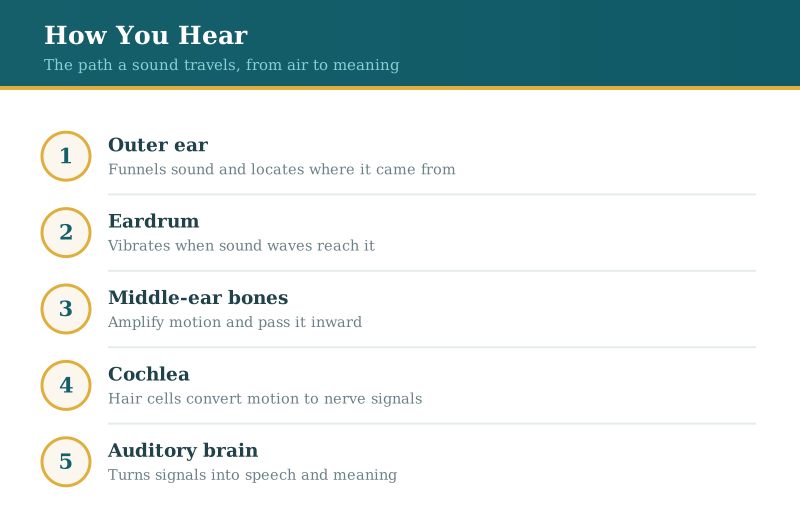
It is easy to picture hearing as something that finishes at the ear. In truth the ear is only the front end of a longer system. It captures sound and converts it into electrical signals, but those signals still have to reach the auditory cortex before they mean anything. This is why someone can have healthy-looking ears and still struggle to follow speech: the difficulty is happening further up the line, in how the brain sorts and interprets what it receives.
The outer ear is not just for holding up glasses
The visible ear, called the pinna, looks decorative, and many people assume that is mostly what it is. Its curves and folds actually shape incoming sound, boosting certain frequencies and helping you judge whether a noise came from in front, behind, above, or below. The ear canal then funnels that sound toward the eardrum. When earwax blocks the canal, this first stage falters, which is one reason a simple earwax removal can sharpen hearing right away.
The eardrum is only the start of the middle ear
People often think of the eardrum as the whole mechanism, but on its own it cannot pass sound efficiently into the fluid-filled inner ear. Behind it sit three of the smallest bones in the body, nicknamed the hammer, anvil, and stirrup. They act as a lever system, amplifying the eardrum's vibrations and delivering them with enough force to move inner-ear fluid. A problem anywhere in this chain, from trapped fluid to a stiffened joint, produces what clinicians call conductive hearing loss.
Inside the cochlea are cells that do not grow back
The inner ear holds the cochlea, a snail-shaped structure lined with thousands of microscopic hair cells. When fluid moves, these cells bend and turn that motion into the nerve signals the brain reads. A widespread and costly misconception is that such damage always heals. In humans, these hair cells do not regenerate, so loud noise or age-related wear causes permanent change. That is why protecting them with custom hearing protection matters: noise-induced hearing loss cannot be reversed once it happens. Researchers have also found hair cells on squid skin, which we describe in our page on squid hair cells and hearing loss.
The brain has to relearn sound after it fades
A common expectation is that hearing aids simply switch hearing back on, like turning up a radio. The reality is gentler and more gradual. When the brain has gone months or years without certain sounds, it needs time to grow comfortable with them again. Well-programmed devices deliver the missing signal, but the listening centers relearn how to use it over several weeks. That adjustment period is normal, and a careful hearing aid fitting is built around it rather than rushed.
Why the whole pathway shapes your care
Because hearing depends on this entire relay, a good evaluation looks at more than volume. It checks how well sound moves through the outer and middle ear, how the cochlea responds, and how clearly you understand speech, which is the brain's part of the job. That fuller picture is what lets us match the right approach to the right person, whether that means hearing aids suited to an older adult or a different path entirely. If you are unsure where your own hearing stands, contact our offices.
Frequently asked questions
Your questions, answered
Do you hear with your ears or your brain?
Both, working as a team. Your ears gather sound waves and turn them into nerve signals, but recognizing those signals as a word, a song, or a warning happens in the brain. Neither part does much without the other, which is why a full evaluation looks at the ear and the listening brain together.
My ears seem fine, so why is speech hard in a noisy room?
This is a common experience, and it usually points to how the brain and inner ear handle competing sounds rather than a blocked ear. Separating one voice from background noise is demanding work, and it can slip even when the ear itself looks healthy. A hearing test can show whether the difficulty sits in the ear, in the processing, or in both.
Can the hair cells in the inner ear be repaired?
Not in humans, at least not with any treatment available today. Once these cells are damaged by noise or age, the loss is permanent, which is why prevention and early care carry so much weight. Hearing aids do not rebuild the cells; they help you make the most of the hearing you still have.
Which part of hearing does a hearing aid actually help?
Mainly the delivery of sound to a working inner ear and brain. A hearing aid amplifies and shapes sound so more of it reaches the cochlea clearly, and then the brain relearns how to use it. Our audiologists can explain what a device will and will not do for your specific type of loss.