


Hearing Tips
A study published November 7, 2026 found that about three in four hearing aid users aged 45 and older report some trouble in noisy rooms. This page gives practical steps for the table, the restaurant and the follow-up visit.
At a glance
- An analysis of national survey data (NHIS 2019 and 2024) found about 76.5% of US hearing aid users aged 45 and older have some trouble in noisy rooms, and about 26.6% have severe trouble.
- Where you sit often matters more than the volume setting.
- Tell the host before the day, and ask the restaurant for a quiet table.
- A fine-tuning visit and a remote microphone can help if noisy rooms stay hard.
You are not the only one who struggles
The study, by Jiang and colleagues in Patient Preference and Adherence, used US National Health Interview Survey data from 2019 and 2024. Among adults aged 45 and older who used hearing aids, about 76.5% reported some trouble in noisy rooms, and about 26.6% reported severe trouble. These are self-reports from a survey, not clinic measurements. They show that noisy rooms are hard for most hearing aid users, and that the problem is common and often fixable.
At the table: seat, light and a plan
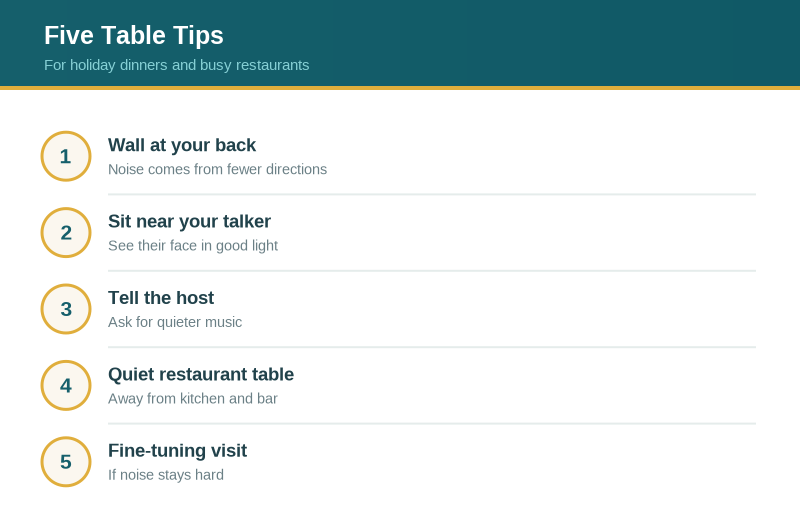
Choose a seat with your back to a wall, so noise comes from fewer directions. Sit near the person you most want to hear, ideally across from them or at a corner, where you can see their face. Good light on faces helps you use lip movements and expression. Ask people to take turns, and ask the host to turn music down while you eat. Our guides to noisy rooms and distance and the family guide have more ideas.
| Situation | What to try | Why it helps |
|---|---|---|
| Family table | Wall at your back; sit near your main talker | Fewer noise directions; you see faces |
| Host's home | Ask to turn music down and keep one conversation going | Less competing sound |
| Restaurant | Book early; ask for a quiet table | Away from kitchen, bar and speakers |
| Long table | Ask us about a remote microphone | Sends the talker's voice to your aids |
| Still struggling | Book a fine-tuning visit | Settings can be adjusted |
In the restaurant: choose the room, not just the menu
Book early, and ask for a quiet table away from the kitchen, the bar and speakers. Go at off-peak times if you can. Hard floors and bare walls make echo, and booths and corners help. Tell your guests before you arrive that you hear best in a quiet place. Many hearing aids have a restaurant or noisy-room program, and you can ask us to check yours. See our guide to noisy rooms and distance.
Tools that can help
A remote microphone sends a talker's voice straight to your aids, which can help at a long table. Ask us if one suits your aids. A fine-tuning visit can adjust how your aids handle noise. Some aids use AI to sort speech from noise, as our AI hearing aids guide explains. If you wear OTC aids, the same tips apply, and a hearing test shows whether another approach would help.
When to book a visit
If you often leave gatherings tired or skip them, book a visit. Tell us the settings that are hardest, such as restaurants, family dinners or cars. We can test your hearing again, check the fit and adjust. Our page on adjusting to new hearing aids and our first 30 days guide cover what to expect. If your hearing test is normal but noise is still hard, read normal hearing test, trouble hearing in noise.
Status and last update
Last updated November 24, 2026. What changed: this is the first version. We will update this page when new evidence or rules change the picture. Sources: Jiang X, et al. Patient-Reported Hearing-Aid Use Patterns and Noisy-Room Communication Difficulty (NHIS 2019 and 2024). Patient Preference and Adherence, November 7, 2026.
Medical information notice
This page offers general information. It is not a diagnosis or treatment plan. Want to know where your hearing stands? A full hearing evaluation usually takes about an hour. Call 650-342-9449 to book at our San Mateo office, 88 N. San Mateo Drive, or our San Carlos office, 1008 Laurel Street.
Frequently asked questions
A few questions worth asking
Why can't I hear in restaurants even with hearing aids?
Noise, echo and several talkers make speech hard for everyone with hearing loss. About 76.5% of US hearing aid users aged 45 and older report some trouble in noisy rooms, according to a survey analysis.
Where should I sit at a holiday dinner?
Put your back to a wall and sit near the person you most want to hear, where you can see their face in good light.
Do I need new hearing aids for noisy rooms?
Not always. A fine-tuning visit, a noisy-room program or a remote microphone may help first. A hearing test shows where you stand.
What is a remote microphone?
It is a small microphone a talker wears or you place on the table. It sends the voice straight to your hearing aids.
Should I tell the host about my hearing?
Yes. Most hosts are glad to help by turning music down and seating you well.