


Choosing a Provider
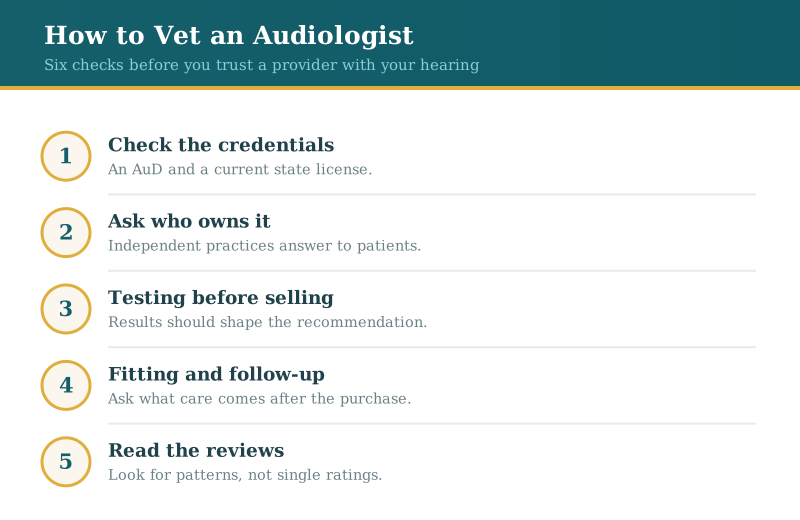
Trust in this field rests on a few concrete things you can check rather than a feeling you have to take on faith. Credentials, who owns the practice, how testing is done, and what happens once the sale is over are all fair questions, and a provider worth your time will welcome them. You are allowed to interview the person who wants to care for your ears.
None of this requires you to become an expert. It asks only that you learn which signals point to careful, honest care and which point the other way. You can meet our audiologists and judge for yourself, and the same yardstick works anywhere you look.
At a glance
- A licensed audiologist holds a doctoral degree (AuD) and a state license, both of which you can verify.
- Independent practices answer to patients, not to a single hearing aid manufacturer.
- Testing and a clear explanation of results should come before any product recommendation.
- Follow-up care, written terms, and honest answers matter more than a polished sales visit.
Start with the letters after the name
The most direct trust check is also the easiest. A licensed audiologist holds a doctoral degree, usually a Doctor of Audiology, or AuD, along with a state license to practice. That training covers the anatomy of hearing, the science of testing, and the fitting of devices, and it is what separates an audiologist from someone who has simply learned to run a machine. The doctoral training and supervised clinical hours behind that credential are set out by ASHA, and you are within your rights to ask where a provider trained and whether their license is current.
Find out who the practice answers to
Not every hearing office is set up the same way. Some are independent, owned by the clinicians who run them. Others are owned or backed by a hearing aid manufacturer or a retail chain, which can narrow the shelf to that company's products. Neither arrangement is automatically bad, but it shifts the incentives, and you deserve to know which one you are dealing with. An independent practice can fit devices from several major brands and choose the one that suits your ears and your budget, rather than the one it is obliged to move. Ask plainly: do you carry more than one manufacturer, and how do you decide what to recommend?
Watch whether testing comes before selling
The order of events on a first visit is telling. Trustworthy care begins with a thorough hearing test and a clear explanation of the results, not with a device already boxed up on the counter. If someone recommends a specific hearing aid before they have measured what you can and cannot hear, that is a reason to slow down. The evaluation should shape the recommendation, and the person testing you should be able to show you your own results and explain them in plain language.
Ask about the fit and what comes after
A hearing aid is not a finished product the day you buy it. Real benefit depends on a careful fitting and on the adjustments that follow as your brain re-learns sound it has been missing. Before you commit, ask what the follow-up looks like: how many visits are included, what a trial period covers, and who you call when something needs tuning. A provider who plans for the long relationship, and puts the terms in writing, is showing you how they work.
Read the reviews, then read past the star rating
Other patients will tell you things a brochure never will. Look beyond the overall number and read what people say about the details that matter over time: whether appointments feel rushed, whether questions get honest answers, whether follow-up help is easy to get. Patterns across many patient reviews are more reliable than any single glowing or angry one. Consistency, especially about how a practice treats people after the sale, is the signal worth weighting.
Look for a recognized standard of care
Outside recognition offers one more data point. Some practices meet the criteria of independent programs that vet how hearing care is delivered, which helps when you are choosing between offices. We are a HearingUp-approved provider, a designation tied to a defined, patient-centered approach rather than to any product line. It does not replace your own judgment, but it tells you a practice has agreed to be measured against a standard set by someone other than itself.
Frequently asked questions
Questions patients ask us
What qualifications should an audiologist have?
Look for a Doctor of Audiology (AuD) degree, or in some cases a master's earned before the doctorate became standard, plus a current state license. Those credentials mean the person has been trained in the science of hearing and the fitting of devices, not just in operating equipment. It is perfectly reasonable to ask where someone trained and to confirm their license is active.
Is an independent practice really better than a manufacturer-owned one?
Better is not guaranteed either way, but independence tends to put the incentives in your favor. A practice that answers to its patients rather than to a single hearing aid maker can compare devices across several brands and recommend what fits you. If an office carries only one company's products, ask why, and weigh the answer in your decision.
How can I tell if I am being sold to rather than cared for?
Pay attention to sequence and pressure. Genuine care starts by measuring your hearing and explaining the results before any product enters the conversation, and it leaves you room to think without a same-day deadline. If the pitch arrives before the hearing test, or you feel rushed toward a signature, treat that as your answer.