


Noise & Hearing Health
This page keeps to what public health sources say. NIOSH, the US agency that studies workplace health, sets its recommended limit at 85 A-weighted decibels (dBA) averaged over an eight-hour day. A 2025 study of landscaping crews found that most of the workday noise measurements were at or above that limit, and that gas leaf blowers were among the loudest tools. We did not find a single trustworthy figure for how loud a typical blower is at the operator's ear, so we do not quote one.
Below you will find the limit explained, a table of how safe listening time shrinks as sound gets louder, the difference between gas and battery tools, and how to choose hearing protection. If you work around blowers, or you have started to notice ringing, a hearing test gives you a baseline to compare against. For the wider picture, see our page on noise-induced hearing loss.
At a glance
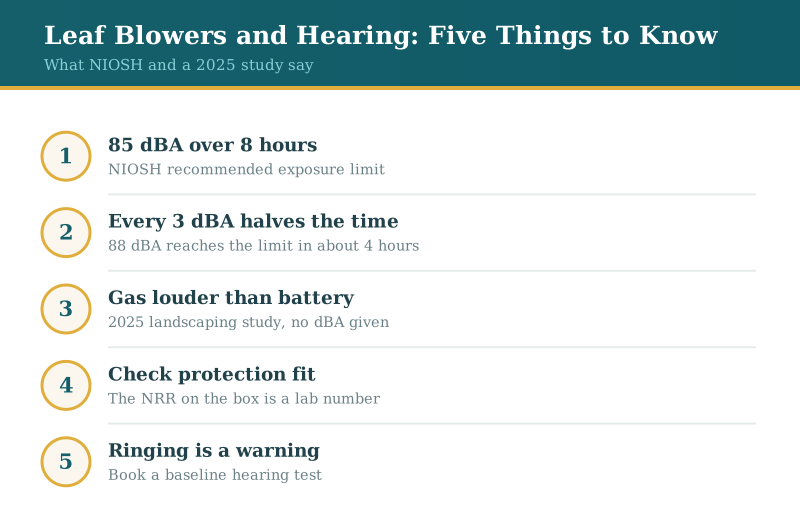
- NIOSH recommends keeping exposure at or below 85 dBA averaged over eight hours. For every 3 dBA increase, it recommends halving the time.
- In a 2025 study of landscaping workers, 94 of 119 full-shift noise measurements were at or above 85 dBA. Gas leaf blowers were among the loudest tools measured.
- The same study found workers were exposed to significantly more noise with fuel-powered blowers than with battery-powered ones. It does not say that battery blowers are safe at any length of time.
- Ringing or muffled hearing after yard work is a warning sign. A baseline hearing test shows where you stand today.
What 85 dBA means
A decibel is a unit of sound level. The "A" in dBA means the measurement is weighted to match how the human ear responds. NIOSH, part of the CDC, sets its recommended exposure limit at 85 dBA averaged over an eight-hour workday. Workers exposed at or above that level over a working lifetime are at risk of significant hearing loss, according to NIOSH. The National Institute on Deafness and Other Communication Disorders says long or repeated exposure to sounds at or above 85 dBA can cause hearing loss, and that louder sounds cause damage in less time.
Why every 3 dB halves the safe time
The scale does not rise in even steps. NIOSH recommends that for each 3 dBA increase in noise level, the allowed exposure time is cut in half. A sound at 88 dBA reaches a full day's limit in about four hours. At 94 dBA it takes about one hour. The table below shows the NIOSH figures. One caution from NIOSH itself: this limit was written for the workplace, and NIOSH says it is not a recommendation for noise exposure in the general environment. We use it here as a reference point for people who work with blowers, and as a rough guide for the rest of us.
Table: sound level and safe listening time
The table lists the average exposure time needed to reach 100 percent of the NIOSH daily noise dose at each level.
| Sound level | Average time to reach the daily limit | Change from the step above |
|---|---|---|
| 85 dBA | 8 hours | NIOSH recommended exposure limit |
| 88 dBA | 4 hours | 3 dBA higher, time halves |
| 91 dBA | 2 hours | 3 dBA higher, time halves |
| 94 dBA | 60 minutes | 3 dBA higher, time halves |
| 97 dBA | 30 minutes | 3 dBA higher, time halves |
| 100 dBA | 15 minutes | 3 dBA higher, time halves |
How loud is a gas leaf blower
We looked for a measured figure at the operator's ear that we could cite with confidence, and did not find one we would stand behind, so we give none. What we can cite is this. NIOSH lists lawn mowers, vacuums and power tools in the 85 to 90 dBA range, and chain saws and nightclubs at 95 dBA or more. In the 2025 landscaping study, published in the Journal of Occupational and Environmental Hygiene, gas leaf blowers were listed among the loudest tools, along with gas chainsaws, chipper-shredders, gas string trimmers and gas mowers. The study reports no decibel level for individual tools, so it ranks them but does not give a number.
Battery versus gas
The same study found workers had significantly more noise exposure when using fuel-powered leaf blowers than battery-powered ones. That is a useful comparison. It is not a promise that a battery blower is quiet enough to use all day without protection, because the source gives no decibel level for the battery models. If you buy a new blower, check the maker's stated sound level, and still use protection for long jobs.
Who is most exposed
Landscapers and grounds crews are the group most at risk, because they run loud tools for hours, day after day. In the 2025 study, 94 of 119 full-shift measurements reached or passed 85 dBA, and the authors said most workers were overexposed. Homeowners are usually exposed for shorter periods, so the risk per day is lower, but years of weekly use, plus a mower and a trimmer, can add up. People who also go to concerts, shoot, or ride motorcycles carry noise from other parts of life. Our pages on occupational hearing loss and noise exposure at work in Atherton cover the job side.
Choosing hearing protection: NRR, plugs and muffs
The Noise Reduction Rating, or NRR, on a package is a laboratory number. NIOSH says workers usually get much less reduction on the job, and that fit testing is the best way to know what you really get. Without a fit test, NIOSH suggests a quick check: count aloud while cupping and uncupping your ears. With a good earplug seal, your voice sounds about the same both ways. Earplugs are light, and they can be harder to fit well. Earmuffs are one size and easier to put on and remove, and they cost more. NIOSH also advises aiming for roughly 75 to 85 dBA under the protector, because too much reduction cuts you off from your surroundings.
When to double up
For noise at 100 dBA or higher, or for sudden impulse sounds, NIOSH recommends double protection, which means earmuffs over earplugs. Most yard work will not need that. A long day with several loud tools might. If you use a blower for a living, talk to your employer about a fit test. Custom-molded plugs are one option we make at our offices, and our hearing protection page explains how they work.
Warning signs after yard work
The NIDCD lists these signs of noise damage: sounds that seem distorted or muffled, trouble understanding speech on the phone or in noisy rooms, and ringing, buzzing or roaring in the ears. Some noise exposure causes a temporary loss that clears within 16 to 48 hours. The NIDCD notes that lasting damage can still occur even when hearing seems to recover. If you notice ringing after a day of yard work, read our page on tinnitus, and give your ears a quiet day. If it lasts more than a day or two, or comes on suddenly in one ear, have it checked. See our page on sudden or worsening tinnitus.
What a baseline hearing test shows
A hearing test measures the softest sounds you can hear at a range of pitches and how well you understand words. Noise damage often appears first as a dip in the higher pitches, so a baseline taken now lets you and your audiologist see change over time. This is the reason we suggest a test for anyone who works around loud tools. You can read more about what to expect at a hearing test, or book a hearing test at our San Mateo or San Carlos office.
Last updated and sources
Last updated October 16, 2026. What changed: this is the first version. Sources: NIOSH, Noise and Hearing Loss Prevention: About noise, NIOSH Science Blog, Understanding Noise Exposure Limits, NIOSH, Provide Hearing Protection, NIOSH, Three Tips for Choosing the Right Hearing Protector, NIDCD, Noise-Induced Hearing Loss, and Alexander BM and others, Hazardous Exposures and Engineering Controls in the Landscaping Services Industry, Journal of Occupational and Environmental Hygiene 2025;22(3):189-202.
Medical information notice
This page offers general information. It is not a diagnosis or treatment plan. If you have ringing, muffled hearing or sudden hearing change, book an evaluation. Call 650-342-9449 to reach our San Mateo office, 88 N. San Mateo Drive, or our San Carlos office, 1008 Laurel Street.
Frequently asked questions
Your questions, answered
Can a leaf blower cause permanent hearing loss?
It can, if the noise is loud enough and lasts long enough. Public health sources say long or repeated exposure at or above 85 dBA can cause hearing loss. Whether a given person is affected depends on the machine, the time spent and whether protection was worn.
Are battery leaf blowers safe for my ears?
They tend to be quieter. A 2025 study found workers had significantly more noise exposure with fuel-powered blowers than with battery-powered ones. The study does not say battery blowers are safe for unlimited use, so use protection for long jobs.
What does NRR mean on hearing protection?
NRR is the Noise Reduction Rating, a number from laboratory testing. NIOSH says workers usually get much less reduction on the job. A fit test, or a simple count-aloud check, tells you more about how well your protection works.
Do I need earplugs or earmuffs for yard work?
Either can work if it fits well and you wear it for the whole job. Earplugs are light but harder to fit. Earmuffs are easier to fit and cost more. For noise at 100 dBA or higher, NIOSH recommends wearing both.
My ears ring after yard work. What should I do?
Rest your ears in a quiet place and avoid more loud noise. Ringing that clears in a day or two is a warning that the noise was too much. If it lasts longer, or you notice muffled hearing, book a hearing test.
Should landscapers get regular hearing tests?
A baseline test and a repeat test each year or two is a sensible habit for people who work with loud tools. It lets changes show up early, when protection can still make a difference. We can arrange tests and custom protection at either office.