


Hearing & Sleep
The honest summary is that the research here is thin and mixed. Loud snoring can reach surprising volumes, and some researchers have asked whether years of that nightly sound might affect the ear resting against the pillow. Others have studied snoring as a warning sign of obstructive sleep apnea, a condition examined for possible links to hearing changes through its effects on blood flow and oxygen. Neither line of work has produced a settled answer.
So the practical takeaway is modest. Snoring is worth addressing for your sleep, energy, and heart health on its own, and if you also notice muffled sound, ringing, or trouble following conversation, those symptoms deserve their own look. Our San Mateo and San Carlos team can check your hearing and, when needed, point you toward the right sleep or medical care.
At a glance
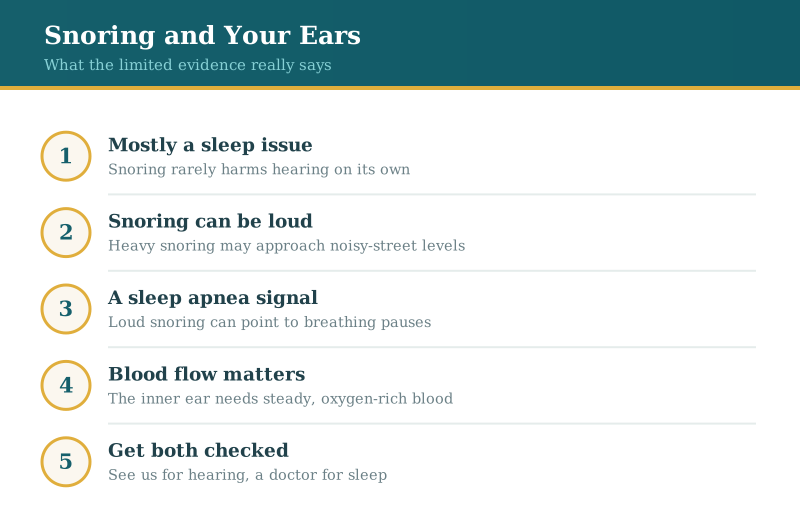
- Snoring is mainly a sleep and breathing issue, and for most people it does not harm hearing.
- Two possible links exist — the loudness of snoring near one ear, and snoring as a sign of sleep apnea — but the evidence is limited.
- If snoring comes with muffled sound, ringing, or trouble hearing, have your hearing evaluated and your sleep looked at.
Just how loud snoring can be
Snoring is not always the soft rumble people picture. Heavy snoring can be genuinely loud, at times approaching the level of a busy street or an appliance running right beside your head. Because loud, sustained sound can damage the delicate structures of the inner ear, a reasonable question follows: could years of nightly snoring affect the ear pressed against the pillow? A few researchers have raised exactly that idea. It is a plausible thought rather than a proven fact, and no one should assume their hearing is at risk simply because they snore.
Snoring as a signal of sleep apnea
For some people, snoring is a symptom of obstructive sleep apnea, in which breathing repeatedly pauses during the night. Apnea lowers oxygen levels and strains the cardiovascular system, and the inner ear depends on a steady, rich blood supply to do its job. That shared plumbing is why several studies have looked for a connection between sleep apnea and hearing loss. Some found an association; others did not. Two conditions turning up together does not prove one causes the other, but it is a good reason to take loud, chronic snoring seriously rather than laughing it off.
What the evidence does and doesn't show
It would be easy to spin these threads into an alarming headline, so it is worth being plain. The research tying snoring or sleep apnea to hearing loss is limited, and the findings do not all point the same way. There is no dependable figure for how much snoring might change anyone's risk, so it is better to speak in general terms. What we can say is that hearing and whole-body health are connected in ways science keeps uncovering, and that caring for your sleep and your ears both belong on a sensible health checklist.
When snoring and hearing trouble show up together
Sometimes snoring and hearing complaints simply share a cause or arrive at the same stage of life. A cold or heavy congestion can worsen both for a while. A buildup of earwax can muffle sound and has nothing to do with your breathing at all. And ringing or buzzing in the ears, known as tinnitus, can disrupt sleep in its own right. Sorting out which is which is the useful work, and it usually begins with a proper hearing check rather than guesswork.
Sensible steps worth taking
If you snore heavily, mention it to your doctor; a sleep evaluation can catch apnea and protect your heart, energy, and mood, whatever the hearing question turns out to be. If you also notice that sound is muffled, voices are hard to follow, or one ear feels off, have your hearing measured. For older adults especially, small hearing changes are common and very treatable, and hearing aids for seniors can make a real difference day to day. When you are ready, our team can book you an evaluation and explain what the results mean.
Frequently asked questions
Questions patients ask us
Can snoring cause hearing loss?
For most people, no. Snoring is primarily a sleep and breathing matter, and there is no strong proof that it damages hearing. Researchers have floated two possibilities — the loudness of snoring near one ear, and snoring as a marker of sleep apnea — yet the evidence behind both is limited. If you are concerned, a hearing test answers the question far better than worry does.
My partner snores loudly — could that hurt my own hearing?
It is a fair thing to wonder, since heavy snoring can be surprisingly loud up close. Any real risk from that exposure is unproven and, if it exists at all, likely small. The stronger reason to address a partner's loud snoring is their own health and the sleep you both lose. If the noise genuinely bothers your ears at night, custom hearing protection made for sleep is a simple, low-cost option.
Should I see someone about snoring, my hearing, or both?
Often both, handled by the right people. Loud or chronic snoring is worth raising with your physician, who can screen for sleep apnea. Hearing symptoms — muffled sound, ringing, or missing parts of a conversation — are ours to evaluate. The two visits complement each other, and our patient care team is glad to coordinate so nothing slips through the cracks.