


Choosing Hearing Aids
There is no single best hearing aid, only the one that fits your ears, your daily routine, and your budget. Two people with nearly identical hearing tests can land on very different hearing aids and both choose well. So it helps to know which factors genuinely move the decision and which are mostly marketing.
Cost belongs in the conversation too, and it is worth understanding what your insurance may cover before you shop. When you are ready to talk it through in person, our team at the San Mateo and San Carlos offices is glad to help you compare options without pressure.
At a glance
- Start with a hearing test so your choice fits your actual loss, not a guess.
- Style, features, and fit matter more than brand name or price tier.
- Match the technology to how and where you live, not to the top of the catalog.
- Follow-up care and adjustments are half of what makes a hearing aid work.
Begin with a real hearing test
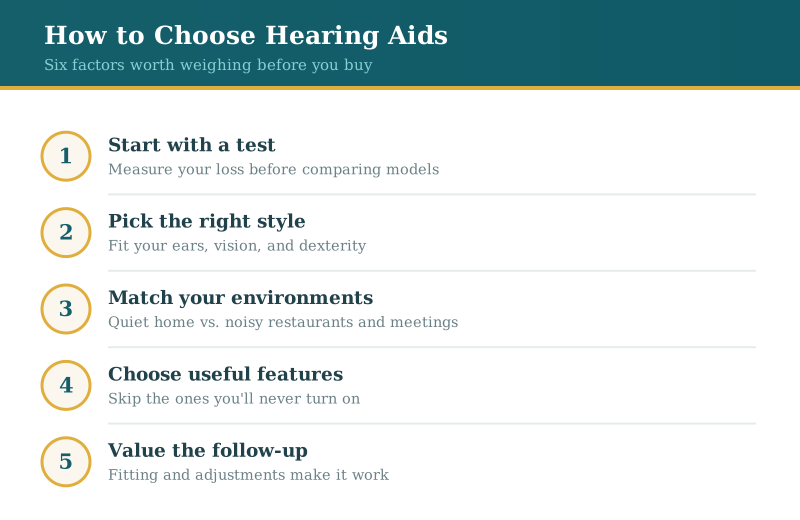
Before you compare a single model, get your hearing measured. A hearing evaluation tells you the shape of your loss: which pitches have faded, how your two ears differ, and how well you make out speech in noise. That profile narrows the field quickly, because some devices suit a gently sloping loss while others are built for steeper drops. Shopping without it is a bit like ordering glasses with no eye exam. You might get lucky, but you are guessing.
Match the style to your ears and your hands
Hearing aids come in several shapes, and the differences are practical, not just cosmetic. The National Institute on Deafness and Other Communication Disorders describes styles ranging from behind-the-ear models to designs that sit fully inside the canal. Smaller is not automatically better. If arthritis or shaky hands make tiny buttons a struggle, or your eyesight makes a fiddly battery door frustrating, a slightly larger device with rechargeable batteries is far easier to live with. Our guide to hearing aids for seniors walks through these trade-offs in more detail.
Map the places you struggle to hear
Think about a normal week. Someone who spends most days in a quiet home has very different needs from someone in daily meetings, loud restaurants, or a busy place of worship. Do you take a lot of phone calls? Do you love music or the theater? Make a short list of the settings where hearing feels hardest, because that list, more than any spec sheet, should steer which features you pay for. A device that shines at a dinner table may be overkill if your world is mostly quiet rooms.
Sort the features you'll use from the ones you won't
Modern hearing aids offer rechargeability, Bluetooth streaming to your phone or television, directional microphones, automatic noise reduction, and app-based control. Some of that will change your day. Some you will never touch. Across major brands, the core sound quality is more alike than the ads suggest, so focus on the two or three features that map to your real listening life and let go of the rest. Paying for capability you never switch on is the most common way people overspend.
Ask who stands behind the fitting
The device is only half of what you are buying. The other half is the fitting and the care that follows, where an audiologist programs the aids to your specific hearing and fine-tunes them over a few visits as your brain adjusts. Ask what is included: How many follow-ups? What happens when something needs a repair or a cleaning? A well-fit aid from an attentive provider will serve you better than a fancier one you set up alone. You can meet our clinicians and see how we work on our team page.
Talk through cost, insurance, and trial periods
Prices vary widely by technology level and by what is bundled in, so compare what a quote actually includes rather than the sticker alone. Some providers bundle fittings, follow-ups, and repairs into one price; others charge separately. Check your insurance coverage before you decide, since it can meaningfully change the math. And ask about a trial or return period. Hearing aids take a little getting used to, and the freedom to adjust or return them takes real pressure off the choice. When you are ready, you can contact our offices to go over the numbers.
Frequently asked questions
What patients often want to know
How much do hearing aids cost?
Prices vary widely depending on the technology level and the services bundled with them. Rather than chase a single number, ask what a quote includes, because fittings, follow-up visits, and repairs often matter more than the sticker price. Checking your insurance coverage first can change the picture considerably.
Are more expensive hearing aids always better?
Not in the way the price tag implies. Higher tiers add automation and finer noise handling that genuinely help in busy, loud settings, but someone who spends most days in quiet rooms may hear just as well with a mid-range device. The goal is to match the technology to your life, not to the top of the catalog.
Can I choose hearing aids online without seeing anyone?
You can buy them that way, but a lot of the benefit lives in the fitting. A device programmed to your specific hearing test and adjusted over a few visits tends to outperform the same hardware set up from a generic profile. If you would rather have that support close by, our team is happy to help.